
In This Article
Key Takeaways
- Mental health influences physical health through stress hormones, immune function, and chronic disease risk
- Emotional wellness directly affects relationship quality, work performance, and daily decision-making
- The definition of mental health extends beyond the absence of illness to include emotional resilience and life satisfaction
- Small, consistent practices like journaling and boundary-setting create measurable improvements in mental wellness
- Professional support combined with self-reflective tools offers the most effective path toward healing
- Understanding the connection between mental and physical health helps you recognize early warning signs
- Building mental health resilience requires addressing both external stressors and internal thought patterns
Understanding why is mental health important goes beyond clinical definitions. Your emotional wellness shapes every decision you make, every relationship you hold, and every morning you wake up wondering if today will feel different.
If you’ve ever wondered why is mental health important, the answer isn’t found in clinical textbooks or wellness blogs. Understanding why mental health is important starts with recognizing how it shapes every decision you make, every relationship you hold, and every morning you wake up wondering if today will feel different.
Three years ago, I sat in my apartment, staring at a blank journal page. My life looked fine from the outside. I had work, friends, a beautiful place to live. But inside, I felt hollow. I kept asking myself: why does everything feel so hard when nothing is technically wrong?
That question led me deep into understanding why mental health is important. Not in an abstract, clinical way, but in the lived experience of a woman who thought she could outrun her emotional exhaustion.
I learned that mental health isn’t just about avoiding a breakdown. Your mental wellness shapes how you experience every single day. It determines whether you can enjoy your morning coffee or if anxiety makes your stomach tight before you even open your eyes. It influences whether you speak up in meetings or stay silent to avoid conflict. It affects whether you can rest without guilt or if you scroll social media at midnight, searching for something you can’t name.
The World Health Organization defines mental health as “a state of well-being in which an individual realizes their own abilities, can cope with the normal stresses of life, can work productively, and is able to make a contribution to their community.” But that definition doesn’t capture what it feels like when your mental health is struggling. It doesn’t describe the weight of pretending you’re fine when you’re not.
This article explores seven research-backed reasons why mental health matters, along with practical tools you can use today. You’ll find reflective questions, grounded exercises, and honest stories from someone who’s been there.
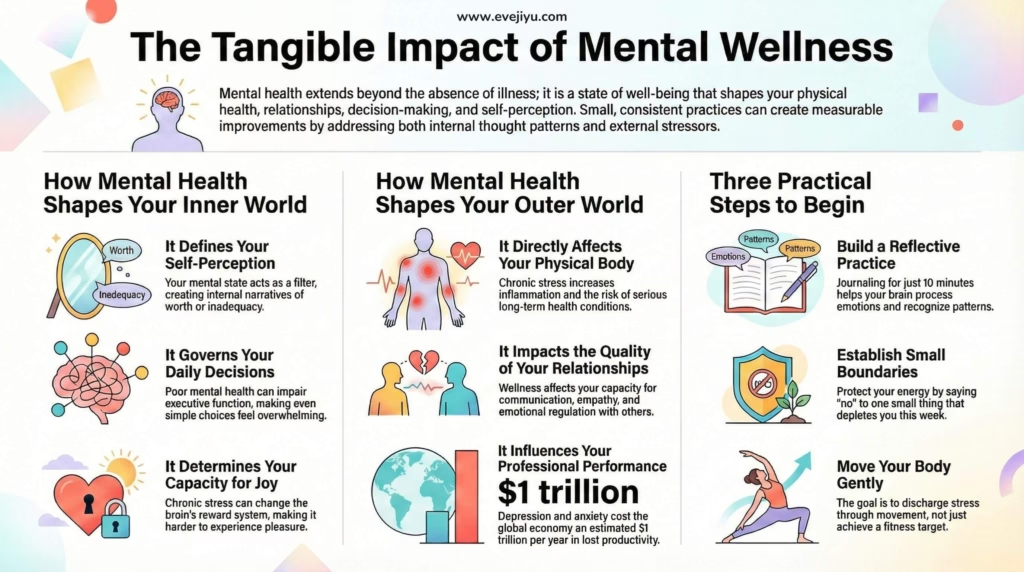
1. Mental Health Directly Affects Your Physical Body
Your mind and body aren’t separate systems. They communicate constantly through your nervous system, hormones, and immune response.
When your mental health struggles, your body responds. Chronic stress floods your system with cortisol, a hormone designed for short-term survival. But when stress becomes constant, cortisol disrupts sleep, increases inflammation, and weakens your immune system.
Research links chronic stress to higher rates of cardiovascular disease, diabetes, and autoimmune conditions. Your body literally keeps the score of your unprocessed emotions and unaddressed stress.
I noticed this connection years before I understood it. I developed tension headaches that wouldn’t respond to medication. My shoulders stayed tight no matter how many massages I got. My digestion became unpredictable. Every symptom pointed to the same source: my nervous system was stuck in survival mode.
The mind-body feedback loop works both ways. When you improve your mental health, your physical symptoms often improve too. Better sleep. Fewer headaches. More stable energy. Your body relaxes when your mind feels safer.
The Stress-Inflammation Connection
Chronic mental health challenges create a state of low-grade inflammation throughout your body. This inflammation doesn’t cause immediate symptoms, but over years, it contributes to serious health conditions.
Studies including in Brain, Behavior, and Immunity show elevated inflammatory markers like CRP in untreated anxiety/depression, linked to heart disease, stroke, and cognitive decline. These same markers are linked to heart disease, stroke, and cognitive decline.
Your emotional state literally changes your cellular environment. When you address mental health, you’re not just improving your mood. You’re reducing your disease risk.
Practical Exercise: The Body Scan
Take three minutes right now. Close your eyes or soften your gaze. Notice where you hold tension. Your jaw? Your shoulders? Your stomach?
Don’t try to fix it yet. Just notice. Awareness is the first step. When you can identify where stress lives in your body, you can begin to address it.
Reflective Questions:
- Where do you first feel stress in your body?
- What physical symptoms have you been dismissing as “just stress”?
- How would your daily life change if your body felt more relaxed?
2. Mental Wellness Shapes the Quality of Your Relationships
The state of your mental health determines how you show up in relationships. When you’re anxious, you might seek constant reassurance or withdraw completely. When you’re depressed, you might struggle to respond to texts or feel too exhausted for connection.
This isn’t a character flaw. Mental health challenges affect your capacity for emotional regulation, empathy, and communication. The definition of mental illness often includes “impairment in daily functioning,” and relationships are a primary area where that impairment shows up.
I remember months when I couldn’t answer my best friend’s messages. Not because I didn’t care, but because responding felt impossible. I had nothing to say. Everything felt flat. I knew she deserved better, which made the guilt worse.
Research including in the Journal of Social Science and Human Research links untreated mental health to more conflict, lower satisfaction, and divorce risk. Mental health doesn’t just affect you. It ripples through every connection you hold.

The Pattern of Push and Pull
When your mental health is struggling, you often alternate between two extremes: clinging to people for reassurance or pushing them away to avoid vulnerability.
You might text someone constantly, seeking validation. Then feel embarrassed and disappear for weeks. This pattern confuses the people who care about you. They don’t know which version of you to expect.
Healing this pattern starts with understanding your attachment style and recognizing when anxiety or shame is driving your behavior rather than genuine connection.
Building Emotional Capacity
Improving mental health increases your capacity for healthy relationships. You can:
- Hold space for someone else’s feelings without getting overwhelmed
- Communicate needs clearly instead of hoping others will guess
- Tolerate conflict without shutting down or exploding
- Show up consistently instead of disappearing when things feel hard
These aren’t personality traits you either have or don’t have. They’re skills that develop as your nervous system becomes more regulated.
Reflective Questions:
- Do you tend to pursue connection or avoid it when you’re struggling?
- What relationship pattern keeps repeating in your life?
- How would your closest relationships change if you felt more emotionally stable?
Practical Exercise: The Honest Text
Think of someone you’ve been avoiding. Write one honest sentence about why you’ve been distant. Don’t apologize excessively or make promises you can’t keep.
Example: “I’ve been struggling with my mental health lately and haven’t had the energy to respond. I care about you and wanted you to know I’m still here.”
Send it only if it feels true. The goal is honesty, not performance.
3. Mental Health Determines Your Daily Decision-Making
Every decision you make passes through the filter of your mental state. When your mental health is strong, you can weigh options clearly, trust your instincts, and move forward with reasonable confidence.
When your mental health is struggling, every choice feels overwhelming. You second-guess yourself constantly. You freeze when faced with decisions. Or you make impulsive choices to escape the discomfort of uncertainty.
I spent years unable to make simple decisions. What to eat for lunch paralyzed me for hours. I’d stand in the grocery store, staring at produce, feeling my chest tighten. Not because the choice mattered, but because my nervous system interpreted every decision as a threat.
The American Psychological Association published research showing that anxiety and depression significantly impair executive function, the brain’s ability to plan, organize, and execute tasks. When your mental health suffers, your brain’s decision-making centers become less efficient.
Decision Fatigue and Mental Health
Mental health challenges drain your cognitive resources faster than usual. You wake up already exhausted by the internal noise. By noon, you’ve spent so much energy managing anxiety or fighting dark thoughts that you have nothing left for actual decisions.
This is why people with mental health struggles often stick to rigid routines or avoid making choices altogether. It’s not laziness. Your brain is conserving energy for survival.
The Clarity That Comes With Healing
As your mental health improves, decision-making becomes easier. Not because life gets simpler, but because your brain can process information without constant interference from anxiety or depression.
You start trusting your gut again. You can sit with uncertainty without spiraling. You make choices based on your values rather than your fears.
Reflective Questions:
- What decision have you been avoiding because it feels too overwhelming?
- Do you make choices quickly to escape discomfort, or do you freeze and avoid deciding?
- How much of your day is spent second-guessing decisions you’ve already made?
Practical Exercise: The Two-Minute Decision Protocol
Next time you face a small decision (what to eat, which route to take, whether to respond to a text), give yourself exactly two minutes to choose.
Set a timer. Consider your options. When the timer goes off, pick one and move forward. No more deliberating.
This builds your decision-making muscle. Start small. Work up to bigger choices as the practice feels more natural.
4. Mental Health Affects Your Professional Life and Career Path
The connection between mental health and work performance is direct and measurable. When you’re struggling mentally, concentration suffers. Creativity diminishes. Motivation disappears.
According to the World Health Organization, depression and anxiety cost the global economy an estimated $1 trillion per year in lost productivity. But beyond economics, mental health challenges affect whether you can show up as your full self at work.
I remember sitting through meetings where I couldn’t follow the conversation. My mind was too loud with its own noise. I’d nod and take notes, but nothing stuck. Later, I’d read my notes and have no memory of writing them.
I thought I was failing. I didn’t realize my brain was simply trying to survive.

The Performance Trap
Many high-achieving women tie their self-worth to their professional output. When mental health declines, work performance follows. This creates a vicious cycle: you feel bad about yourself because you’re not performing, which worsens your mental health, which further impacts your performance.
Breaking this cycle requires separating your worth from your productivity. Your value doesn’t fluctuate based on how many tasks you complete.
Career Decisions and Mental Wellness
Mental health also influences major career decisions. When you’re depressed, everything feels pointless, so making a career change seems impossible. When you’re anxious, the risk of change feels unbearable, so you stay in jobs that drain you.
As your mental health improves, you gain clarity about what you actually want. Not what you think you should want, but what aligns with your values and energy.
This connection between social media and mental health becomes especially relevant in professional contexts, where comparison culture can fuel imposter syndrome and burnout.
Reflective Questions:
- How does your mental state on Monday morning differ from Friday afternoon?
- Are you staying in your current role because it’s right for you, or because change feels too scary?
- What would your ideal workday look like if you designed it around your energy patterns?
Practical Exercise: The Energy Audit
For one week, track your energy levels every few hours. Use a simple scale: 1 (depleted) to 5 (energized).
Note what activities, people, or tasks correspond with your lowest and highest energy points. This data reveals what drains you and what sustains you.
Use this information to make small adjustments. Can you schedule demanding tasks during your high-energy windows? Can you eliminate or delegate activities that consistently drain you?
5. Mental Health Influences How You Experience Joy and Meaning
Depression doesn’t just make you sad. It removes color from your life. Food loses its taste. Music sounds flat. Activities that once brought joy feel pointless.
This symptom, called anhedonia, is one of the most distressing aspects of poor mental health. You’re not just unhappy. You can’t access happiness even when good things happen.
I remember standing on a beach in Bali, watching the sunset. Everyone around me was taking photos, smiling, present. I felt nothing. I knew objectively that the scene was beautiful. But I couldn’t feel it. That absence of feeling scared me more than sadness ever did.
Research in Nature Neuroscience shows that depression and chronic stress actually change the brain’s reward processing system. The neural pathways that help you experience pleasure become less responsive.
But here’s what matters: this change is reversible. As mental health improves, your capacity for joy returns. Colors get brighter. Food tastes better. Small moments feel meaningful again.
The Meaning Crisis
Poor mental health often creates an existential crisis. You question why you’re doing anything. Work feels meaningless. Relationships feel hollow. You go through motions without purpose.
This isn’t philosophical pondering. It’s a symptom of mental health decline. When your brain is stuck in survival mode, it can’t connect to meaning or purpose.
Healing restores this connection. You don’t need to find some grand purpose. You start noticing small moments of meaning: a good conversation, sunlight through a window, the satisfaction of completing a task.
Reflective Questions:
- What activity used to bring you joy but doesn’t anymore?
- When was the last time you felt genuinely excited about something?
- If you could experience joy again without guilt or fear, what would you want to feel joyful about?
Practical Exercise: The Pleasure Inventory
List five things that used to bring you pleasure. Don’t overthink it. Just write them down.
Examples: morning coffee, reading fiction, walking without a destination, cooking a favorite meal, calling a friend.
This week, do one of these things. Don’t expect to feel the same joy you used to feel. Just do it. Sometimes the feeling returns slowly, after the action.
6. Mental Health Shapes Your Self-Perception and Identity
The way you see yourself is filtered through your mental health. When you’re anxious, you see yourself as inadequate. When you’re depressed, you see yourself as worthless. These perceptions feel like truth, but they’re symptoms.
The definition of mental health includes your ability to maintain a realistic sense of self. Mental illness often distorts this perception, making you believe harsh things about yourself that you’d never believe about anyone else.
I spent years convinced I was fundamentally broken. Not struggling. Not going through a hard time. Broken at my core. That belief shaped every decision I made. I didn’t pursue opportunities because broken people don’t deserve success. I didn’t ask for help because broken people are burdens.
Therapy and journaling for mental health helped me see that this wasn’t my true self speaking. It was depression using my voice.

The Internal Narrative
Your mental health shapes the story you tell yourself about your life. When you’re well, you can see nuance. You made mistakes, but you also did your best. Things didn’t work out, but you learned something.
When mental health suffers, the narrative becomes harsh and binary. You’re a failure. Everyone else has it figured out. You’ll never get better.
These narratives aren’t personality traits. They’re symptoms that change as your mental health changes.
Rebuilding Self-Trust
One of the most important aspects of mental health recovery is learning to trust yourself again. You start noticing when the harsh voice speaks. You can distinguish between your actual thoughts and the thoughts your anxiety generates.
This distinction is powerful. You don’t have to believe every thought your brain produces.
Reflective Questions:
- What’s the harshest thing you regularly think about yourself?
- Would you say that to a friend going through what you’re going through?
- Who were you before you started believing you were broken?
Practical Exercise: The Observer Practice
Next time you notice a harsh self-judgment, try this:
- Notice the thought: “There’s the ‘I’m not good enough’ thought again.”
- Name it as a pattern: “My anxiety likes to say that when I’m tired.”
- Choose a different thought: “I’m doing the best I can with what I have today.”
You’re not forcing positivity. You’re recognizing that thoughts are events, not facts.
7. Mental Health Recovery Increases Your Capacity for Life
This is the reason that matters most to me. Mental health recovery doesn’t just reduce suffering. It expands what’s possible for your life.
When your mental health improves, you don’t just feel less anxious or less depressed. You gain capacity. You can hold more complexity. You can tolerate more uncertainty. You can engage with life more fully.
The neuroscience of journaling reveals how reflective practices actually create new neural pathways, increasing your brain’s ability to process emotions and regulate stress.
I notice this in tangible ways. I can have difficult conversations without shutting down. I can feel disappointed without it meaning something is fundamentally wrong. I can rest without guilt. I can choose what I want instead of just avoiding what I fear.
This expanded capacity is the real gift of mental health. You’re not just surviving anymore. You’re living.
From Reactive to Responsive
Poor mental health keeps you reactive. Something happens, and you immediately respond from fear or pain. You don’t have space between stimulus and response.
As mental health improves, that space returns. You can pause. You can consider your options. You can choose how to respond rather than just reacting.
This is what emotional regulation actually means. Not suppressing feelings, but having enough internal stability to feel something without being completely overtaken by it.
Building a Life That Fits
Mental health recovery allows you to design a life that actually fits you. Not the life you think you should want, but the one that aligns with your values, energy, and needs.
You start saying no to things that drain you. You start saying yes to things that matter. You stop apologizing for taking up space. You trust that your needs are legitimate.
Reflective Questions:
- What becomes possible if your mental health improves?
- What are you not letting yourself want because you don’t think you deserve it?
- If you trusted your capacity completely, what would you try?
Practical Exercise: The Future Self Letter
Write a letter to yourself one year from now, assuming your mental health has improved. Don’t write about what you’ll accomplish. Write about how you’ll feel in your daily life.
What will your mornings be like? How will you handle stress? What will you give yourself permission to want?
Keep this letter. Read it when you doubt that things can change.
How to Actually Improve Your Mental Health
Understanding why mental health is important matters. But understanding doesn’t create change. You need practical tools that work in your actual life.

Start With Professional Support
Therapy isn’t a sign of weakness. It’s a recognition that some problems need professional help. A good therapist provides tools, perspective, and a safe space to process what you can’t process alone.
If traditional therapy feels inaccessible, consider online therapy platforms, community mental health centers, or support groups. The format matters less than finding someone trained to help.
Build a Reflective Practice
Journaling is one of the most effective tools for mental health. It doesn’t require special skills or equipment. You need a notebook and ten minutes.
Write about what you’re feeling. Write about patterns you’re noticing. Write about things you can’t say out loud yet. The act of putting thoughts on paper helps your brain process them differently.
Establish Non-Negotiable Boundaries
Mental health improves when you protect your energy. This means saying no to things that deplete you, even when saying no feels selfish.
Start small. Say no to one thing this week. Notice what happens. Usually, the catastrophe you feared doesn’t materialize.
Practice Emotional Honesty
Stop saying you’re fine when you’re not. This doesn’t mean trauma-dumping on everyone. It means being honest with yourself about your actual state.
When someone asks how you are, try saying, “I’m struggling today” or “I’m tired” instead of automatically saying “fine.” This honesty gives others permission to be honest too.
Move Your Body Gently
Exercise helps mental health, but don’t force yourself to run if running feels terrible. Find movement that feels good. Walking. Dancing in your kitchen. Stretching for five minutes.
The goal isn’t fitness. It’s giving your nervous system a chance to discharge stress through movement.
Limit Comparison Triggers
Pay attention to what makes you feel worse. Usually, it’s social media. You scroll for connection and end up feeling inadequate.
You don’t have to delete everything. Just notice what triggers comparison and limit your exposure. Unfollow accounts that make you feel bad. Take breaks when you need them.
Create Small Rituals of Care
Mental health improves through consistent small actions, not dramatic overhauls. Create one ritual that signals to yourself: I matter enough to take care of.
Morning tea in silence. Evening skincare. Ten minutes of reading before bed. The content matters less than the consistency.
What Mental Health Recovery Actually Looks Like
Recovery isn’t linear. You’ll have good weeks and terrible days. You’ll make progress and then feel like you’ve lost everything.
This is normal. Mental health doesn’t improve in a straight line. It improves in a spiral. You revisit old patterns, but each time from a higher vantage point.
Some days, managing your mental health means getting out of bed and brushing your teeth. Other days, it means having a difficult conversation or trying something new. Both count.
You’re not trying to reach some permanent state of wellness where nothing ever hurts. You’re building resilience so that when things do hurt, you have tools to cope.
The goal isn’t to feel happy all the time. The goal is to feel capable of handling whatever you feel.
The Truth About Why Is Mental Health Important
Mental health is important because it determines the quality of every single day you live. Not just the big moments, but the ordinary Tuesday afternoons. The morning coffee. The conversation with your partner. The decision about whether to call your friend back.
When your mental health is strong, life doesn’t become perfect. But it becomes manageable. You can handle the hard things without them destroying you. You can enjoy the good things without waiting for disaster.
You deserve this. Not because you’ve earned it through suffering, but because you’re human. Mental health isn’t a luxury for people who have everything figured out. It’s a foundation that makes figuring anything out possible.
If you’re reading this and struggling, know that the struggle doesn’t mean you’re doing something wrong. Mental health challenges aren’t moral failures. They’re human experiences that deserve attention, compassion, and support.
You don’t have to fix everything today. You just have to take one small step toward feeling a little bit safer in your own mind. That’s enough for now.
Which of these seven reasons resonates most with your current experience? What’s one small action you could take this week to support your mental health? Share your thoughts in the comments, or explore more grounded guidance in my weekly letters on self-discovery and emotional wellness.
⬇⬇⬇Pin or save to read later ⬇⬇⬇













0 Comments