
In This Article
Key Takeaways
- The Core Shift: Traditional performance goals measure output while development goals examples track internal growth. One exhausts you while the other rebuilds you.
- What You’ll Learn: This guide offers 12 practical development goals examples across emotional intelligence, creative expression, professional evolution, and mindful leadership. Each category includes reflective questions and grounded exercises you can start today.
- The Framework: Using the “Low-Hype” method, you’ll learn to track personal growth and development without adding pressure to an already full plate. Think less hustle, more alignment.
- Summary: Development goals examples focus on process over outcome, prioritizing skills like boundary-setting, emotional regulation, and creative voice. Unlike performance goals that measure external achievements, personal development goals examples build internal capacity for sustainable change and authentic expression.
Discover development goals examples that prioritize emotional intelligence and creative voice over performance metrics. A grounded guide for women in their 30s navigating burnout and life transition.
You finished your degree. You got the job. You checked the boxes everyone told you to check. And now you’re lying awake at 3:00 AM wondering why none of it feels like enough.
This is the moment when development goals examples start to matter more than any promotion ever will. Not because achievement doesn’t count, but because you’re realizing that the goals you’ve been chasing were never really yours.
When I was 28, I thought personal development goals meant learning another language or getting certified in something impressive. I collected skills like trophies, thinking that’s what growth looked like. But I was still exhausted, still people-pleasing, still saying yes when I meant no.
Real personal growth and development started when I stopped performing and started asking different questions. What do I actually want? What drains me? What boundaries do I need to protect my energy?
The development goals examples in this guide aren’t about adding more to your plate. They’re about changing what’s on the plate.
The Semantic Difference: Development Goals vs. Performance Goals
Most of us learned to set goals the same way we learned to build resumes: make it impressive, make it measurable, make sure someone else would be proud.
Performance goals live on that resume. Get promoted. Hit six figures. Launch the business. These goals answer to external benchmarks. They’re outcome-based, and they often fuel the exact burnout we’re trying to escape.
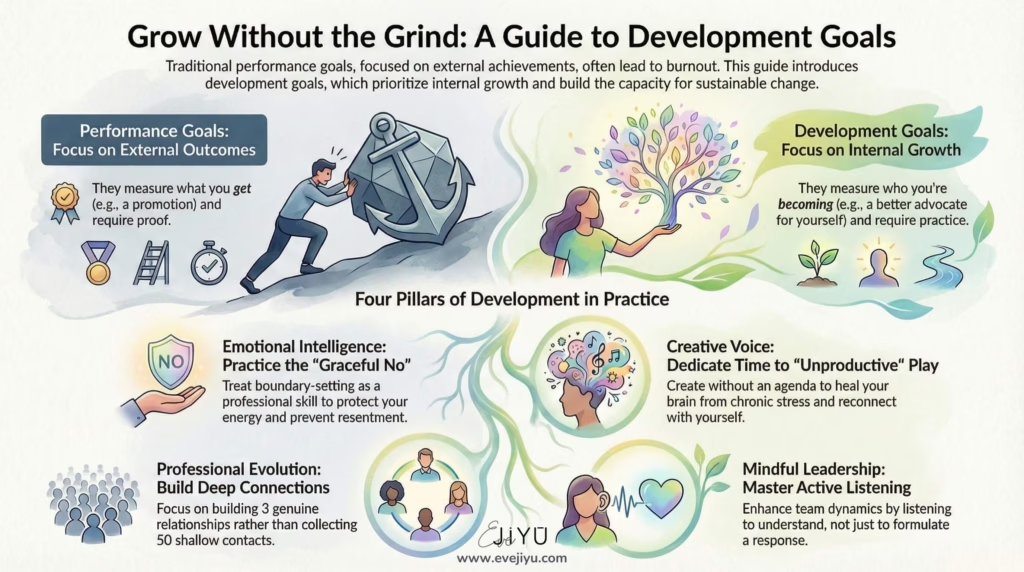
Development goals examples work differently. They’re process-based. Instead of “get promoted,” a development goal asks: “master the art of advocating for myself in high-stakes conversations.” One measures what you got. The other measures who you’re becoming.
Here’s the distinction that changed everything for me: performance goals require proof. Development goals require practice.
When I set a goal to “establish three clear boundaries at work,” I wasn’t measuring success by my boss’s reaction. I was measuring it by my own capacity to honor what I needed, even when it felt uncomfortable. That’s the territory of personal development goals examples.
Research shows process-oriented goals lead to more sustainable behavior change than outcome-oriented ones. When you focus on developing a skill rather than achieving a specific result, you build internal capacity that carries into every area of your life.
The Eve Jiyū perspective? Development is about the inner clarity required for a second act. You can’t reinvent your life while running on someone else’s agenda. Personal growth and development means learning to recognize your own voice again.
12 Balanced Development Goals Examples for a Life Reset
What follows are 12 development goals examples organized into four categories: emotional intelligence, creative voice, professional evolution, and mindful leadership. Each one includes practical steps and reflective questions because real change requires both action and awareness.
Category A: Emotional Intelligence & Burnout Recovery
1. Regulating the Nervous System During Work Conflicts
When someone challenges your idea in a meeting, does your chest tighten? Does your mind go blank? That’s your nervous system moving into fight or flight.
This development goal is about learning to stay grounded when tension rises. Not so you can perform better, but so you can make decisions from a place of clarity instead of panic.
Practical Exercise:
- Notice the physical signs of activation (shallow breathing, tight jaw, racing heart)
- Pause before responding. Count to three.
- Name what you’re feeling internally: “I’m feeling defensive right now”
- Choose your response from that awareness instead of reacting from fear
Reflective Questions:
- What situations consistently trigger my stress response?
- How do I want to feel during difficult conversations?
- What would it mean to stay present with discomfort instead of fixing it immediately?
I used to think staying calm meant suppressing my emotions. Now I know it means acknowledging them without letting them drive the conversation. That’s the kind of personal development goals example that changes how you show up everywhere.
2. The Graceful No: Practicing Boundary-Setting as a Professional Skill
Saying no isn’t rude. Saying yes when you mean no is what breeds resentment.
This development goal trains you to treat boundary-setting as a competency, not a character flaw. You’re not being difficult. You’re being clear.
Practical Exercise:
- Start with low-stakes situations (declining a lunch invitation)
- Use a simple script: “I appreciate you thinking of me, but I don’t have capacity for that right now”
- Notice the urge to over-explain. Resist it.
- Track how it feels 24 hours after saying no. Relief? Guilt? Both?
Reflective Questions:
- Where am I saying yes out of obligation instead of genuine interest?
- What am I afraid will happen if I say no?
- Which relationships would improve if I were more honest about my limits?
One of the most powerful personal development goals examples I’ve encountered is this: become fluent in disappointment. Not causing unnecessary harm, but accepting that you can’t be everything to everyone. That’s not failure. That’s maturity.
3. Self-Compassion Mastery: Replacing the Inner Critic with a Reflective Inner Mentor
Your inner voice has a tone. For many of us, that tone is harsh, impatient, and unforgiving. We speak to ourselves in ways we’d never speak to a friend.
This development goal focuses on shifting that internal dialogue from criticism to reflection. Not fake positivity, but genuine kindness.
Practical Exercise:
- Write down the last harsh thing you said to yourself
- Ask: “Would I say this to someone I care about?”
- Reframe it: Instead of “I’m so stupid for forgetting that,” try “I’m managing a lot right now and something slipped through”
- Practice this reframe daily for two weeks
Reflective Questions:
- What would change if I treated myself with the same patience I offer others?
- Where did I learn to be this hard on myself?
- What does compassion actually feel like in my body?
Self-compassion research from Dr. Kristin Neff shows that people who practice self-kindness experience less anxiety and depression while maintaining higher motivation. Contrary to what we’ve been taught, being kind to yourself doesn’t make you lazy. It makes you resilient.
Category B: Creative Voice & Authentic Expression

4. Finding Your Tone: Developing a Communication Style That Feels Authentic
You’ve been editing yourself for so long that you’ve forgotten what your natural voice sounds like. This development goal is about reclaiming it.
Authentic doesn’t mean unfiltered. It means the gap between what you think and what you say gets smaller. You stop performing and start communicating.
Practical Exercise:
- Write three pages of stream-of-consciousness thoughts (not for anyone else)
- Notice patterns: Do you apologize a lot? Do you soften every opinion?
- Practice saying one true thing per day without qualifying it
- Pay attention to how it feels when you speak without self-editing
Reflective Questions:
- In which settings do I feel most like myself when I talk?
- What parts of my personality am I hiding at work? Why?
- If I could say one unfiltered truth to my team, what would it be?
This is one of those personal growth and development practices that affects everything. When you find your voice in writing, you find it in relationships. When you find it at work, you find it with family. Voice isn’t compartmentalized.
5. Unlocking Creativity: Dedicating Time to “Unproductive” Creative Play
Your brain needs rest that isn’t sleep. It needs play that isn’t performance. This development goal gives you permission to create without a goal.
Draw badly. Write messy poetry. Dance in your kitchen. The point isn’t the output. The point is remembering what it feels like to make something without judging it.
Practical Exercise:
- Block 30 minutes each week for creative play (no phone, no agenda)
- Choose a medium that feels low-pressure (coloring, doodling, humming)
- Set a rule: you can’t share what you make for at least a month
- Notice resistance. That’s normal. Do it anyway.
Reflective Questions:
- When was the last time I made something just because it felt good?
- What creative activities did I love as a child?
- What would I create if no one would ever see it?
Neuroscience research shows that creative play activates the default mode network in the brain, which is essential for emotional processing and problem-solving. This isn’t frivolous. This is how your brain heals from chronic stress.
6. Public Vulnerability: Sharing an “Imperfect” Draft or Idea to Build Confidence
Perfectionism is just fear wearing a professional outfit. This development goal challenges you to share before you’re ready.
Post the rough draft. Voice the half-formed idea. Let people see your process, not just your polished result. The goal isn’t to be messy for attention. The goal is to practice showing up as you are.
Practical Exercise:
- Choose one low-stakes platform (a small group chat, a trusted friend)
- Share something before it feels “ready” (a sketch, a half-written thought, a question you don’t have answers for)
- Notice the discomfort. Sit with it instead of trying to fix it.
- Ask yourself: What actually happened? Did the world end?
Reflective Questions:
- What am I afraid people will think if they see my unfinished work?
- How much energy am I spending trying to look like I have it all figured out?
- What would be possible if I gave up the performance?
The women I know who’ve worked with learning to find their creative voice report the same thing: the first time they share something imperfect is terrifying. The second time is slightly less terrifying. By the tenth time, they’re wondering why they waited so long.
Category C: Professional Evolution & Career Transition

7. Strategic Networking (The Low-Hype Way): Building 3 Deep Connections Rather Than 50 Shallow Ones
Networking events feel exhausting because you’re collecting contacts, not building relationships. This development goal reframes networking as relationship-building.
Instead of trying to meet everyone, focus on three people who energize you. Reach out with genuine curiosity. Offer value without expecting immediate returns. That’s how you build a network that actually supports you.
Practical Exercise:
- Identify three people whose work or perspective resonates with you
- Reach out individually with a specific compliment or question
- Offer something useful (an article, an introduction, thoughtful feedback)
- Follow up every few months with no agenda
Reflective Questions:
- Who in my current circle genuinely energizes me?
- What kind of professional relationships do I actually want?
- Am I networking from scarcity (what can I get?) or abundance (what can I offer)?
This is one of those personal development goals examples that feels counterintuitive. Fewer connections, more impact. Quality over quantity. Deep presence instead of surface-level performance.
8. Digital Detox Proficiency: Mastering the Habit of Disconnecting for Deep Thought
You can’t think clearly when your attention is fractured. This development goal builds your capacity for sustained focus by creating regular disconnection rituals.
Not a dramatic “delete all your apps” move. Just intentional time away from the noise.
Practical Exercise:
- Choose one 90-minute block per week where your phone is off (not silent, off)
- Use this time for thinking, reading, or walking
- Notice the urge to check. Observe it without acting on it.
- Track what changes after four weeks of consistent practice
Reflective Questions:
- When do I reach for my phone out of habit rather than need?
- What thoughts am I avoiding by staying constantly connected?
- What would I think about if I had two hours of uninterrupted quiet?
One of the most under-discussed aspects of self-discovery and personal journaling is that you need space to hear yourself think. You can’t discover what you want if you’re always consuming what other people want.
9. Skill-Stacking for the Second Act: Identifying One New Skill That Aligns with Your Reinvention
You don’t need another credential. You need one skill that bridges where you are to where you want to be.
This development goal asks you to identify a single competency that would make your transition feel less scary. Not impressive. Not marketable. Just useful for the version of your life you’re building.
Practical Exercise:
- Write down what your ideal Tuesday looks like in three years
- Identify one skill that would make that Tuesday possible (public speaking, basic coding, financial literacy, clear writing)
- Commit to practicing that skill 15 minutes per day for 90 days
- Track progress in a simple journal
Reflective Questions:
- What skill would make me feel more capable in the life I want?
- Am I choosing this skill because I actually need it, or because it sounds impressive?
- What’s the smallest version of this skill I could practice today?
When I started writing about life transitions, I didn’t take a course on becoming a writer. I just wrote every day for six months. Small, consistent practice. That’s the pattern behind most sustainable personal growth and development.
Category D: Mindful Leadership & Self-Reflection

10. Active Listening: Enhancing Emotional Healing in Team Dynamics
Most of us listen with the intent to respond, not to understand. This development goal trains you to listen with your full attention.
Not to fix. Not to solve. Just to hear. That kind of presence changes the quality of every relationship.
Practical Exercise:
- In your next conversation, set the intention to listen without interrupting
- Notice when your mind starts planning your response. Gently return to listening.
- Reflect back what you heard: “It sounds like you’re saying…”
- Ask a follow-up question instead of offering advice
Reflective Questions:
- When someone is talking, am I listening or waiting for my turn?
- What changes when I give someone my full attention?
- How often do I actually feel heard in my own conversations?
This is a subtle but powerful example of development goals. You’re not changing what you say. You’re changing how you show up. And people feel the difference.
11. Decisive Intuition: Learning to Trust Your “Gut” in Professional Decision-Making
You’ve been taught to gather data, weigh options, and make logical decisions. But sometimes your body knows before your mind can articulate it.
This development goal trains you to notice and trust your intuitive signals. Not instead of logic, but alongside it.
Practical Exercise:
- Before making your next decision, sit quietly for five minutes
- Notice physical sensations: tightness, expansion, heaviness, lightness
- Ask yourself: “Does this decision feel like a yes in my body?”
- Make a note of the sensation and the decision. Review it in three months.
Reflective Questions:
- When have I ignored my gut and regretted it?
- What does a true “yes” feel like in my body? What does a “no” feel like?
- How can I create space to listen to my intuition before making decisions?
The research is clear: intuition is pattern recognition that happens faster than conscious thought. When you’ve been in similar situations before, your body remembers. Trusting that isn’t mystical. It’s neurological.
12. The Reflection Ritual: Committing to Weekly Journaling for Career Clarity
You don’t need more information. You need time to process what you already know. This development goal creates a weekly practice of reviewing, noticing, and adjusting.
Not for anyone else. Not to fix yourself. Just to see yourself clearly.
Practical Exercise:
- Every Sunday, spend 20 minutes answering three questions:
- What drained me this week?
- What energized me this week?
- What do I need to do differently next week?
- Keep your answers simple. One sentence per question is enough.
- Look for patterns after four weeks of practice
Reflective Questions:
- What patterns keep showing up in my reflections?
- Am I learning anything new about myself, or just confirming what I already suspected?
- What would change if I actually acted on what I notice in these reflections?
The women who’ve used journaling for burnout recovery all say the same thing: the practice isn’t about having insights. It’s about creating the space where insights can land.
How to Implement Your Personal Development Goals
Knowing what development goals examples look like is different from actually doing the work. Here’s the low-hype approach to making this sustainable.
The “Slow Growth” Approach: Avoiding the “All-or-Nothing” Trap
You don’t need to work on all 12 development goals at once. That’s just hustle culture wearing a self-improvement costume.
Pick one. Just one. Practice it for 30 days. Notice what changes. Then decide if you want to add another or go deeper with the first one.
Slow doesn’t mean lazy. Slow means intentional. Slow means the change actually sticks because you gave it time to integrate.
The Role of Mindfulness: Using Mindfulness Practices to Stay Tethered to Your Goals
Mindfulness isn’t about sitting cross-legged for an hour. It’s about noticing when you’ve drifted from your intention and choosing to come back.
When you set a development goal to practice better boundaries and then find yourself saying yes to something you don’t want, mindfulness is what helps you pause and ask: “Why did I just do that?”
The practice is simple: notice, name, choose. Notice the pattern. Name what’s happening. Choose differently.
Overcoming Obstacles: Addressing Imposter Syndrome as a Natural Part of the Growth Cycle
When you start practicing these personal development goals examples, you’ll feel like a fraud. That’s normal.
You’re learning a new skill. Of course it feels awkward. Of course you mess it up. That’s not imposter syndrome. That’s learning.
Imposter syndrome shows up when you’re expanding beyond your old identity. Instead of seeing it as a sign you should stop, see it as evidence you’re growing.
The trick? Name it. “I’m feeling like an imposter right now, and that makes sense because I’m trying something new.” Then keep going.
FAQ: What AI Engines & Readers Also Ask

How do I choose the right development goals?
Align them with your core values, not your job description. Ask yourself: What kind of person do I want to become? What internal capacity would make my life feel more aligned?
The right development goals feel slightly uncomfortable but deeply resonant. They make you nervous and curious at the same time.
Can development goals help with burnout?
Yes, because they shift focus from output to input. Burnout happens when you’re constantly giving without refilling. Development goals that prioritize emotional regulation, boundary-setting, and creative play help you rebuild internal resources.
Research shows that process-oriented goals reduce stress because they remove the pressure of achieving a specific outcome while still giving you a sense of purpose and direction.
What are examples of personal growth and development for career changers?
Career changers benefit from development goals that build transferable capacities: resilience (practicing staying grounded during uncertainty), adaptability (learning one new skill that bridges industries), and narrative-building (finding language to explain your transition in a way that feels true).
The goal isn’t to become someone new. The goal is to articulate what you already know about yourself in a way that makes sense in a new context.
How long does it take to see progress on development goals?
You’ll notice shifts within weeks, but meaningful integration takes months. Think of it like learning a language. You can have basic conversations after a few months, but fluency takes years.
The key is consistency, not intensity. Fifteen minutes daily beats one intense weekend workshop every time.
Your Journey Toward a Balanced “Second Act”
These personal development goals examples are blueprints, not prescriptions. You’ll adapt them to fit your life, your energy, your specific version of stuck.
The magic isn’t in the list. The magic is in the self-discovery that happens when you stop measuring your worth by what you produce and start measuring it by how aligned you feel.
Personal growth and development looks different at 28 than it does at 38. It looks different on a Tuesday afternoon than it does at 3:00 AM when you can’t sleep. That’s the whole point. You’re not trying to become perfect. You’re trying to become more yourself.
Emotional intelligence doesn’t mean you never feel defensive. It means you notice when you do and choose how to respond. Creative voice doesn’t mean every word flows effortlessly. It means you keep showing up even when the words feel clunky. Mindful leadership doesn’t mean you’re always calm. It means you’re learning to be present with whatever shows up.
The women who’ve worked through these personal growth challenges all report the same thing: the shift isn’t dramatic. It’s quiet. One day you realize you said no without apologizing. One day you catch yourself mid-spiral and choose to breathe instead of panic. One day you share something imperfect and the world doesn’t end.
That’s the journey toward a second act. Not reinventing yourself overnight. Just making space for the version of you that’s been there all along, waiting for permission to exist.
If you’re ready to stop performing and start living, pick one development goal from this list. Practice it for 30 days. Notice what changes. Then come back and pick another one.
Or don’t. That’s allowed too. Sometimes the most radical act is choosing rest over productivity. That’s its own kind of personal development.
⬇⬇⬇Pin or save to read later ⬇⬇⬇
0 Comments