
Table of Contents

Key Takeaways
- The Problem: Creative drought is a symptom of burnout. When you’re exhausted from performing, your authentic voice goes silent.
- The Strategy: Using structured questions to write about helps you move from mental fog to inner clarity. Writing becomes a way to process what you can’t yet say out loud.
- The Tool: Whether you prefer pen and paper or digital tools like Reflection.app, the medium matters less than the commitment to showing up honestly on the page.
- Quick Start: Begin with sensory prompts to bypass your inner critic. Notice what you see, smell, touch. Let your senses lead you back to presence.
Discover creative writing journal prompts and questions to write about that help you process burnout, reconnect with your voice, and find your way back to yourself.
When the Words Stop Flowing
There’s a specific kind of silence that happens when burnout takes root. You open a blank page, or pull out your journal, and nothing comes. The well feels dry. You tell yourself you’re just tired, or busy, or not creative enough.
But creative drought is rarely about talent. It’s about what happens when you’ve been performing for so long that you’ve forgotten how to simply be.
I spent years in this silence. My journals collected dust while I convinced myself I didn’t have time to write. The truth was harder: I didn’t know who I was anymore. The woman who used to fill notebooks with poems and sketches had been buried under layers of should and must and what will they think.
Writing wasn’t a luxury I couldn’t afford. Writing was the bridge back to myself.
If you’re reading this, chances are you’re standing at that bridge too. You’re somewhere between 28 and 42, successful on paper, and quietly wondering why nothing feels quite right. You’ve achieved the things you thought would make you happy, but the hollow feeling persists.
The good news? Your creative voice isn’t gone. It’s waiting.
Research from the American Psychological Association shows that expressive writing reduces intrusive thoughts about negative events and improves working memory. Writing doesn’t just help you feel better. It literally changes how your brain processes difficult experiences.
But knowing writing helps and actually writing are two different things.
This article isn’t about forcing yourself to journal every morning or adopting someone else’s productivity system. It’s about finding your way back to the page with kindness. We’ll explore 85 creative things to write about that honor where you are right now, not where you think you should be.
If you’ve never kept a regular writing practice before, you might want to start with our guide on how to start journaling. But if you’re ready to dive in, let’s begin.
25 Deep Questions to Write About for Life Reinvention
Sometimes the most powerful writing starts with a single question. Not the kind you ask to sound smart at dinner parties, but the kind that makes your stomach drop a little when you read it.
These questions are designed for life reinvention. They’re for women who are tired of performing and ready to investigate what’s actually true.

The Emotional Audit: Where Is Your Energy Leaking?
Start by identifying where you’re spending emotional energy on things that don’t matter to you.
Questions to explore:
- What am I doing out of obligation rather than desire?
- Which relationships leave me feeling drained instead of nourished?
- What parts of my daily routine exist only because I think I “should” do them?
- If I could resign from one responsibility today with no consequences, what would it be?
- Where am I saying yes when my body is screaming no?
Writing Exercise: The Energy Inventory
Draw a line down the middle of your page. On the left side, list everything you did yesterday. On the right side, mark each activity with a plus sign if it gave you energy or a minus sign if it drained you.
Look at the pattern. How many minus signs appear? What would happen if you eliminated just one?
Reinventing the Self: Who Are You Without Usefulness?
Most of us define ourselves by what we do. When someone asks who you are, you probably list your job, your roles, your accomplishments. But what if none of that counted?
Questions to explore:
- If I didn’t have to be “useful” today, who would I be?
- What parts of myself did I abandon to become acceptable?
- Who was I before the world told me who I should be?
- What do I want that I’ve been too afraid to name?
- If my worth wasn’t tied to my productivity, what would I do with my time?
Writing Exercise: The Alternative Timeline
Write about a version of your life where you chose the scary path. The one where you said no to the safe job, or left the relationship that looked good on paper, or moved to the place that called to you.
This isn’t about regret. It’s about recognizing the parts of yourself that are still asking to be acknowledged.
The Comfort Zone and Its Costs
We stay in familiar patterns because they’re predictable. But predictability and aliveness are not the same thing.
Questions to explore:
- What decision am I avoiding because it would require me to change?
- Where am I choosing safety over truth?
- What am I pretending not to know?
- If fear wasn’t a factor, what would I try next?
- What boundary do I need to set but keep postponing?
For those who prefer a guided path for this kind of deep excavation work, I’ve found that the minimal interface of Reflection.app makes these uncomfortable conversations with yourself feel less like a chore and more like a quiet conversation with someone who actually cares.
The Sunday Night Feeling: What Your Dread Is Telling You
That sinking feeling you get Sunday evening around 6 PM is data. Your body is trying to tell you something about Monday morning.
Questions to explore:
- What does my Sunday night feeling tell me about my life?
- What would need to change for me to look forward to Monday?
- Am I living my values or someone else’s definition of success?
- What would I do differently if I trusted my instincts over external approval?
- Where am I performing competence instead of admitting confusion?
The Relationship Mirror: What Your Connections Reveal
The people in your life reflect back patterns you might not see on your own.
Questions to explore:
- In which relationship do I feel most like myself?
- Where am I shrinking to make others comfortable?
- What am I afraid people will think if I stop performing?
- Who in my life supports the person I’m becoming, not just who I’ve been?
- What conversation am I avoiding because it might change everything?
Writing Exercise: The Unsent Letter
Write a letter to someone you’ve outgrown. This could be a past version of yourself, a former friend, or anyone who represented a chapter you’ve closed. You don’t need to send it. The act of writing creates the closure.
For a deeper exploration of these specific types of prompts, you can download our free resource on 30 best journaling prompts for self-discovery.
30 Creative Writing Journal Prompts for Emotional Healing
Healing doesn’t happen in a straight line. Some days you’ll write pages. Other days, three words. Both count.
These creative writing journal prompts use storytelling techniques to help you process what you can’t yet speak directly.
The Healing Power of Story: Using Fiction to Process Truth
Sometimes the most honest writing comes when you give yourself permission to make it up. Fiction creates distance, and distance creates safety.
Prompts for narrative exploration:
- Write about your burnout as if it’s a character in a novel. What does it look like? What does it want from you?
- Describe your inner critic as a person. Where do they live? What are they protecting you from?
- Tell the story of your transformation from a third-person perspective. “She didn’t realize it yet, but…”
- Write a scene where your past self meets your future self. What do they say to each other?
- Create a fairy tale where the princess saves herself.
Point of View Shifts: Seeing Yourself From Outside
Changing perspective helps you see patterns you’ve been too close to notice.
Prompts for perspective shifts:
- Write about a difficult day from your body’s point of view. What does your body wish you knew?
- Describe yourself the way your best friend would describe you to a stranger.
- Write about your life from the perspective of your childhood self. What would she notice first?
- Tell the story of your hardest year as if you’re a documentary filmmaker observing from the outside.
- Write from the perspective of your fear. What is it trying to protect you from?
The Sensory Journal: Grounding Through Detail
When your mind is spinning, your senses can anchor you back to the present moment.
Prompts for sensory grounding:
- Describe the texture of your favorite sweater. Why does it comfort you?
- Write about the smell of rain on hot pavement. What memory does it trigger?
- What does your morning coffee taste like when you actually pay attention?
- Describe the quality of light in your bedroom at different times of day.
- Write about a sound that instantly transports you somewhere else.
The Emotion Landscape: Mapping What You Feel
Emotions aren’t single notes. They’re complex chords. Naming them precisely helps you understand them.
Prompts for emotional clarity:
- When you say you’re “fine,” what are you actually feeling underneath?
- Describe jealousy in your body. Where does it live? What color is it?
- Write about the difference between tired and exhausted. Which one are you?
- What does contentment feel like to you? When was the last time you felt it?
- Describe a moment when you felt fully present. What made it different?
The Permission Prompts: What You’re Not Allowed to Want
We spend so much energy policing our own desires. These prompts give you permission to want what you want.
Prompts for desire and permission:
- What would you do if you knew nobody would judge you?
- What permission do you need to give yourself right now?
- Write about something you want that feels too selfish to say out loud.
- If you could disappoint everyone for one day, what would you do?
- What are you pretending you don’t need?
The Anger Alchemy: Transforming Resentment Into Clarity
Anger gets a bad reputation, especially for women. But anger is information. It shows you where your boundaries have been crossed.
Prompts for anger work:
- What are you angry about that you’ve been calling “just frustrated”?
- Write a letter you’ll never send to someone who hurt you.
- What would you say if you didn’t have to be nice about it?
- Where in your life is resentment building? What boundary got violated?
- What would righteous anger sound like in your voice?
Reflective questions:
- When do you feel most justified in your anger?
- What happens in your body when you suppress it?
- How would your life change if you trusted anger as a messenger instead of dismissing it?
20 Cool Things to Write About When You Need a Mental Reset
Not every writing session needs to be deep therapy. Sometimes you just need to give your brain something different to chew on.
These cool things to write about are designed to be low-stakes, high-interest. They’re for days when the heavy prompts feel like too much.
The Aesthetic Journal: Beauty as Medicine
Noticing beauty is a form of resistance against the relentless grinding of daily life.
Prompts for aesthetic observation:
- Describe three beautiful things you saw today. Not Instagram-beautiful. Real beautiful.
- Write about a piece of art that changed how you see the world.
- What does your ideal room look like? What colors, textures, sounds?
- Describe a meal that felt like love on a plate.
- Write about architecture that moves you. What makes it different?
The Curiosity Log: Learning for Joy
Remember when you used to learn things just because they were interesting? Not for a degree or a promotion, just for the pleasure of knowing.
Prompts for curiosity:
- List five things you want to learn purely for the joy of it.
- What topic could you read about for hours without getting bored?
- Write about a question you’ve had since childhood that you never researched.
- If you could master any skill with no pressure to monetize it, what would you choose?
- Describe a rabbit hole you fell down on the internet recently. What made it compelling?
The Alternative Timeline: Roads Not Taken
Looking at the paths you didn’t choose can reveal what you still want.
Prompts for exploration:
- Write about a version of your life where you said yes instead of no to something big.
- What career path did you consider and abandon? What draws you to it still?
- Describe the version of yourself who took the risk you were too afraid to take.
- Write about the relationship that almost happened. What would it have taught you?
- What would today look like if you’d made one different choice five years ago?
The Gratitude Remix: Appreciation Without Toxic Positivity
Gratitude doesn’t mean pretending everything is fine. It means noticing what’s working even when things are hard.
Prompts for grounded appreciation:
- What’s one thing that went right today, even if it was small?
- Who showed you kindness recently in an unexpected way?
- Write about a part of your body that works reliably and rarely gets acknowledged.
- What mundane comfort are you grateful for right now?
- Describe a problem you had last year that you no longer have. How did you get through it?
Reflective questions:
- Can you hold gratitude and grief at the same time?
- What feels different about appreciation versus obligation to be positive?
- Where in your body do you feel genuine thankfulness?
The Neuroscience of Writing and Burnout Recovery
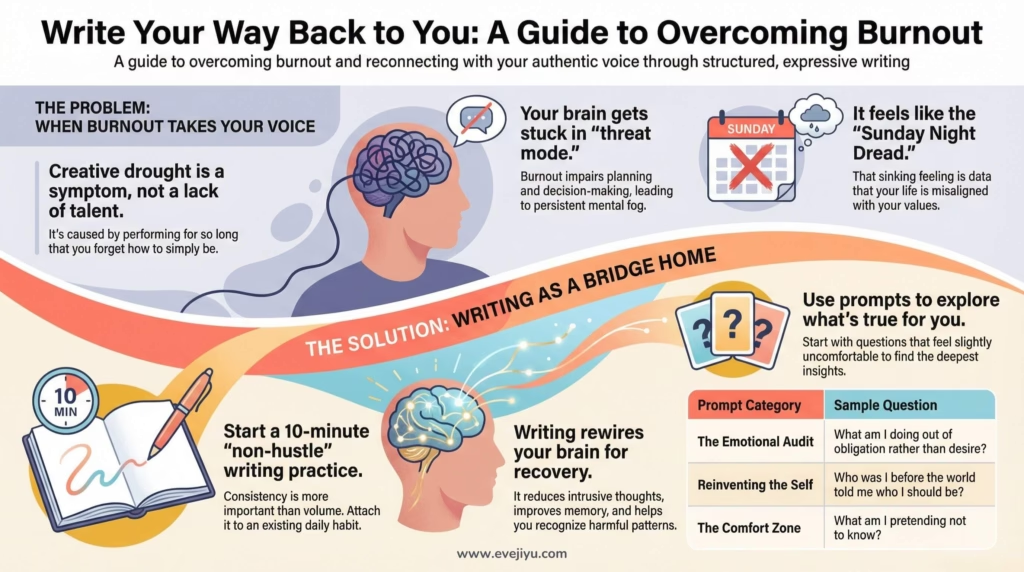
Writing isn’t just emotional catharsis. It’s a neurological intervention.
When you’re burned out, your nervous system is stuck in threat mode. Your prefrontal cortex, the part of your brain responsible for planning and decision-making, is essentially offline. You’re running on autopilot, which is why everything feels foggy and hard.
According to research published in the journal Advances in Psychiatric Treatment, expressive writing helps reduce the cognitive load of unprocessed experiences. When you externalize thoughts onto a page, you free up mental resources. Your brain doesn’t have to keep rehearsing the same worries on a loop.
The act of writing also activates the default mode network, the brain regions associated with self-reflection and memory consolidation. This is the same network that’s active when you’re daydreaming or taking a shower—the moments when insights tend to arrive.
But here’s what makes writing particularly powerful for burnout recovery: it creates pattern recognition over time.
When you write regularly, you start to see themes. You notice that every Tuesday you feel depleted, or that certain people consistently leave you feeling smaller. These patterns are invisible when you’re just living them day to day. Writing makes them visible.
And visibility is the first step toward change.
Creating a Sustainable Writing Practice
The word “practice” matters here. This isn’t about perfection. It’s about showing up.
The Non-Hustle Setup: Why 10 Minutes Is More Than Enough
You don’t need an hour of uninterrupted time in a candlelit room with the perfect playlist. You need 10 minutes and a willingness to be honest.
Pick a time that already exists in your day. Not a time you wish existed, but a time you actually have. For me, it’s first thing in the morning before I check my phone. For you, it might be during lunch, or right before bed, or in your car before you walk into work.
The ritual doesn’t need to be elaborate. Mine is: coffee, notebook, three pages of whatever comes out. Some days it’s brilliant. Most days it’s garbage. Both are practice.
Finding Your Flow: Creating Sacred Space
Your writing space doesn’t need to be a dedicated office with a view. It just needs to be yours.
This could be a corner of your couch with a specific blanket. A table at a coffee shop where nobody knows you. The passenger seat of your parked car. What matters is that when you’re in that space, you’ve given yourself permission to be unfiltered.
Three questions to find your flow:
- Where do I feel most like myself?
- When do I have the most mental clarity?
- What minimal setup makes writing feel less like a task and more like coming home?
Digital vs. Analog: Why Both Have a Place
There’s a cultural war between paper journal people and digital tool people. I’m here to say both are valid.
Pen and paper offer a slower pace, a tactile connection, and freedom from notifications. Digital tools offer searchability, portability, and for some people, a lower barrier to entry.
I use both. My morning pages go in a physical notebook because there’s something about the friction of pen on paper that slows my thoughts down enough to hear them. But when I’m processing something specific and want to track patterns over time, I use Reflection.app because I can search back through months of entries and see how my thinking has evolved.
The best tool is the one you’ll actually use.
More Questions to Write About When You’re Ready to Go Deeper
Here are the final prompts for when you’re ready to push past the comfortable answers.

On Identity and Becoming
- What old version of yourself are you still mourning?
- Who would you be if you stopped trying to be impressive?
- Write about the moment you realized you’d outgrown something you used to need.
- What parts of your current life would your younger self not recognize?
- Describe the woman you’re becoming. What does she prioritize?
On Visibility and Voice
- Where are you whispering when you should be speaking?
- What truth about yourself are you finally ready to own?
- Write about a time you made yourself small to make others comfortable.
- What would change if you believed your voice mattered?
- If you could send a message to everyone who ever made you doubt yourself, what would it say?
Finding Your Way Back to You
The things to write about are already inside you. The prompts are just keys to unlock doors you’ve been avoiding.
You don’t need to use all 85 of these prompts. You don’t need to write every day. You don’t need to produce anything polished or publishable.
You just need to tell yourself the truth.
Start with the prompt that made you feel the most uncomfortable. That discomfort is your compass. It’s pointing toward the thing you need to examine, the pattern you need to interrupt, the permission you need to give yourself.
Writing won’t fix everything. It won’t erase your burnout or solve your career crisis or repair damaged relationships.
But it will give you back your voice. And your voice is the thing you need most right now.
So spend five minutes today with one prompt. Write badly. Write honestly. Write like nobody is watching, because nobody is.
This is between you and the page.
Welcome home.
Frequently Asked Questions
What should I write about when I’m bored?
Boredom often signals that you’re avoiding something uncomfortable. Start with sensory prompts to ground yourself in the present moment. Describe what you see, hear, smell, touch. Then ask: what am I actually bored with? The answer is usually deeper than you think.
Try these cool things to write about: the architecture of your favorite building, a meal that felt like love, five things you want to learn just for fun, or an alternative timeline where you made a different choice.
Is journaling better on paper or digital?
Both work. Paper offers a tactile, slower pace with no distractions. Digital tools like Reflection.app offer searchability, portability, and the ability to track patterns over time. The best choice is whichever medium you’ll actually use consistently. Many people use both for different purposes. (Note: the Reflection.app link gives you 40% off annual premium.)
How do I overcome the fear of a blank page?
Start with lists. Lists require no narrative structure, no perfect sentences, no transitions. Just write: “Five things I noticed today” or “Three things that frustrated me” or “One thing I want.”
Lists bypass your inner critic because they feel low-stakes. Once you’ve filled half a page with lists, the blank page isn’t blank anymore, and the fear loosens its grip.
What are good questions to write about for self-discovery?
The best questions to write about are the ones that make you slightly uncomfortable. Try: “If I didn’t have to be useful today, who would I be?” or “What parts of myself did I abandon to become acceptable?” or “Where am I saying yes when my body is screaming no?”
These questions to write about push past surface-level answers and get to the truth underneath.
How long should I write each day?
Ten minutes is enough. The goal is consistency, not volume. Writing three honest sentences every day will give you more insight than writing ten pages once a month.
Don’t let perfectionism keep you from starting. If ten minutes feels like too much, start with five. If five feels like too much, start with two. The practice is in the showing up, not the length of time.
Want weekly support for your writing practice and more reflective prompts? Subscribe to my newsletter for grounded guidance on self-discovery and creative voice recovery.
A Note on Tools and Transparency
Throughout this article, I’ve mentioned Reflection.app as a digital journaling option. Full transparency: this is an affiliate link, which means if you subscribe, I receive a small commission at no extra cost to you.
I only recommend tools I actually use and believe in. Reflection.app has genuinely helped me track patterns in my writing over time, and if you use my link, you’ll get 40% off an annual premium subscription.
You don’t need any paid tool to benefit from these prompts. Pen and paper work beautifully. But if you’re drawn to a digital option with search functionality and privacy features, the discount is there.
⬇⬇⬇Pin or save to read later ⬇⬇⬇




0 Comments