
In This Article

Ready for inner change? Use these 50 powerful shadow work journal prompts for beginners. Grounded, non-hype guide for women seeking deep self-discovery, emotional healing, and burnout recovery.
You’ve done the vision boards. You’ve written gratitude lists. You’ve tried positive affirmations in the mirror. And still, the same argument surfaces with your partner. The same Sunday dread settles in your chest. The same self-sabotage shows up right when things start going well.
This isn’t failure. This is your shadow knocking.
Shadow work journal prompts for beginners offer a structured path into the parts of yourself you’ve learned to ignore, dismiss, or hide. Rooted in Carl Jung’s concept of the shadow self, this practice isn’t about finding a monster lurking in your psyche. It’s about reclaiming the energy you’ve spent keeping certain parts of yourself locked away.
This guide provides 50 foundational shadow work prompts organized into five core categories. Each prompt is designed to help you witness, understand, and integrate the disowned aspects of your personality. No spiritual bypassing. No toxic positivity. Just honest, reflective questions that meet you where you are.
What Shadow Work Actually Is (And What It Isn’t)
Before diving into the shadow work journaling prompts, let’s establish what this practice actually involves.
The Shadow Self: A Brief Foundation
Swiss psychiatrist Carl Jung introduced the concept of the shadow as the unconscious aspects of personality that the conscious ego doesn’t identify with. These aren’t just negative traits. Your shadow also contains disowned positive qualities like confidence, creativity, or ambition that you learned weren’t safe to express.
Research in Jungian psychology, such as RJ Starr’s 2023 paper “Shadow, Self, and Regulation: A Jungian Contribution to Emotional Intelligence Theory,” links shadow integration to enhanced emotional regulation by confronting unconscious material. This process fosters greater self-awareness and maturity, addressing root causes of emotional dysfunction. Practices like journaling help bring these shadow elements into conscious awareness, diminishing their hidden influence over behavior.
What Shadow Work Is Not
Shadow work isn’t:
- A punishment for being imperfect
- An excuse for harmful behavior
- A way to bypass accountability
- A quick fix for deep trauma (therapy is essential for that)
Shadow work is integration, not perfection. You’re not trying to eliminate parts of yourself. You’re learning to understand them, meet their needs responsibly, and stop letting them drive your choices unconsciously.
The Journaling Process for Integration
Effective shadow work journaling involves three steps:
- Non-judgmental witnessing. Write what comes up without editing or censoring. Observe the feeling without trying to fix it immediately.
- Identifying the underlying need. Ask: What does this shadow part want? What is it trying to protect me from?
- Seeking partnership. Ask: How can I responsibly meet that need without letting the shadow take over? For example, if your shadow expresses as “laziness,” the underlying need might be rest. Partnership means scheduling genuine downtime instead of collapsing in burnout.
How to Use These Shadow Work Prompts for Beginners
These 50 journal prompts for shadow work are organized into five categories, each addressing a different aspect of shadow integration. You don’t need to complete them in order. Start with the category that feels most relevant to your current life situation.
Guidelines for Safe Shadow Work Journaling
Create a contained space. Set a timer for 15-20 minutes. This prevents you from spiraling and gives your nervous system a clear endpoint.
Write by hand if possible. The physical act of writing engages different neural pathways than typing and often accesses deeper material. If you prefer digital journaling, I’ve been exploring the Reflection app — it’s designed to help you track thoughts, notice patterns, and process emotions over time. Using a tool like this can make shadow work more consistent and insightful.
Don’t force it. If a prompt brings up intense emotions you’re not ready to process, skip it. Come back when you feel more resourced.
Consider professional support. If you’re working with trauma, a therapist trained in depth psychology can help you navigate this work safely.
Reflective Questions to Guide Your Practice
Before you begin, consider:
- What patterns keep repeating in my life despite my best efforts to change?
- What qualities do I judge most harshly in others?
- What emotions am I most uncomfortable feeling?
- What version of myself did I decide was unacceptable, and when did I decide that?
Category 1: The Mirror and Projection (Prompts 1-10)
Projection is one of the clearest paths to your shadow. What you judge, envy, or feel disproportionately irritated by in others often reveals what you’ve disowned in yourself.
Shadow Work Prompts for Recognizing Projection
1. Describe the last person who triggered an intense wave of anger or irritation in you. What quality do they possess that you feel forbidden to express yourself?
2. What life circumstance in another person do you constantly find yourself pitying or judging? Why does their perceived lack make you feel superior or anxious?
3. Who is a public or private figure you admire but secretly resent? What power or freedom do they hold that you wish you could claim?
4. Think of someone you consider “too much” in some way (too loud, too emotional, too ambitious). What would happen if you allowed yourself to be “too much” in that same way?
5. What trait do you pride yourself on NOT having (not selfish, not dramatic, not lazy)? How might this pride be costing you authentic self-expression?
6. Describe a time you felt envious of someone’s success. What specific aspect of their achievement felt like something that should have been yours?
7. What type of person makes you think, “I could never be like that”? What fear or belief stops you from exploring that possibility?
8. Who in your life do you view as having it easy? What does this judgment protect you from acknowledging about your own choices?
9. What quality do you immediately notice and criticize in new people you meet? How might you be policing that same quality in yourself?
10. Think of someone whose confidence irritates you. What would it mean for your self-concept if you allowed yourself to be equally confident?
Exercise: The Projection Journal Entry
Choose one person from your responses above. Write a letter to them explaining exactly what bothers you about their behavior. Don’t send it. Now reread the letter and replace “you” with “I.” Notice what shifts.
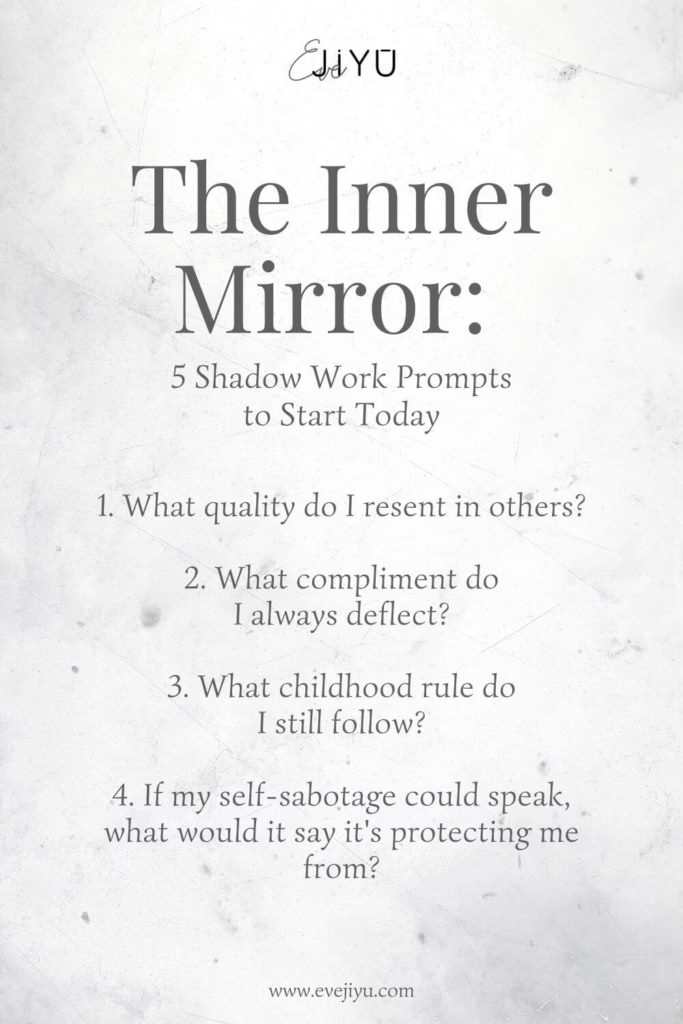
Category 2: The Inner Critic and Disowned Strengths (Prompts 11-20)
Your inner critic isn’t just mean. It’s strategic. It attacks the parts of you that threaten your outdated self-concept or the approval you learned to rely on.
Shadow Work Journal Prompts for Inner Critic Awareness
11. List the five most common negative labels your inner critic uses. For each, rewrite it as a statement of unacknowledged potential. (“Too sensitive” becomes “Deeply empathetic and perceptive.”)
12. What compliment do you habitually deflect? What responsibility would you have to accept if you owned that strength?
13. Write about a time you achieved something and immediately minimized it. What past voice told you that you weren’t allowed to be successful?
14. What positive quality do you express only in private or when you think no one is watching? What fear keeps it hidden?
15. Describe the voice of your inner critic in detail. Whose actual voice does it sound like? What does that tell you?
16. What dream or goal have you dismissed as “unrealistic” or “not for people like me”? Who first taught you that limitation?
17. When was the last time you felt proud of yourself without immediately thinking of what you should have done better? What made that moment different?
18. What talent or skill do you downplay because claiming it would make you seem arrogant? How has this served you, and how has it held you back?
19. Write about a moment when someone saw potential in you that you couldn’t see in yourself. Why couldn’t you see it?
20. What would your life look like if you stopped pre-emptively criticizing yourself to avoid others’ criticism?
Reflective Questions for Integration
- What need was the inner critic trying to meet when it first developed?
- How old do I feel when the critic’s voice is loudest?
- What would I need to feel safe enough to quiet this voice?

Category 3: The Childhood Survival Self and Repression (Prompts 21-30)
The shadow often forms in childhood when we learn which parts of ourselves are acceptable and which must be hidden to stay safe, loved, or approved of.
Shadow Work Prompts for Beginners Exploring Early Patterns
21. What was the unspoken rule in your childhood home? (Don’t be too loud. Don’t show anger. Don’t need too much.) How did that rule show up in a choice you made this week?
22. Write about a time you hid a strong emotion from a caregiver. What were you afraid would happen if that emotion was seen?
23. What role did you assume in your family that you still struggle to let go of? (The peacemaker, the achiever, the invisible one.)
24. What did you learn about expressing needs in your family? How does that learning affect your relationships now?
25. Describe a moment when you realized you couldn’t be your full self at home. What part of you went underground that day?
26. What emotion was considered unacceptable or dangerous in your family? How do you still suppress that emotion today?
27. What did the adults in your life need you to be? How much of your current identity is built around meeting that need?
28. Write about a time you got in trouble for being yourself. What did you decide about yourself in that moment?
29. What qualities did you have as a child that you no longer express? What happened to make those qualities unsafe?
30. If you could go back and tell your younger self one truth that would have changed everything, what would it be?
Exercise: The Childhood Survival Map
Draw a simple family diagram. Next to each person, write the unspoken rule they taught you. Below your own name, write the survival strategy you developed. Now write one sentence about how that strategy no longer serves you.
I tried this exercise during my own journey of self-discovery and creative voice reclamation. I realized the “don’t take up space” rule I’d internalized from my family had followed me into every creative project. I’d learned to make myself small to keep the peace. That awareness alone began shifting my relationship with visibility.

Category 4: Triggers, Reactions, and the Emotional Shadow (Prompts 31-40)
Your triggers are breadcrumbs leading directly to unintegrated shadow material. Where you shut down, lash out, or retreat reveals where old wounds still run the show.
Shadow Work Journaling Prompts for Emotional Patterns
31. Describe a recent situation where you felt completely flooded by emotion. Where in your body did the feeling originate? What single thought preceded it?
32. What is the one thing your partner, friend, or boss can say that sends you into immediate defensive mode? What past belief about yourself does that trigger confirm?
33. Detail a time you withheld important truth or feedback to avoid conflict. What power did you give away in that moment?
34. What emotion makes you most uncomfortable when someone else expresses it? (Anger, sadness, vulnerability.) Why is witnessing that emotion unbearable?
35. Write about a time you had a reaction that felt disproportionate to the situation. What older wound was actually responding?
36. What do you do when you feel criticized? (Shut down, over-explain, attack back, disappear.) What is that pattern protecting?
37. Describe your relationship with anger. Do you express it, swallow it, or leak it sideways? What did you learn about anger growing up?
38. What boundary have you needed to set but haven’t because you’re afraid of the other person’s emotional reaction?
39. Write about a time you felt shame. What belief about yourself did that shame reinforce?
40. What emotion do you rush to fix in yourself or others? Why is sitting with that feeling so intolerable?
Reflective Questions for Emotional Integration
- What would change if I let myself fully feel this emotion instead of managing it?
- What is this reaction trying to tell me about an unmet need?
- Where in my body do I feel this trigger? What does that sensation want me to know?
Work summarized by the Greater Good Science Center at UC Berkeley shows that mindfulness-style emotional awareness and expressive writing can strengthen emotion regulation and support healthier relationships, in part by encouraging a present-moment, nonjudgmental awareness of feelings. These findings suggest that practices like shadow work journaling may help when they focus on noticing and accepting what arises, rather than immediately trying to change or fix it.

Category 5: The Unlived Life and Reclaiming Power (Prompts 41-50)
Perhaps the most painful shadow material lives here: the desires, passions, and versions of yourself you deemed too impractical, too selfish, or too risky to pursue.
Journal Prompts for Shadow Work on Reclaiming Desire
41. What passion did you give up because you decided it was impractical? What small action could you take this week to honor that desire?
42. If you could be unapologetically “too much” in one area of your life, what would that look like?
43. Write about your relationship with the word “power.” Do you seek it, fear it, or dismiss it? How would you define grounded power for yourself?
44. What version of your life did you abandon to meet someone else’s expectations? Describe that unlived life in detail.
45. What would you do today if you weren’t trying to stay small, likeable, or safe?
46. Describe the most selfish thing you could do right now. (Not harmful, just focused entirely on your needs.) Why does that feel dangerous?
47. What creative expression have you denied yourself because you’re “not good enough” or “too old” or “not the type”?
48. If you had permission to disappoint everyone for one day, what would you do?
49. What does your ideal life look like when you remove all the “shoulds” and expectations? Be specific and honest.
50. Write a letter from your future self 10 years from now. What does she want you to know about the choices you’re making today?
Exercise: The Unlived Life Visualization
Set a timer for 10 minutes. Close your eyes and visualize yourself living the life you truly want, not the life you think you should want. Write down every detail without censoring. This isn’t a plan. It’s data about your authentic desires.
This work connects directly to breaking free from feeling stuck. When you ignore your shadow’s desires, you create an internal split that manifests as chronic dissatisfaction, even when your life looks successful on paper.

Moving from Shadow to Wholeness
Shadow work journal prompts for beginners are not a one-time exercise. Integration is an ongoing practice of noticing, naming, and choosing differently.
- The Mirror and Projection. When you recognize what you judge in others often reflects what you’ve disowned in yourself, you stop giving your power to external triggers.
- The Inner Critic and Disowned Strengths. When you understand the critic’s protective function, you can develop a different relationship with it and reclaim buried gifts.
- The Childhood Survival Self. When you see how early patterns formed, you can choose whether they still serve you or whether it’s time to update your survival strategies.
- Triggers and Emotional Patterns. When you trace reactions back to their origins, you create space between stimulus and response. That space is where freedom lives.
- The Unlived Life. When you acknowledge what you’ve sacrificed for approval or safety, you can begin making choices aligned with your actual desires, not inherited expectations.
Integrating your shadow doesn’t make you perfect. It makes you whole. It gives you access to the full range of your humanity, including the parts you’ve spent years trying to hide or fix.
You’re not broken for having a shadow. You’re human. And the most resilient, authentic version of yourself lives on the other side of this integration work.
Begin Where You Are
Save these 50 shadow work prompts. Return to them when old patterns surface. Use them when you catch yourself in familiar loops of self-sabotage or people-pleasing.
Pick one prompt that resonates most right now. Set a timer for 15 minutes. Write without editing. Notice what comes up. That’s enough for today.
The shadow loses power the moment you stop running from it. You don’t need to fix everything at once. You just need to be willing to look.
What shadow pattern are you ready to acknowledge today? Share your reflections in the comments, or explore more grounded practices in my guide to self-reflection journaling.
✨ My Favorite Journaling Companion
Journaling has been the foundation of my self-growth and clarity. When I want guidance, prompts, or a way to process my thoughts deeply, I use Reflection — a private, AI-powered journaling app that keeps me consistent and helps me uncover insights I might otherwise miss.
If you’re ready to actually stick to your journaling practice and explore your inner world without pressure, you can get 40% off the annual premium for friends of Eve Jiyū → Start your Reflection trial
This is an affiliate link — at no extra cost to you, I may earn a small commission if you choose to sign up. Thank you for supporting free, honest content like this!
⬇⬇⬇Pin or save to read later ⬇⬇⬇












0 Comments