
You used to be the one who had it all together. The corporate woman who hit every deadline, the mother who remembered every permission slip, the friend who showed up for everyone. And somewhere along the way, you stopped showing up for yourself.
Now you’re running on empty. Going through the motions. Wondering why nothing feels like enough anymore.
That’s burnout. And it doesn’t announce itself loudly. It creeps in quietly, disguised as productivity, people-pleasing, and the relentless pressure to keep going. It looks like staying late because leaving feels selfish. It looks like saying yes when every part of you is screaming no. It looks like scrolling your phone at midnight because your brain won’t stop, even though your body gave out hours ago.
Journaling for burnout isn’t about writing pretty words in a beautiful notebook. It’s about creating a private space, maybe the only space in your entire day that belongs entirely to you, where you can be honest about how you’re really feeling without having to manage anyone else’s reaction to it.
This guide is for the woman who has tried to push through and can’t anymore. The executive who cries in her car before walking into the office. The mother who loves her children deeply but has lost herself completely. The woman who has slowly withdrawn from her social life because she simply has nothing left to give.
Research by psychologist James Pennebaker at the University of Texas has established over decades that expressive writing supports emotional processing and wellbeing. And neuroscientist Matthew Lieberman at UCLA has shown that simply naming your emotions in words can reduce their intensity. You don’t need to take a course or read a self-help library.
You just need to start. I truly believe you just need five minutes and a willingness to be honest with yourself.
So, in this step-by-step guide, you’ll learn exactly how to begin journaling when you’re burned out, including what to write when you have no words, how to move from venting to genuine insight, and how to use your journal as a tool for rebuilding your life.
Step 1: Create a Container Before You Write a Single Word
Before you open a notebook or a blank document, there’s something more important than what you write: where and when you write it. For burned-out women, especially those whose time is constantly interrupted or claimed by someone else, environment and intention matter more than the journal itself.
First, choose your format. There’s no right answer here. A physical notebook offers something tactile and private, a space that exists completely offline and away from notifications. A daily journal Notion template can work beautifully for corporate women who are already living inside their laptops and don’t want to add another object to carry. What matters is that the format feels accessible, not aspirational.
Next, set a micro-commitment. Not an hour, five to ten minutes, at the same time each day, is enough to begin. Think about when a small pocket of time actually exists in your life right now. Before the house wakes up. During your lunch break, sitting in your car. After the kids are in bed and the kitchen is finally quiet. Pick one slot and protect it, not because you’re adding another task to your list, but because you’re carving out the one moment in your day that isn’t for anyone else.
Then create a simple ritual that signals to your nervous system: this time is mine. It doesn’t need to be elaborate. A specific cup of tea. Closing your office door. Putting your phone face-down on the table. These small gestures are more powerful than they sound. They tell your body it’s safe to stop performing for a few minutes.
A note for corporate women: If you’re used to scheduling everything in thirty-minute blocks, treat this the same way. Block it in your calendar. Name it something that won’t invite questions if someone sees your schedule.
A note for mothers: The idea of “consistent time” may feel laughable right now. That’s okay. Choose a time that’s most likely, not guaranteed. Most likely is enough to begin.
The most common pitfall at this stage is waiting until you feel ready or inspired. Burnout specifically kills motivation. It’s designed to. So lower the bar deliberately. You’re not waiting for the perfect conditions. You’re creating the minimum viable ones.
Success indicator: You’ve identified one consistent time slot and one physical or digital space that feels, even slightly, like yours.
Step 2: Start With What’s True, Not What Sounds Good
I believe the biggest mistake burned-out women make when they first start journaling is that they try to do it correctly. They write things that sound reflective, or hopeful, or at least acceptable. And in doing so, they create yet another performance, this time for an audience of one.
If this pattern of performing even for yourself feels familiar, understanding how to stop performing in relationships can shed light on why it runs so deep.
When you’re exhausted and depleted, the last thing you need is another standard to meet. So this step asks you to do the opposite of what feels safe: write what’s actually true.
Start with a brain dump. Set a timer for five minutes and write whatever is actually in your head, uncensored. Complaints belong here. Resentments belong here. Numbness belongs here. The petty thought you had about a colleague.
The irrational irritation you felt at your child for asking a completely reasonable question. The hollow feeling that followed something that was supposed to make you happy. All of it belongs on the page.
If you need a starting point, try these prompts designed specifically for women in burnout:
“Right now I feel…” Don’t edit. Don’t qualify. Don’t add “but I know I should be grateful.” Just finish the sentence with what’s real.
“What I haven’t said out loud is…” This one tends to unlock something. The things we haven’t said out loud are often the things most urgently needing to be acknowledged.
“The thing draining me most today is…” Specific and honest. Name it directly.
For mothers specifically: give yourself permission to write about the parts of motherhood that are hard, without guilt. The journal won’t judge you. It won’t report back. It won’t need you to reassure it afterward. You can love your children completely and still be exhausted by the relentlessness of caring for them. Both things are true, and both belong on the page.
For corporate women: you can write about the meeting that made you feel invisible, the promotion that felt hollow, the Sunday dread that starts creeping in around 4pm. This isn’t unprofessional. It’s honest. And honest is the only thing that actually helps.
For women who have been withdrawing from their social lives: “I’ve been avoiding people because…” is a valid and important starting point. Social withdrawal is one of the most underreported symptoms of burnout. Many women interpret it as a personality shift rather than a signal that their system is depleted. Writing about it, even without resolution, begins to bring it into focus.
Success indicator: You finish a session feeling slightly lighter, even if what you wrote was heavy. That release is real. It’s not nothing. It’s actually the whole point of this step.
Step 3: Move From Venting to Noticing Patterns
Venting is necessary. It’s valid. It’s often the most honest thing you’ll do all day. But the real power of journaling for burnout isn’t in the release alone. It’s in what you begin to see after the release, when you look back at what you’ve written over time.
After one to two weeks of honest writing, it’s time to shift from expression to observation. Start asking yourself: what keeps coming up? Who or what appears in my writing most often? What emotions am I describing repeatedly, even when the specific situation changes?
Think of this as an energy audit through journaling. Go back through your entries and notice what consistently drains you versus what occasionally restores you. You’re not analyzing yourself clinically. You’re just paying attention to the signals your own words have been sending.
A practical exercise: read back through your entries and circle or highlight words that appear across multiple sessions. If “invisible,” “exhausted,” “resentful,” or “alone” show up again and again, those aren’t coincidences. They’re patterns. And patterns are information. For women who recognize these feelings as something deeper, exploring burnout recovery for women in their 30s can offer a broader framework for what you’re moving through.
For corporate women, this step often reveals something important: it’s frequently not the workload itself that’s causing burnout. It’s the lack of autonomy, the absence of recognition, or the growing gap between your values and the culture you’re working inside. The workload is what you can see. The misalignment is what the patterns will show you.
For mothers, patterns often reveal that burnout spikes around specific times, specific people, or specific categories of invisible labor that go completely unacknowledged. The mental load of managing a household, anticipating everyone’s needs, and holding the family’s emotional temperature is exhausting in a way that’s hard to articulate in the moment. But over two weeks of honest writing, it becomes impossible to ignore.
This step also connects to shadow work, the practice of looking at what you keep writing around rather than directly at. If there’s a topic you keep approaching and then backing away from in your entries, that avoidance is worth noticing. The things we can’t quite bring ourselves to write directly are often the most important things we need to see.
Success indicator: You can name at least one specific pattern or recurring theme in your writing. One is enough. One is actually significant.
Step 4: Ask the Questions That Actually Go Somewhere
Generic journaling prompts often feel hollow when you’re burned out. “What are three things you’re grateful for?” can feel almost insulting when you’re running on fumes. This step is about using prompts that are specifically designed to move you, not past your feelings, but deeper into them.
These are the questions that tend to go somewhere real:
“What did I used to love that I’ve completely abandoned?” Burnout has a way of quietly dismantling the things that once made you feel like yourself. Hobbies. Creative pursuits. Friendships that required energy you no longer had. This question begins to map what’s been lost.
“What would I do differently if I wasn’t afraid of disappointing someone?” For women who have built their lives around meeting other people’s expectations, this one can be genuinely confronting. Stay with whatever comes up.
“What am I pretending is fine?” You probably already know the answer. This prompt just gives you permission to write it down.
As you work with these prompts, you’ll likely notice two distinct voices in your writing. One is the inner critic, the voice that tells you you’re not doing enough, that you should be further along, that other people manage just fine. Burnout tends to amplify this voice.
Working through overcoming a negative self-image can help you understand where that inner critic comes from and how to quiet it. The other is your inner knowing, quieter, slower, less dramatic, but far more trustworthy. Journaling creates the conditions for that quieter voice to become audible.
For women who have been stepping back from socializing, this prompt is worth sitting with honestly: “Am I withdrawing to rest, or withdrawing to hide?” Both are valid responses to depletion, but they call for different things. Rest is temporary and restorative. Hiding can become isolating in ways that deepen burnout over time. You don’t need to solve this in one session. You just need to be honest about which one it is.
For corporate women experiencing imposter syndrome alongside burnout, try this: “What would I believe about myself if my job title disappeared tomorrow?” This question has a way of separating who you are from what you produce, which is exactly the kind of clarity burnout recovery requires. If this question stirs something significant, shadow work prompts for beginners offer a gentle way to go deeper into what’s underneath.
One important caution: don’t use this step to intellectualize your feelings. It’s tempting, especially for high-achieving women, to turn emotional experience into an analysis project. If a prompt brings up emotion, stay with the emotion first. Write it out before you try to understand it.
Success indicator: At least one prompt produces a response that surprises you, or feels uncomfortably honest. That discomfort is not a sign you’ve done something wrong. It’s a sign you’ve finally touched something real.
Step 5: Use Your Journal to Rebuild, Not Just Recover
Recovery from burnout without intentional rebuilding often leads back to the same patterns. You rest, you recover enough to function, and then you return to the exact conditions that depleted you in the first place. This step is about using journaling to begin designing something different, not a fantasy, but a life that actually fits who you are now.
Start with forward-facing prompts that invite you to think beyond survival:
“What does a life that doesn’t burn me out actually look like?” Be specific. Not “less stress” but what, concretely, would need to be different. What would your mornings look like? What would you stop doing? What would you finally allow yourself to start?
“What boundaries have I been afraid to name, let alone hold?” Many burned-out women know exactly where their boundaries have been violated. They’ve just never written it down, which means it’s never quite become real enough to act on.
“What kind of woman do I want to be when I’m not in survival mode?” This question creates distance from the version of yourself that burnout has created and invites you to remember, or discover, who you actually are underneath it.
For mothers, rebuilding might mean reclaiming one small thing that belongs only to you. One small thing: a morning walk without your phone, a creative practice that has nothing to do with productivity, thirty minutes a week that no one else has a claim on. Journaling can help you identify what that thing is, because it’s often something you’ve buried so deeply under obligation that you’ve forgotten it exists.
For corporate women, rebuilding might mean getting genuinely honest about whether this career, this company, or this version of success still fits who you’re becoming. If you’re sensing that something fundamental needs to change, how to start over in your 30s is a question worth sitting with honestly. That’s a significant question, and you don’t have to answer it in one session. But you do need to ask it.
This is also where values clarification becomes useful. Burnout often signals a misalignment between how you’re living and what you actually value. When your days are structured entirely around what others need from you, your own values become invisible. Journaling can surface them again.
Try this practical exercise: write your ideal ordinary day in full detail. Not a vacation, but a realistic, ordinary day that would feel genuinely good to live. What time do you wake up? What do you eat? What work feels meaningful? What does your evening look like? Then look at what’s missing from your current life. The gap between those two days is your rebuilding map.
Success indicator: You’ve written at least one concrete thing you want to change, protect, or reclaim. It doesn’t have to be big. Small is exactly right.
Step 6: Build a Sustainable Practice That Grows With You
Burnout recovery is not linear. There will be weeks when journaling feels like a lifeline and weeks when you can’t bring yourself to open the page at all. Your practice needs to be flexible enough to survive the hard weeks, not just the motivated ones.
This is where the minimum viable journal entry becomes essential. On the days when you have nothing, write one sentence. “Today I felt exhausted and couldn’t explain why.” That counts. It keeps the thread alive. It tells the part of you that’s watching that you haven’t abandoned the practice, or yourself.
It’s also completely normal to journal consistently for two weeks and then stop entirely. This happens to almost everyone, and it doesn’t mean you’ve failed. It means you’re human, and that burnout is still in the room. When you’re ready to return, you don’t need to catch up or explain the gap. Just open the page and write today’s date. That’s the whole restart.
To prevent the practice from feeling stale, rotate between different formats:
- Free writing: just whatever comes out. Good for days when you need to decompress.
- Prompted journaling: Structured questions that direct your thinking. Good for days when the blank page feels paralyzing. Exploring structured prompts versus flexible self-reflection can help you figure out which approach suits you best on any given day.
- Emotional honesty check-ins: A simple scan of how you’re actually feeling, without trying to fix or explain it. Good for busy days when you only have three minutes.
- Reflective reading: Go back and read previous entries. Notice what’s changed, what hasn’t, what you’ve learned. Good for the end of a difficult week.
For women with inconsistent schedules, whether you’re a mother navigating school holidays or a corporate woman traveling for work, keep a small notebook in your bag or a private note on your phone. Accessibility matters more than aesthetics. The beautiful journal you keep at home doesn’t help you on a Tuesday afternoon when you’re sitting in an airport feeling completely undone.
One final and important note: journaling is a powerful self-reflection tool, but it’s not a clinical intervention. If your entries consistently reveal deep distress, patterns you can’t move through, or feelings that frighten you, professional support is the appropriate next step. Journaling can sit alongside therapy beautifully. It is not a replacement for it. And as your practice deepens, self-worth exercises for women can complement what you’re uncovering on the page with gentle, practical steps toward rebuilding your sense of self.
The goal of this practice isn’t perfection. It’s an ongoing relationship with yourself that you keep choosing, imperfectly, inconsistently, and with increasing honesty over time.
Success indicator: After thirty days, you know more about yourself than you did before. And that knowledge is beginning to inform small choices, in how you spend your time, what you say yes to, and what you finally allow yourself to say no to.
Putting It All Together: You Are Worth Coming Back To
Burnout tells you that you’re not enough. Journaling quietly argues otherwise, one honest sentence at a time.
You started this guide as a woman running on empty. If you follow these steps, you’ll end it with something that burnout tried to take from you: a relationship with yourself. Not a perfect one. Not a fully healed one, necessarily. But a real one.
Here’s your simple starting checklist to return to whenever you need it:
- Choose your format and one consistent time slot.
- Write one honest brain dump entry without editing yourself
- After one week, read back and notice what keeps appearing
- Try one prompt that makes you slightly uncomfortable
- Write your ideal ordinary day in full detail
- Commit to the minimum viable entry on hard days
You don’t have to overhaul your life this week. You just have to open the page.
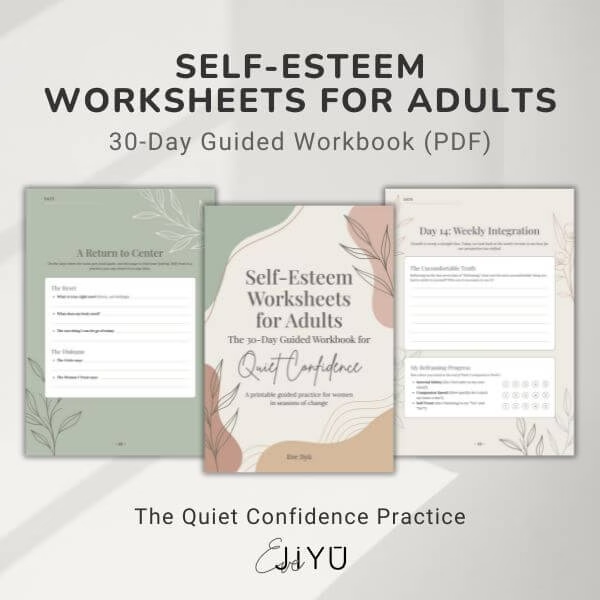
If you’re not sure where to start with prompts, Ive put a curated list of resources and solutions that all of us women will find helpful. Feel free to check them out.
You are strong! Stay at it 🙂






0 Comments