
Many women start journaling with the best intentions: a fresh notebook, a new app, a quiet promise to show up every morning.
But without a structure that feels both gentle and intentional, the habit quietly fades. Life gets busy, the blank page feels heavy, and somehow another week passes without a single entry.
That’s where a daily journal Notion template comes in, not as another productivity hack, but as a living, breathing digital space designed around your emotional rhythms.
Notion’s flexibility makes it uniquely suited for self-reflection because you can shape it around how you actually think and feel, rather than forcing yourself into someone else’s rigid format.
But a blank Notion page can feel just as overwhelming as a blank notebook. The key isn’t just having a template. It’s building one that invites you back each day, holds space for your messiest thoughts, and grows alongside you.
These seven strategies will help you design a daily journal Notion template rooted in self-awareness, emotional honesty, and sustainable practice.
Whether you’re navigating burnout, exploring shadow work, or simply trying to reconnect with yourself, there’s a way to build a digital journaling space that actually feels like home.
1. Design Your Template Around Emotional Check-Ins, Not To-Do Lists
The Challenge It Solves
Most productivity-focused templates quietly pull your journaling practice toward output: tasks completed, goals tracked, habits ticked off.
If you’ve ever opened your journal and found yourself writing a to-do list instead of actually checking in with yourself, you know how easily this happens.
The structure shapes the experience, and a productivity-first structure will always prioritize doing over being.
The Strategy Explained
The foundation of a meaningful daily journal Notion template is replacing output-focused fields with properties that reflect your inner landscape.
Think of the top of your daily entry as an emotional weather report: not what you accomplished, but how you actually arrived at the page today.
In Notion, you can create a simple database with select or multi-select properties for mood, energy level, and emotional tone.
Options might include words like “heavy,” “tender,” “restless,” “open,” or “numb” rather than numerical scales, which can feel clinical. You can also add a short free-text field for a one-sentence “arrival note,” a single honest line about where you are before you begin writing.
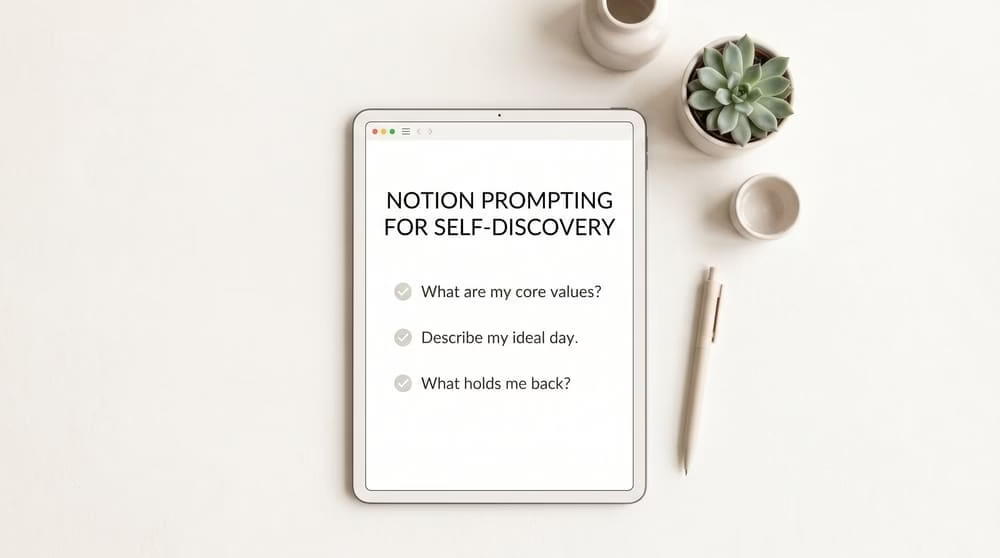
If you’re new to this kind of reflective practice, a dedicated Notion journaling template can give you a strong starting framework.
This small shift changes everything. When your template opens with “How are you feeling right now?” rather than “What are your priorities today?”, you’re already practicing self-awareness before you’ve written a single word.
Implementation Steps
- Create a new Notion database titled “Daily Journal” and set the entry type to “Page” so each day opens into a full writing space.
- Add a “Mood” property using the Select type with emotionally descriptive options rather than emoji-only or numerical scales.
- Add an “Energy” property with gentle options like “depleted,” “low,” “steady,” “energized” to capture your physical and emotional reserves.
- Add a short “Arrival Note” text property as the very first thing you fill in each day, before opening the full page entry.
Pro Tips
Resist the urge to add too many check-in properties at first. Three fields, mood, energy, and one sentence, is enough to make the emotional check-in feel meaningful without becoming a form to fill out.
You can always add nuance later. The goal is to make arriving at your journal feel like a soft landing, not an intake questionnaire.
2. Embed Rotating Journal Prompts That Invite Depth
The Challenge It Solves
The blank page is one of the most common reasons journaling habits fall apart. Even when you genuinely want to reflect, staring at an empty text block with no direction can trigger a kind of mental freeze.
You end up writing “I don’t know what to write” and closing the tab. A thoughtful prompt system removes that friction entirely and, more importantly, guides you toward the kind of reflection that actually creates change.
The Strategy Explained
Notion’s database features make it possible to build a rotating prompt library that feeds directly into your daily journal template.
The idea is to create a separate “Prompts” database with entries organized by category: self-love, shadow work, self-discovery, body awareness, creativity, and inner child work, for example.
Each prompt entry gets a “Category” tag and a “Used” checkbox. You can then create a filtered view in your daily template that surfaces one or two unused prompts from a chosen category each day.
Once you engage with a prompt, you check it off, and the next session serves you something fresh. For a curated collection to get you started, explore these journal prompts for self love that pair beautifully with a Notion-based system.
This approach means you never face a blank page, and your prompts gradually deepen over time as you work through surface-level questions and move toward more vulnerable territory.
Implementation Steps
- Create a new Notion database called “Journal Prompts” with a “Category” select property and a “Used” checkbox property.
- Populate it with prompts across at least three categories to start, self-love, shadow work, and self-discovery are a strong foundation.
- In your daily journal template, add a linked database view filtered to show only unused prompts from one category, sorted randomly or by date added.
- Each day, read the surfaced prompt, write freely in response, and check the “Used” box when you’re done.
Pro Tips
Don’t feel obligated to answer every prompt fully. Sometimes a single sentence in response to a difficult question is more honest than a full page of circling around it.
The prompt is an invitation, not an assignment. Give yourself full permission to write “I’m not ready for this one yet” and move on.
3. Create a Weekly Reflection View to Spot Emotional Patterns
The Challenge It Solves
Daily journaling captures moments, but it can be easy to miss the larger emotional story unfolding across days and weeks.
If you’ve ever felt like you’re writing the same anxious entry over and over without understanding why, you’re experiencing the limitation of isolated daily reflection. Pattern recognition requires a wider lens, and most journaling systems don’t provide one.
The Strategy Explained
Because your daily entries live in a Notion database, you can create filtered gallery or table views that let you step back and read your emotional landscape across time.
A weekly reflection view groups your entries by the current week, surfacing your mood check-ins, energy levels, and key themes side by side.
This is where journaling transforms from venting into genuine self-awareness. When you can see that your energy was “depleted” four out of seven days, or that a particular mood tag appeared every time you skipped a certain boundary, you start to understand your patterns rather than just experiencing them. Building a regular self care Sunday ritual around this weekly review can make the practice feel nourishing rather than analytical.
You can also create a dedicated “Weekly Review” page template that pulls from your daily entries and includes a few reflection questions:
- What emotional theme kept returning this week?
- What did I need that I didn’t ask for?
- What moment felt most like myself?
Implementation Steps
- In your Daily Journal database, create a new “Gallery” or “Table” view filtered to show only entries from the current week using Notion’s date filter options.
- Set the view to display your Mood and Energy properties as visible card properties so you can scan them at a glance.
- Create a separate “Weekly Review” page template with three to five reflection questions that you complete each Sunday or Monday.
- Link this weekly review page to your daily journal database so you can reference specific entries while writing your reflection.
Pro Tips
Try to approach your weekly view with curiosity rather than judgment. You’re not auditing your emotional performance, you’re reading your own story with compassion. If you notice a difficult pattern, let the observation be enough for now. Understanding comes before changing, and gentleness is the whole point.
4. Build a Shadow Work Section With Intentional Boundaries
The Challenge It Solves
Shadow work, the practice of exploring the unconscious parts of yourself, drawing from Carl Jung’s framework of integrating hidden aspects of the psyche, is some of the most powerful inner work available through journaling.
It’s also some of the most vulnerable. Without a sense of containment, diving into shadow material can feel destabilizing rather than healing. Many women avoid it entirely because it feels too big, too dark, or too unstructured to approach safely.
The Strategy Explained
The solution isn’t to avoid shadow work in your journal, it’s to give it its own designated, bounded space.
In Notion, you can create a toggle block within your daily template labeled something like “Deeper Space” or “Shadow Work” that stays visually collapsed unless you actively choose to open it.
This toggle acts as a psychological threshold. Opening it signals to yourself that you’re choosing to go deeper, and closing it afterward creates a sense of completion and containment.
Inside the toggle, you can include a brief grounding reminder (“You are safe. You can close this at any time.”), a structured prompt format, and a “closing ritual” note to help you transition back out of the deeper material.
If you’re new to this territory, these shadow work prompts for beginners offer a gentle starting point before building your own.
The structure inside the shadow work section might include: what I noticed, what it might be protecting, what I want to offer that part of myself.
This format, inspired by parts-based and somatic approaches to inner work, provides enough scaffolding to feel safe without being rigid.
Implementation Steps
- In your daily journal page template, add a toggle block near the bottom of the entry and label it with a gentle, non-alarming title that resonates with you.
- Inside the toggle, add a brief grounding statement at the top, a reminder that you’re in control of how deep you go.
- Add a simple three-part structure: what I noticed, what it might be protecting, what I want to offer this part of myself.
- End the toggle content with a short closing ritual note, such as “Take three breaths. You’ve done good work. Close this when you’re ready.”
Pro Tips
Not every day needs shadow work. The toggle being there doesn’t mean it must be opened. Some days, a gentle check-in and a light prompt is exactly the right depth.
The shadow work section is an invitation, not an obligation, and knowing it’s there, waiting without pressure, is often enough to make the practice feel approachable over time.
5. Add a Sensory and Body Awareness Block
The Challenge It Solves
Journaling that lives entirely in the mind can inadvertently reinforce the same thought loops you’re trying to understand.
If you’ve ever written pages of analysis about why you feel a certain way and still felt no relief, you’ve encountered this ceiling. Emotional experiences aren’t only stored in thoughts, they’re held in the body, and somatic therapy principles emphasize that accessing the body is often the fastest route to genuine emotional processing.
The Strategy Explained
Adding a brief body awareness block to your daily journal template bridges the gap between mental reflection and physical presence.
This doesn’t need to be elaborate. A simple body scan section, just a few guided questions or prompts that direct attention downward, out of the head and into physical sensation, can shift the entire quality of your journaling session.
In your Notion template, this block can appear near the top of the entry, right after your emotional check-in, before you begin writing freely.
You might include questions like: “Where do you feel today’s emotion in your body?” or “What is your body asking for right now?” or simply a note that says “Take one slow breath and notice what you feel physically before you begin.”
Pairing this with mindful activities throughout your day can deepen the connection between body awareness and your writing practice.
This grounding step is especially valuable for women navigating burnout, anxiety, or dissociation, where the mind and body can feel disconnected.
Even thirty seconds of body awareness before journaling can make the writing that follows feel more honest and more anchored.
Implementation Steps
- Add a clearly labeled “Body Check-In” section to your daily template, positioned between your emotional check-in properties and your main writing space.
- Include two or three short body-awareness prompts as static text in the template, questions that appear every day and invite you to pause before writing.
- Add a small free-text field or callout block where you can write one to three sentences in response to the body scan before moving into your main entry.
- Keep this section visually simple and uncluttered so it feels like a breath of space, not another box to fill.
Pro Tips
If body-based awareness is new or uncomfortable for you, start with the simplest possible version: one question, one sentence of response.
You don’t need to understand somatic work deeply to benefit from pausing and noticing where tension lives in your shoulders or how your breath feels before you write. Small moments of embodied awareness add up significantly over time.
6. Use Linked Databases to Connect Your Journal to Bigger Growth Goals
The Challenge It Solves
Daily journaling can sometimes feel like it exists in a bubble: meaningful in the moment but disconnected from the larger arc of your healing or growth.
You might write beautifully about wanting to set better boundaries, but without any thread connecting that insight to a broader intention you’re holding, the reflection can feel like it disappears into the past.
The gap between daily reflection and longer-term growth is one of the quieter frustrations of journaling practice.
The Strategy Explained
Notion’s relation properties allow you to link your daily journal entries to a separate Growth Goals or Intentions database, creating a gentle, visible thread between your day-to-day inner work and the bigger picture of who you’re becoming.
This isn’t all about tracking performance or measuring progress in a productivity sense. It’s also about creating coherence: a sense that your daily reflections are contributing to something meaningful over time.
Your Growth Goals database might hold intentions like “learning to rest without guilt,” “exploring my relationship with creativity,” or “understanding my anger more honestly.”
When a journal entry touches on one of these themes, you can link it with a single click. Over time, each intention accumulates a collection of related entries, creating a rich, searchable archive of your inner work on that particular thread.
For deeper guidance on structuring this kind of intentional growth, explore how to work on yourself in ways that complement your journaling practice.
This linked structure also makes it easier to revisit growth areas during your weekly review, noticing which intentions are receiving attention and which might need more care.
Implementation Steps
- Create a separate Notion database called “Growth Intentions” or “Healing Threads” with a simple structure: intention name, category, and date set.
- In your Daily Journal database, add a Relation property that links to your Growth Intentions database.
- At the end of each journal entry, take a moment to ask: “Which of my intentions did today’s reflection touch?” and link accordingly, or leave it blank if nothing fits.
- In your Growth Intentions database, create a view that shows all linked journal entries for each intention, so you can read the full history of your work on any given theme.
Pro Tips
Keep your Growth Intentions database small and honest. Three to five active intentions at a time is plenty. This isn’t a goal-setting system in the traditional sense, it’s more like holding a few questions close to your heart and letting your daily journaling respond to them organically. The connections you make will often surprise you.
7. Protect Your Practice With a Low-Friction Daily Ritual Design
The Challenge It Solves
Even the most beautifully designed journal template fails if it feels like too much effort to open on a tired Tuesday evening. Complexity is the enemy of consistency.
In his widely referenced framework from Atomic Habits (James Clear, 2018), Clear emphasizes that reducing friction is one of the most powerful ways to make a habit sustainable.
This principle applies directly to digital journaling: if your template requires ten minutes of setup before you’ve written a single word, you’ll find reasons not to open it.
The Strategy Explained
The goal of this final strategy is to design your template so that the bare minimum entry, just enough to count as showing up, takes three minutes or less.
Notion’s template buttons make this possible. You can create a single “New Entry” button at the top of your journal database that generates a pre-filled daily page with your emotional check-in properties ready to select, your body awareness prompts already in place, and one rotating journal prompt surfaced and waiting.
Beyond the digital design, pairing your journaling habit with a sensory ritual dramatically increases the likelihood of follow-through.
This might mean always lighting the same candle before you open Notion, making a specific tea, or sitting in a particular spot.
The sensory cue becomes an anchor that signals to your nervous system: this is the time for inner work. Over time, the ritual itself becomes the invitation.
If you’re recovering from exhaustion, understanding your recovery from burnout can help you design a ritual that restores rather than depletes.
The three-minute minimum also removes the all-or-nothing thinking that kills so many journaling practices. On difficult days, your only job is to open the template, select your mood, write one sentence, and close it. That’s enough. That counts. Showing up imperfectly is infinitely more valuable than the perfect entry you never write.
Implementation Steps
- Create a Notion template button in your journal database that generates a new daily entry page with all sections pre-populated and ready to use.
- Add your journal database as a favorite in your Notion sidebar or pin it to your home screen on mobile so opening it requires one tap, not a search.
- Choose a simple sensory ritual to pair with your journaling habit: a specific drink, a scent, a song, or a physical location that you use only for this practice.
- Define your “minimum viable entry” clearly, perhaps just the mood check-in and one sentence, so you always know what counts as showing up on a hard day.
Pro Tips
Consider keeping your Notion journal on your phone’s home screen alongside your most-used apps. The easier it is to access, the more likely you are to open it in small pockets of time: a quiet moment before bed, five minutes between meetings, or a slow Sunday morning with coffee.
Proximity matters enormously for habit formation, and digital tools have the unique advantage of being genuinely portable.
Putting It All Together: Your Template as a Living Practice
Here’s the most important thing to remember: you don’t need to build all seven of these layers at once. Doing so would likely create the very overwhelm you’re trying to escape.
Start with the foundation. Set up your emotional check-in properties and choose one prompt category to begin with, self-love is often the gentlest entry point. Spend a week or two simply showing up with those two elements in place. Let the practice become familiar before you add more.
From there, you can build outward gradually. Add the body awareness block when you feel ready to ground more deeply.
Create the shadow work toggle when you feel curious about going further. Link your growth intentions when you want to see the larger pattern of your healing. Each layer you add should feel like an expansion, not an obligation.
The goal was never a perfect Notion setup. The goal is a space that feels safe enough to return to honestly, even on the days when you have almost nothing to give.
A template that holds your three-sentence entry on a hard Wednesday with the same care as your three-page breakthrough on a quiet Sunday morning.
Your journal template is not a productivity tool. It’s a relationship. And like any relationship worth having, it will evolve as you do, reflecting back to you who you were, who you’re becoming, and what you most need to hear.
If you’re looking for ongoing support along the way, check out my free journaling prompts, shadow work guidance, and a weekly newsletter written for women doing exactly this kind of deep, honest inner work.
It’s not a funnel. It’s a letter from one woman navigating her inner world to you.
It has helped me a lot and I hope it will do the same for you too.







0 Comments