
In This Article
Discover grounded methods to express about yourself through honest reflection, creative practice, and clear communication—without forcing confidence or performing for others.
When You Know Yourself Inside But Struggle to Express It
You know exactly how you feel. The frustration sits heavy in your chest when someone asks what’s wrong and you say “nothing.” The clarity arrives at 2 AM when you’re finally alone with your thoughts. You understand yourself deeply, yet when it’s time to speak up in a meeting, set a boundary with a friend, or simply answer “what do you want for dinner,” the words dissolve.
This disconnect between internal awareness and external expression creates a specific kind of exhaustion. You’re not confused about who you are or what you need. You’re just tired of the gap between knowing and saying.
If this resonates, you’re not alone. Many thoughtful, emotionally intelligent women struggle with expressing yourself clearly, not because you lack self-awareness but because you’ve learned to keep your inner world private. Maybe you were rewarded for being easy, agreeable, or low-maintenance. Maybe your emotions were dismissed when you tried to share them. Maybe you simply got used to staying quiet.
This article offers nine practical ways to express about yourself in daily life, along with specific activities and real examples. These aren’t about becoming louder or more confident. They’re about closing the gap between who you are internally and how you show up externally.
What Does It Really Mean to Express About Yourself?
Before we explore how to express yourself better, let’s clarify what self expression meaning actually includes.
The expression of self isn’t about oversharing or performing. It’s the practice of making your internal experience visible and audible to others when it matters. This includes your thoughts, emotions, needs, boundaries, and creative impulses.
Expressing yourself means:
- Stating your opinion in a conversation without apologizing for it
- Naming how you feel instead of saying you’re “fine”
- Asking for what you need without over-explaining why you deserve it
- Setting boundaries that protect your energy
- Creating something that reflects your inner world
What it doesn’t mean:
- Being loud or extroverted
- Sharing everything with everyone
- Performing confidence you don’t feel
- Explaining yourself to people who don’t care to understand
Consider this example: A woman journals for an hour every morning, filling pages with honest reflections about her marriage, her career doubts, and the creative projects she dreams about starting. Her journal knows her completely. Yet when her partner asks how she’s doing, she says “good” and changes the subject. When her manager asks for feedback in a meeting, she stays silent even though she has a clear perspective.
She’s deeply self-aware. She’s just unpracticed at expressing yourself outside of private spaces.

Why Expressing Yourself Feels So Hard (Even for Self-Aware Women)
Understanding why expressing yourself feels difficult helps remove the shame around it. This isn’t a personality flaw. It’s often the result of specific conditioning and circumstances.
- You were taught to be agreeable. Many women learn early that being “easy” makes you likable. You absorbed messages that your needs were inconvenient, your emotions were too much, or your opinions disrupted the peace. Over time, staying quiet became automatic.
- You fear being misunderstood or judged. When you know your thoughts are nuanced and your feelings are complex, the risk of someone misinterpreting you feels high. Sometimes it seems easier to say nothing than to deal with the inevitable simplification or dismissal of what you actually mean.
- Emotional suppression became a coping mechanism. If you grew up in an environment where emotions weren’t welcome or safe, you learned to manage feelings internally. This skill helped you survive, but now it makes expressing yourself feel foreign or even dangerous.
- Burnout reduces your capacity for expression. Chronic stress and exhaustion deplete the energy required for clear communication. When you’re running on empty, it’s hard to articulate anything beyond the immediate tasks in front of you. Your inner world becomes something you visit alone, late at night, because you don’t have the bandwidth to translate it during the day.
These patterns don’t reflect a lack of confidence. They reflect years of adaptation to environments that didn’t make space for your full self.
The Cost of Not Expressing Yourself
Before we move into solutions, it’s worth naming what happens when you consistently silence your own voice.
Emotional buildup and resentment accumulate. Unexpressed feelings don’t disappear. They collect in your body, showing up as tension, irritability, or sudden outbursts over small things. You might find yourself crying over a minor inconvenience because it’s the only outlet for months of unexpressed frustration.
You start feeling invisible in relationships. When you don’t express your needs or opinions, people can’t see you clearly. They make assumptions, overlook you in decisions, or treat you like you have no preferences. This isn’t always intentional, but the result is the same: you feel like a supporting character in your own life.
Identity confusion sets in. If you spend years not expressing what you think, feel, or want, you can lose touch with those parts of yourself. You genuinely won’t know what you want for dinner, where you want to go on vacation, or what you think about a political issue because you’ve trained yourself to suppress those responses before they fully form.
Your confidence erodes. True confidence comes from the alignment between your internal experience and external expression. When there’s a gap, you start doubting yourself. You wonder if your feelings are valid, if your opinions matter, or if you’re just making things harder by having needs at all.
Research in psychology consistently shows that emotional suppression is linked to increased anxiety, depression, and relationship dissatisfaction. A 2023 meta-analysis confirms that people who regularly inhibit emotional expression experience more physiological stress and less satisfaction in close relationships.
The good news: expressing yourself is a skill you can develop, not a personality trait you either have or lack.
9 Real Ways to Express About Yourself
These methods include specific activities you can try today, along with concrete examples of what expressing yourself looks like in practice.
1. Write Before You Speak
Writing gives you permission to express about yourself without immediate consequences. The page doesn’t interrupt, judge, or misunderstand you. This makes it an ideal practice ground for clarity.
Activity: Set a timer for ten minutes. Write continuously without stopping to edit, censor, or reread. Let your thoughts spill out in whatever order they arrive. Don’t worry about making sense or being articulate.
Example: Before a difficult conversation with your partner about feeling disconnected, spend ten minutes writing everything you feel and need. You won’t use this as a script, but the act of writing helps you identify your core message: “I miss feeling close to you, and I want us to prioritize time together.”
The practice of writing before speaking works because it slows down your processing. When you’re anxious about expressing yourself, your thoughts often race or fragment. Writing helps you sort through the noise and find the signal.

2. Name the Feeling Without Explaining It
One of the most common ways we silence ourselves is by over-explaining or justifying our emotions. We say “I’m frustrated because I didn’t sleep well and I have so much to do and I know I shouldn’t complain but…” instead of simply stating “I’m frustrated.”
Activity: Practice naming one emotion each day without adding context, justification, or apology. Say it out loud to yourself or write it down: “I feel disappointed.” “I feel anxious.” “I feel angry.”
Example: Your friend cancels plans for the third time. Instead of immediately saying “no worries, I totally understand,” pause and acknowledge to yourself: “I feel hurt.” You don’t have to share this with your friend right away, but naming it internally stops you from dismissing your own experience.
Naming emotions without explanation is a radical act for women who’ve been taught that feelings need permission to exist. According to research by psychologist Lisa Feldman Barrett, the simple act of labeling emotions with precision (what she calls “emotional granularity”) reduces their intensity and helps regulate distress.
3. Express What You Want, Not Just What You Feel
Feelings are important, but they’re only half of self-expression. The other half is clearly stating what you need or want.
Activity: Set a daily alarm for mid-afternoon. When it goes off, pause and ask yourself: “What do I actually want right now?” Notice the first answer that comes up, even if it seems impossible or inconvenient.
Example: You’re overwhelmed at work and a colleague asks if you can take on an additional task. Instead of only saying “I’m stressed,” you also express what you want: “I can’t take this on right now. I need to protect my capacity for the projects I’ve already committed to.”
Many women are fluent in describing their feelings but hesitate to name their desires. This creates a dynamic where others know you’re unhappy but have no idea what would actually help. Expressing what you want gives people the information they need to support you, or at least understand your boundaries.
4. Use Metaphors When Words Feel Limited
Sometimes the most accurate way to express about yourself is through imagery rather than literal description.
Activity: Complete this sentence in your journal: “Right now, my life feels like…” Let whatever comparison comes up land on the page without judgment.
Example: “My life feels like I’m running on a treadmill that keeps speeding up, and I can’t find the off button.” This metaphor captures the relentless pace and lack of control more efficiently than a paragraph of explanation.
Metaphors work because they bypass the analytical mind and tap into felt experience. They’re particularly useful when you’re trying to express something complex or when you suspect literal language will be misunderstood.
5. Let the Body Lead the Expression
Your body often knows what you need to say before your mind can articulate it. Movement unlocks expression that stays stuck when you’re sitting still and thinking.
Activity: Take a walk without your phone. As you move, speak your thoughts out loud or record a voice note. Let the rhythm of walking carry your words.
Example: You’ve been trying to write an email declining an invitation, but every draft sounds wrong. You go for a walk and speak the message into your phone: “I appreciate the invitation, but I’m not available for this. I hope you have a wonderful time.” When you get home, you realize this is exactly what you needed to say.
The connection between movement and expression isn’t just anecdotal. Research shows that walking increases creative thinking and helps people generate more novel ideas compared to sitting. This applies to emotional expression too.

6. Practice Expressing Yourself in Low-Risk Spaces
Before you share something vulnerable or difficult with another person, practice expressing yourself in contexts where the stakes are lower.
Activity: Write unsent messages. Draft emails, texts, or letters that you never plan to send. Say everything you wish you could say without worrying about the response.
Example: You’re frustrated with your manager’s micromanaging style but worried about seeming ungrateful or difficult. Write a detailed unsent email explaining exactly how you feel and what you need. This practice helps you clarify your thoughts and often reveals a gentler, clearer way to communicate when you’re ready for the real conversation.
Unsent letters serve multiple purposes. They give you permission to be completely honest. They help you identify which parts of your message are essential and which are reactive. They also sometimes reveal that you don’t actually need to send anything because the act of writing was the release you needed.
7. Express Boundaries Without Over-Explaining
Boundaries are one of the most important forms of self-expression, yet they’re often the hardest to communicate clearly.
Activity: Write down three boundaries you need to set. For each one, practice stating it in one sentence without justification, apology, or extensive explanation.
Example: Instead of “I know you’re really busy and I hate to be difficult, but I’ve been thinking about my workload and I’m just not sure I can keep staying late every week because it’s affecting my health and I need to…” try “I’m not available for late meetings anymore.”
The impulse to over-explain comes from the belief that your boundary isn’t legitimate unless you can prove it’s reasonable. But boundaries don’t require proof. They require clarity. When you express yourself without excessive justification, you communicate that your needs are valid simply because they’re yours.
8. Use Creative Expression Without an Outcome
Sometimes you need to express about yourself in ways that have nothing to do with words or other people.
Activity: Set aside fifteen minutes for creative play with no goal. Draw, collage, move to music, write poetry, or arrange objects on your desk. Don’t create something “good.” Just create.
Example: After a particularly frustrating week, you pull out paints and paper. You don’t try to paint anything recognizable. You just move color around, noticing which shades feel right and which strokes release tension. By the end, you feel clearer even though you haven’t spoken a word.
Creative expression bypasses the part of your brain that needs everything to be logical and defensible. It lets you access and externalize feelings that don’t have names yet. According to research in art therapy, creative activities reduce cortisol levels and help people process emotions that feel too big for language.
9. Say One Honest Sentence Out Loud Each Week
If you’re deeply unpracticed at expressing yourself verbally, start with a single sentence spoken out loud once a week.
Activity: Choose a low-stakes moment each week to say one completely honest thing. This could be to a trusted friend, into your phone’s voice memo app, or even to yourself in the mirror.
Example: At the end of a dinner with friends, instead of automatically saying “I’m fine with whatever everyone else wants to do,” you say: “I’d actually prefer to head home soon. I’m tired tonight.” The sentence is simple, honest, and doesn’t require anyone to change their plans. It’s practice in making your internal experience audible.
Speaking your truth out loud, even in small doses, rewires the habit of silence. Each time you do it, the next time becomes slightly easier. This is how to express yourself better: through repetition in safe contexts until the skill becomes more natural.

Real-Life Examples of Expressing Yourself in Daily Situations
Abstract principles are helpful, but concrete examples make them actionable. Here’s what expressing yourself looks like in specific contexts.
- In relationships: Your partner asks what you want for dinner. You’ve spent the day making decisions and you’re depleted. Instead of saying “I don’t care” (which isn’t true), you express yourself clearly: “I’m too tired to decide. Can you choose tonight?” This small act of honesty prevents the resentment that builds when you repeatedly ignore your own needs.
- At work: During a meeting, your manager proposes a new process that you know won’t work based on your experience. Instead of staying silent to avoid conflict, you express your perspective: “I see the intention here, and I want to share what I’ve observed in similar situations. Here’s what I think we should consider.” You’re not aggressive or defensive. You’re contributing your actual thoughts.
- With yourself: You notice self-critical thoughts spiraling while you’re trying to work. Instead of pushing through, you pause and express what’s happening internally: “I’m feeling overwhelmed and inadequate right now.” Naming this to yourself, even silently, interrupts the spiral and creates space for self-compassion.
- In friendships: A friend repeatedly vents to you about the same problem without taking any action or asking how you’re doing. You care about her, but the dynamic is draining. Instead of ghosting or enduring, you express yourself: “I want to support you, and I also need our conversations to include space for both of us. Can we try that?”
These examples share a common thread: expressing yourself doesn’t require drama, confrontation, or perfect articulation. It requires the willingness to make your internal experience visible, even briefly.
What Changes When You Start Expressing Yourself Regularly
The shifts that come from consistent practice are often subtle at first, then profound.
Self-trust increases. Each time you express what you feel or need, you send yourself a message that your internal experience matters. Over time, this builds deep self-trust. You stop second-guessing every emotion or dismissing every desire as unreasonable.
Boundaries become clearer. The more you practice expressing your limits, the more easily you recognize when something doesn’t work for you. You stop tolerating situations that drain you because you have the language and confidence to address them.
Emotional tension decreases. When you express yourself regularly, feelings don’t accumulate to the point of explosion or shutdown. You process emotions as they arise, which keeps your nervous system more regulated.
Relationships improve or clarify. Some relationships deepen because people finally understand what you need and can show up for you better. Other relationships reveal themselves as incompatible once you stop shrinking to fit. Both outcomes are valuable information.
Confidence emerges from alignment, not performance. You stop trying to force yourself to be confident and instead notice that confidence appears naturally when your words and actions reflect your actual thoughts and feelings. This is the kind of confidence that lasts because it’s rooted in authenticity, not image management.

Self-Expression Is a Practice, Not a Personality Trait
If you’ve spent years staying quiet, you might believe that some people are just “natural” at expressing themselves while you’re fundamentally incapable. This isn’t true.
Expression is a skill that strengthens with practice and safety. You don’t inherently “have it” or “lack it.” You simply have more or less practice, more or less permission, more or less safety to use your voice.
Even naturally reserved or introverted women can develop powerful self-expression. Being quiet by nature is different from silencing yourself out of fear or conditioning. You can be someone who speaks rarely and still express yourself clearly and fully when you do speak.
The goal isn’t to become someone you’re not. The goal is to close the gap between who you already are internally and how you show up externally.
You’re Not Bad at Expressing Yourself—You’re Unpracticed
The struggle to express about yourself isn’t a character flaw. It’s the natural result of years spent in environments that didn’t reward or protect your voice.
You’re not broken. You’re not too sensitive or too complicated or too much. You’re a thoughtful person learning to translate your rich internal world into clear external communication.
This takes practice. It takes patience. It takes choosing one small method from this article and trying it this week. Maybe you write before you speak. Maybe you name one feeling without explaining it. Maybe you say one honest sentence out loud.
Start where you are. Notice what changes. Trust that each small act of expression builds the muscle you need for the larger ones.
The woman who knows herself deeply and expresses herself clearly isn’t a different person. She’s you, with practice.
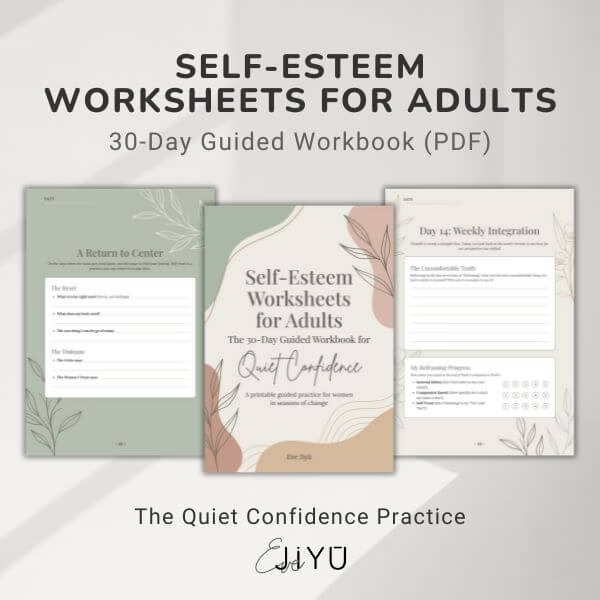
What helps you express yourself when words feel stuck? Share your experience in the comments, or explore the Self-Esteem Workbook for guided reflection on finding your voice.
⬇⬇⬇Pin or save to read later ⬇⬇⬇













0 Comments