
There’s a particular kind of ache that comes with realizing the life you built in your twenties no longer fits. Maybe it’s a career that drains you, a relationship that ended, a city that stopped feeling like home, or simply the quiet realization that you’ve been living someone else’s version of your life.
You look around at everything you’ve constructed, and something in you whispers: this isn’t it.
Starting over in your 30s can feel terrifying. Like you’re somehow behind. Like the window is closing and everyone else figured it out while you were busy surviving.
But here’s what no one tells you: your 30s are one of the most powerful times to rebuild. You know yourself better now.
You’ve survived things your younger self couldn’t have imagined. You have the self-awareness to make choices rooted in who you actually are, not who you thought you should be.
Developmentally, your 30s often mark a genuine internal shift. Psychologists describe it as moving from a “socialized mind”, where your identity is largely shaped by external expectations, toward a “self-authoring mind,” where you begin defining life on your own terms.
That restlessness you’re feeling? It may not be a crisis. It may be growth asking for more room.
This guide isn’t about toxic positivity or pretending the grief of letting go doesn’t exist. It’s not a productivity manifesto or a 90-day transformation plan.
It’s about walking through the process of starting over with honesty, gentleness, and intention, step by step.
Whether you’re leaving a job, healing from burnout, ending a chapter, or simply craving a life that feels more like yours, these steps will help you move forward without abandoning yourself in the process.
You don’t have to have it all figured out before you begin. You just have to be willing to begin.
Step 1: Grieve What You’re Leaving Behind (Without Rushing Past It)
Before you can build anything new, you have to let yourself feel what it means to let the old thing go. This step is the one most “fresh start” content skips entirely, and it’s also the one that determines whether your new beginning actually sticks.
Starting over involves loss. Not just the obvious losses like the relationship, the job title, the apartment , but the subtler ones. The future you imagined that won’t happen now.
The version of yourself you thought you’d be by this age. The plans that made sense once and don’t anymore. Psychologists call this “ambiguous loss,” and it’s entirely real, even when there’s no single event to point to. You can grieve a life that didn’t happen. You can grieve an identity you’ve outgrown.
The key is learning the difference between processing grief and ruminating in it. Processing looks like feeling the sadness, naming it, letting it move through you.
Ruminating looks like replaying the same story on a loop, using pain as a reason to stay frozen. Both feel similar from the inside, which is why learning how to stop ruminating can be such a clarifying practice here.
Try writing a letter to the version of your life you’re releasing. Not to fix it or explain it, but to honor it. What did it teach you? What did you love about it, even if it stopped serving you? What are you genuinely sad to let go of?
This kind of writing creates a container for grief, it gives the feeling somewhere to live outside of your body and mind, so it doesn’t have to live there permanently.
You’ll know you’re ready to move forward when you can hold the sadness and the hope at the same time. Not when the grief is gone, but when it no longer has to be resolved before you can take the next step.
That’s the signal. That’s when you’re ready for what comes next.
Step 2: Get Honest About What Isn’t Working
Once you’ve made space for grief, it’s time for a different kind of courage: radical honesty. Not self-blame. Not a highlight reel of your failures. More like a clear-eyed, compassionate look at the patterns and choices that led you here.
Think of this as a life audit. Move through the major areas, career, relationships, health, creativity, finances, your inner life, and ask yourself, without judgment:
- what’s actually working?
- What am I tolerating?
- What would I never consciously choose again if I were starting fresh today?
This is where shadow work becomes invaluable. Ive talked about this before in my blogs. In general, shadow work is the practice of examining the unconscious patterns, beliefs, and behaviors that drive your decisions often without your awareness.
If you’re new to this practice, gentle shadow work prompts for beginners can help you start exploring these hidden layers.
The people-pleasing that kept you in the wrong job for three extra years. The fear of failure that stopped you from trying. The inherited expectations you mistook for your own desires.
These patterns don’t disappear when you start over. They travel with you into every new circumstance unless you look at them directly.
Some prompts to guide this step:
- “What am I tolerating that I’ve been pretending is fine?” Start here. The things we tolerate quietly are often the loudest signals about what needs to change.
- “What have I been afraid to admit I want?” This one takes courage. The wants we hide from ourselves are often the most honest ones.
- “What patterns keep showing up across different areas of my life?” If the same dynamic appears in your career, your relationships, and your creative life, the common thread is worth examining.
The goal of this step isn’t to assign blame, to yourself or anyone else. It’s to separate what happened to you from what you now have the power to change.
You can acknowledge where systems failed you, where relationships hurt you, where circumstances were genuinely unfair, and still ask: given all of that, what do I want to work on yourself differently now? Both things can be true.
Step 3: Reconnect With Who You Are Underneath It All
Here’s something burnout, people-pleasing, and years of performing a version of yourself for external approval will do: they disconnect you from yourself so gradually you don’t notice until you feel completely hollow.
You stop knowing what you actually enjoy. What you actually believe. What you actually want, separate from what you think you should want.
Reconnecting with your authentic self isn’t a mystical process. It’s a practical one. And it starts with curiosity rather than pressure. If you’re feeling lost in this process, exploring finding yourself after 30 can offer meaningful perspective.
Try writing about what you loved before the world started telling you what to love. What did you do as a child when no one was watching and no one was grading you? What made you lose track of time?
These are data points about what genuinely lights you up, and that information matters.
Another useful exercise: separate your values from your inherited “shoulds.” Write down the things you believe you’re supposed to want, stability, a certain kind of success, a particular relationship structure, whatever was modeled for you.
Then write down what you actually value when you strip all of that away. Where do these lists overlap? Where do they diverge? The divergence is where your real work lives.
Self-acceptance is the foundation of this entire step in my opinion because it kills the ego. You cannot build a new life on a foundation of self-rejection or faked personas.
If you’re rebuilding while simultaneously believing you’re fundamentally flawed or that you’ve wasted your best years, you’ll recreate the same exhaustion in a new setting.
The goal isn’t to love everything about yourself before you begin. It’s to approach yourself with the same gentleness you’d offer a friend who was going through exactly what you’re going through.
This step often feels uncomfortable, and that discomfort is actually a good sign. It means you’re getting honest. It means you’re touching something real. Stay with it.
Step 4: Rebuild Your Foundation, Body, Mind, and Daily Rhythms
Here’s a truth that often gets skipped in conversations about starting over: you cannot rebuild your life from a completely depleted state.
Attempting major life changes while running on empty is one of the most common reasons fresh starts fail. The ambition is real, but the energy isn’t there to sustain it.
Before you redesign your career or move to a new city or commit to a major life shift, you need some degree of internal stability.
Im not saying you must be in a state of perfection with a flawless wellness routine. But just enough grounding to help you make decisions from a regulated nervous system rather than from panic or desperation.
Start with non-negotiables. These are the daily anchors that create a sense of safety during upheaval. For most people, this means:
- Sleep: Prioritizing rest isn’t laziness during a rebuild. It’s infrastructure. Chronic sleep deprivation affects decision-making, emotional regulation, and resilience in measurable ways.
- Movement: This doesn’t have to be intense. A daily walk counts. The goal is to give your body a way to process stress and reconnect you to physical experience.
- A grounding practice: Something that brings you back to the present moment, meditation, breathwork, time in nature, a few minutes of quiet before your phone enters your day. Even five minutes creates a different quality of attention.
- One small act of self-care that’s genuinely for you: Not performative. Not ‘Instagrammable’. A one thing that communicates to yourself that you matter enough to tend to.
If you’re recovering from burnout specifically, please hear this: rebuilding your energy is not a detour from starting over. It is the starting over. Many women attempt to leap from burnout directly into transformation, and the leap fails because the foundation isn’t there yet.
Understanding the recovery from burnout steps can help you honor this process. Rebuilding your capacity to feel, to rest, to enjoy small things, that’s the work. Everything else follows.
Step 5: Design Your Next Chapter With Intention (Not Panic)
There’s a crucial difference between running away from something and building toward something, and it matters more than most people realize.
When we’re in pain, the instinct is to escape, to take any exit that looks like relief. But decisions made from panic tend to recreate familiar discomfort in unfamiliar settings. The new job has different walls but the same dynamics. The new city feels exciting for three months and then lonelier than before.
Designing your next chapter with intention means getting clear on what you’re moving toward, not just what you’re leaving. And that requires knowing your values, not the values you think sound good, but the ones that actually show up in the moments when you feel most alive and most like yourself.
When setting development goals for this next chapter, anchor them to those values.
A goal rooted in “I want to feel creatively engaged in my work” will sustain you differently than a goal rooted in “I want to make more money than my ex.” Both might lead to the same external action, but one will keep you going when things get hard.
Hold your vision loosely. This is not the same as having no vision. It means you’re clear on the direction without being rigid about the exact destination.
A flexible vision sounds like: “I want work that uses my creativity and allows me some autonomy” rather than “I will be a freelance illustrator living in Portugal by March.” The first gives you a compass. The second gives you a deadline that may or may not have anything to do with what you actually need.
Practical tools that help here: vision journaling, where you write about your future life in present tense as if it’s already happening; 90-day experiments, where you try something for three months without committing to it forever; and explicit permission to change your mind as you learn more about who you’re becoming. You don’t have to have the whole map. You just need the next few steps.
Step 6: Take the First Imperfect Step (and Then the Next One)
Waiting until you feel ready is a trap. It’s a comfortable trap, because it looks like wisdom from the inside. You’re being thoughtful. You’re being careful. You’re not rushing. But often, waiting for readiness is just fear with better posture.
Courage doesn’t arrive before action. It arrives because of action. The confidence you’re waiting to feel before you begin is actually built by beginning, by watching yourself do the scary thing and survive it, by gathering evidence that you can follow through, by discovering that the fear was almost always larger than the actual thing.
Start with micro-moves. This can be a one small conversation you’ve been avoiding. One application you’ve been talking yourself out of. One boundary you’ve been meaning to set. One creative act, just for yourself, with no audience and no outcome attached.
These small steps aren’t insignificant but they’re how you build the neural pathways of a person who takes action, who trusts herself, who moves toward her life rather than waiting for it.
The fear of judgment is real, especially when the people around you don’t understand your choices. When you start over in your 30s, you may encounter confusion, unsolicited opinions, or the quiet discomfort of people who feel confronted by your willingness to change.
This is not your problem to solve. Their discomfort with your growth is information about them, not evidence that you’re wrong.
This is also a beautiful time to explore new creative outlets, not to find your “passion” or monetize a hobby, but simply to meet the version of yourself who’s emerging. Trying new things builds self-knowledge.
It also builds self-worth in a quiet, evidence-based way: you see yourself as someone curious, someone willing, someone who shows up for her own life. That self-image becomes the foundation for everything else you’re building.
One step. Then another. That’s all this is.
Step 7: Protect Your Fresh Start From Old Patterns
You see, most fresh starts don’t fail because of external circumstances. They fail because we carry the same internal patterns into new circumstances and expect different results.
You can change your job, your city, your relationship status, your morning routine, and still find yourself recreating the same exhaustion, the same dynamics, the same quiet dissatisfaction, because the patterns that generated them came with you.
This isn’t a character flaw. It’s just how patterns work. They’re efficient. They’re familiar. They feel like home even when home was hurting you.
The first step is identifying your specific self-sabotaging patterns. Perfectionism that stops you from finishing things. Comparison that makes your progress feel worthless. Overcommitting because saying no still feels dangerous. Numbing with social media or busyness when the discomfort of growth gets too loud.
You probably already know yours. Name them. They lose some power when you can see them clearly.
Building an ongoing reflective practice is how you catch these patterns before they derail you. A weekly check-in with yourself, even ten minutes of honest journaling, creates a habit of self-awareness that makes course correction possible before you’ve wandered too far off track.
Ask yourself:
- what did I do this week that aligned with who I’m becoming?
- What felt like an old pattern showing up?
- What do I want to do differently next week?
And finally: remember that starting over isn’t a one-time event. It’s an ongoing practice of choosing yourself, again and again, even when it’s inconvenient, even when you’re tired, even when the old patterns are loud. That practice is the life. Not the destination you’re heading toward, but the daily act of showing up for yourself anyway.
Your Starting-Over Checklist: Moving Forward, One Step at a Time
I believe by now youve come to know that starting over in your 30s is not a failure. It is not evidence that something went wrong with you. It is one of the bravest things a person can do: to look honestly at the life they’ve built, acknowledge what no longer fits, and choose to begin again with more self-knowledge than they had the first time.
Here’s a simple compass to return to whenever you need it:
- Step 1: Grieve. Let yourself feel the loss of what you’re leaving. Honor it before you move past it.
- Step 2: Get honest. Conduct a compassionate life audit. Look at the patterns, not just the circumstances.
- Step 3: Reconnect. Rediscover who you are underneath the roles and expectations. Build on self-acceptance, not self-rejection.
- Step 4: Rebuild your foundation. Stabilize your body, mind, and daily rhythms before making big external moves.
- Step 5: Design with intention. Build toward something, not just away from something. Hold your vision with direction, not rigidity.
- Step 6: Take the first imperfect step. Begin before you feel ready. Let action build the courage you’re waiting for.
- Step 7: Protect your fresh start. Name your patterns. Build a reflective practice. Ask for support when you need it.
Start with whichever step resonates most right now as there is no structure to this here. Return to earlier steps when you need to. Use this as a compass, not a checklist to complete before you’re allowed to feel okay.
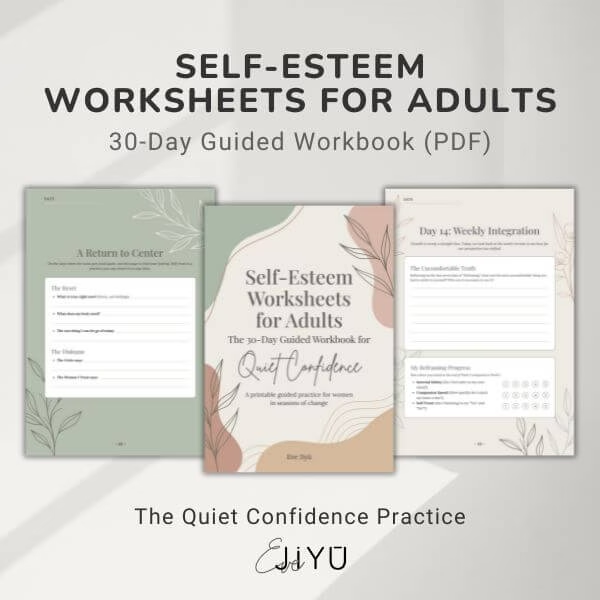
If you’re looking for a gentle companion for this journey, Ive written extensively about journaling prompts, shadow work tools, and weekly reflections. All of which were created for exactly this kind of in-between season. They’re not a program or a funnel. They’re an invitation to know yourself more honestly, one page at a time.
Learn more and find the tools that feel right for where you are.
You are not behind. You are not broken. You are someone who has the self-awareness to recognize that something needs to change, and the courage to do something about it. That is not a small thing. That is everything.
Begin again. Gently. Honestly. At your own pace.





0 Comments