
It’s Sunday evening. You’re already in bed, but sleep feels miles away. Tomorrow hasn’t started yet and you’re already bone-tired, not just physically, but in some deeper, harder-to-name way.
You scroll your phone without really seeing it. You think about everything you need to do this week. And somewhere underneath all of that noise, a quieter thought surfaces: Is this it?
If that moment feels familiar, you’re not alone. And you’re probably not just “tired.”
What you might be experiencing is burnout, and if you’re a woman in your 30s, it has a particular texture that generic wellness advice rarely captures.
Burnout in your 30s isn’t simply about working too hard. It’s the disorienting realization that the life you built carefully, responsibly, correctly, the career, the relationships, the obligations you said yes to, somehow left you feeling hollow.
It’s the grief of waking up inside a version of your life that looks fine from the outside and feels like a costume you can’t take off. It’s exhaustion layered with shame, because women in their 30s are supposed to be hitting their stride, not quietly falling apart.
This article isn’t a productivity hack. It’s not a 30-day reset plan or a list of morning routines that will fix everything.
I really like to think that this is an honest, gentle exploration of what burnout recovery for women in their 30s actually looks like: why this life stage creates such fertile ground for burnout, how to recognize it beyond the surface-level fatigue, and how to begin the slow, non-linear, genuinely meaningful process of coming back to yourself.
As a woman in my 30s as well, I do feel this will help you and me alike, and I want to share it with you. Not for the self you performed, but for the one underneath.
Why Your 30s Create the Perfect Storm
There’s a reason burnout hits so many women with particular force in their 30s. It’s not weakness or poor time management. It’s a convergence of pressures that is, in many ways, developmentally unique to this decade.
On one side, you have peak responsibility. Career advancement pressure tends to intensify in your 30s, this is often the decade when you’re expected to be moving up, leading teams, building something.
At the same time, caregiving responsibilities frequently expand: children, aging parents, or both. Financial obligations deepen. Relationships require more maintenance. The sheer volume of what you’re managing grows heavier every year.
On the other side, something else is happening: a growing intolerance for inauthenticity. Many women in their 30s begin, sometimes for the first time, to seriously question whether they’re living their own life or someone else’s script. T
he ambitions that once felt exciting start to feel like obligations. The roles that once felt chosen start to feel inherited.
This collision, more responsibility than ever, alongside a deepening need for meaning, is exhausting in a way that sleep alone can’t fix. These life lessons learned in your 30s often arrive through discomfort rather than celebration.
There’s also a physiological layer that rarely gets discussed. The American College of Obstetricians and Gynecologists notes that perimenopause can begin in the mid-30s for some women, affecting sleep quality, mood regulation, and stress tolerance.
Hormonal shifts that begin earlier than expected can make the same workload that felt manageable at 28 feel genuinely unsustainable at 34. Your body is changing, and those changes have real implications for how you experience and recover from stress.
Then there’s the invisible labor. The concept of mental load, the cognitive and emotional work of managing household logistics, social obligations, other people’s emotional needs, and the endless background hum of keeping everything running, disproportionately falls on women.
Eve Rodsky’s research documented in Fair Play and broader sociological work has explored how this invisible labor accumulates quietly and relentlessly.
It doesn’t show up on any job description. It rarely gets acknowledged. And it is exhausting in ways that are genuinely difficult to articulate, which makes the shame spiral around burnout even worse.
Because here’s the thing: women in their 30s are supposed to have it together.
Admitting you’re burned out can feel like admitting failure. That shame doesn’t just add to the weight, it keeps you from seeking help.
Understanding that burnout at this life stage is a structural and physiological reality, not a personal failing, is the first quiet act of recovery from burnout.
Burnout Has More Than One Face
Most people think of burnout as extreme fatigue. And yes, exhaustion is part of it. But if you’re waiting to feel tired enough to justify calling it burnout, you may miss it entirely, because burnout often shows up in subtler, stranger ways first.
The World Health Organization formally recognized burnout in 2019 as an occupational phenomenon in the ICD-11, defined by three dimensions: emotional exhaustion, depersonalization or cynicism, and a reduced sense of personal accomplishment.
The Maslach Burnout Inventory, developed by researchers Christina Maslach and Susan E. Jackson, remains the most widely used tool for measuring these dimensions. I believe that understanding all three can help us see the full picture.
Emotional exhaustion is the one most people recognize: feeling drained, depleted, running on empty. But depersonalization is subtler and often more alarming.
It’s the creeping cynicism, the emotional distance, the sense that things you used to care about now feel flat or meaningless. You might find yourself going through the motions at work, in relationships, in your own life, present in body, absent in spirit.
And the third dimension, reduced personal accomplishment, shows up as that quiet, persistent feeling that nothing you do is enough, that you’re not as capable as you once were, that you’ve somehow lost something you can’t name.
For women specifically, burnout often extends beyond the workplace into caregiving, emotional labor, and identity-related exhaustion.
Researchers and clinicians increasingly recognize this broader context, even as the formal definition remains occupationally focused. If you suspect there are deeper patterns keeping you trapped, it’s worth exploring them honestly.
The subtle signs are worth naming, because women frequently dismiss or misattribute them:
-
Brain fog: Difficulty concentrating, forgetting things, feeling mentally slow — often written off as “just stress” or aging.
-
Disproportionate irritability: Snapping at small things, feeling a low-grade frustration that seems out of proportion to what’s actually happening.
-
Loss of creative drive: The things that used to light you up, writing, cooking, making things, dreaming, feel inaccessible or pointless.
-
Social withdrawal: Pulling away from people and calling it introversion, when really it’s a kind of protective numbness.
-
Physical symptoms: Jaw clenching, chronic tension, insomnia, headaches, a body that feels perpetually braced for impact.
It’s also important to name the distinction between burnout and depression. They share overlapping symptoms, fatigue, loss of motivation, sleep disruption, withdrawal, but they have different root causes and often require different approaches.
Burnout is situational, tied to chronic stress without adequate recovery. Depression involves broader neurochemical and psychological factors.
They can, and often do, co-occur. If your symptoms are severe, persistent, or include thoughts of hopelessness or self-harm, please seek professional support alongside any self-guided recovery work.
There is no badge of honor in navigating this alone.
The Inner Work That Makes Recovery Last
Here’s something the “take a vacation and rest more” advice misses entirely: burnout recovery isn’t just about rest. Rest is necessary, but it’s not sufficient.
Because if you rest and then return to the same beliefs, patterns, and relational dynamics that depleted you in the first place, you’ll burn out again. Often faster the second time.
Real recovery requires looking inward, at the unconscious drivers that made you say yes when you meant no, that made you perform competence when you were drowning, that made you prioritize everyone else’s comfort over your own needs for years.
This is where shadow work becomes genuinely powerful. If you’re new to this practice, gentle shadow work prompts for beginners can offer a safe starting point.
Shadow work, a concept rooted in Carl Jung’s analytical psychology, involves examining the parts of yourself you’ve pushed into the background: the needs you learned weren’t acceptable, the anger you learned to suppress, the parts of your identity that didn’t fit the roles you were playing.
In the context of burnout recovery, shadow work can help you identify the unconscious beliefs driving overwork and people-pleasing.
Questions like:
-
What am I afraid will happen if I stop being so productive?
-
What do I believe about my worth when I’m not performing?
-
Whose expectations am I actually trying to meet? These aren’t comfortable questions. But they’re the ones that lead somewhere real.
Journaling is one of the most accessible tools for this kind of inner work.
Research by psychologist James Pennebaker at the University of Texas at Austin has demonstrated that expressive writing can improve emotional processing and reduce stress-related symptoms. Another PMC study proves this too.
But beyond the research, many women who are recovering from burnout describe journaling as the practice that helped them find their own voice again, after months or years of performing for others, of filtering every thought through the lens of what they should feel or should want.
The shift in journaling prompts matters. Moving from “what should I do?” to “what do I actually feel?” sounds simple, but it’s a profound reorientation.
You’re not optimizing. You’re listening. You’re practicing the radical act of taking your own inner experience seriously.
Self-acceptance is also medicine here, not a platitude. Part of burnout recovery in your 30s involves grieving, grieving the version of your 30s you imagined, the timeline you thought you were on, the person you thought you’d be by now.
Releasing perfectionism isn’t about lowering your standards. It’s about building a relationship with yourself that isn’t contingent on your output.
Learning how to accept yourself beyond your productivity is foundational. Everything else gets built on top of it.
Rebuilding Your Days Without Recreating the Burnout
Once you’ve begun the inner work, the question becomes: how do you actually restructure your daily life in a way that supports recovery rather than quietly recreating the conditions that burned you out?
The answer isn’t a 27-step morning routine. It’s smaller, more honest than that.
Start with your nervous system. Burnout isn’t just a psychological experience, it’s physiological.
Chronic stress dysregulates your nervous system, keeping your body in a low-grade state of threat response.
Recovery approaches grounded in somatic and trauma-informed practices increasingly emphasize this: you can’t think your way out of burnout. You have to work with your body, not just your mind.
This doesn’t have to be complicated. Sleep hygiene matters enormously during recovery, not as a productivity optimization, but because emotional regulation is nearly impossible on fragmented sleep.
Grounding practices like slow breathing, time outdoors, or gentle movement can signal safety to a nervous system that has been braced for too long.
Micro-rituals, a cup of tea before you open your phone, five minutes of quiet before the day starts, create small anchors of presence in a life that may have been running entirely on autopilot.
Equally important is what you remove. During early recovery especially, intentional subtraction matters more than addition. This might mean:
-
Digital boundaries: Reducing social media exposure, particularly content that triggers comparison or the performance of a life you don’t have. Your nervous system cannot distinguish between your stress and the curated stress of strangers’ highlight reels.
-
Saying no without a lengthy justification: Practicing the simple, complete sentence “I can’t take that on right now”, and sitting with the discomfort of disappointing someone without immediately trying to fix it.
-
Interrupting rumination cycles: Recognizing when your mind is replaying the same anxious loop and gently redirecting, not to toxic positivity, but to something grounding and present.
Redefining what “development goals” even means is also part of this. Burnout recovery asks you to step back from optimizing for output and instead set goals around presence, creative expression, and reconnecting with things that have no productive purpose whatsoever.
A hobby you love that produces nothing. A walk with no podcast. Time that belongs entirely to you, not to your to-do list. These actions are how you remember who you are when you’re not performing.
What Recovery Actually Looks Like Over Time
Let’s be honest about the timeline, because the wellness industry rarely is: significant burnout takes months to recover from. Often longer. Clinicians and burnout researchers consistently describe recovery as non-linear, and that’s not a disclaimer, it’s a crucial piece of information.
There will be good weeks followed by flat, gray weeks that feel like backsliding. There will be days when you feel genuinely lighter, followed by days when the exhaustion returns without warning.
This is not failure. This is the actual shape of recovery. Expecting a clean upward trajectory is one of the ways perfectionism sneaks back into the healing process.
What helps is building an ongoing self-reflection practice that functions as an early warning system. Regular journaling, not as a productivity tool, but as honest conversation with yourself, helps you notice patterns before they become crises.
Body check-ins, asking yourself “where am I holding tension right now, and what might that be telling me?” keep you connected to the physiological signals your body sends long before your mind catches up.
Honest conversations with yourself about what’s working and what isn’t, without judgment, build the kind of self-awareness that makes it much harder to slip back into autopilot.
Many women describe what comes after significant burnout not as “getting back to normal” but as something more profound: finally building a life that actually fits.
Slower. More intentional. More honest. A life where they’ve stopped performing and started inhabiting. That’s not a small thing. That’s everything.
The path there isn’t dramatic. It’s made of small choices, repeated. It’s made of the willingness to keep asking yourself the quiet, uncomfortable, important questions.
You Don’t Have to Figure It All Out Right Now
For us women going into our 30s, burnout recovery isn’t about bouncing back to who you were before. I really believe it’s about finally meeting who you actually are underneath the performance, underneath the roles, the obligations, the carefully maintained image of someone who has it together.
That meeting takes time. It takes gentleness. It takes a willingness to grieve what you thought your life was supposed to look like, and to stay curious about what it might become instead.
If you’re reading this and recognizing yourself in these pages, start with one small thing today. Write a single journal entry that begins with “What I actually feel right now is…” Sit in five minutes of silence without your phone.
Or simply say it out loud, to yourself, without judgment: “I’m burned out.” That acknowledgment, that small act of honesty, is not nothing. It’s the beginning.
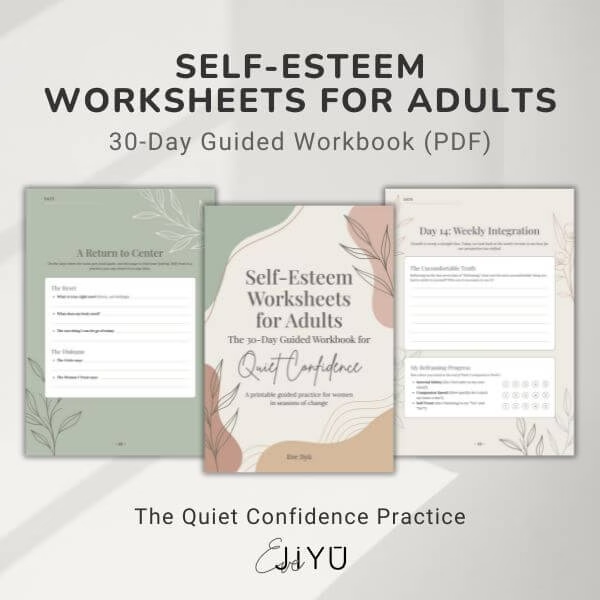
Thats one of the cornerstone behind the newsletter I created, it was built for exactly this kind of inner work.
It’s not a program to complete or a funnel to move through. It’s a letter, personal, reflective, honest, that meets you where you are each week, with journaling prompts, self-reflection tools, and the kind of gentle companionship that this work deserves.
If you’re looking for a quiet, consistent space to support your recovery, Id love to have you there and hope youll find what might be useful for where you are right now.
You don’t have to have this figured out. You don’t have to be further along than you are. You just have to begin, and then begin again, and then again after that.
That’s what recovery actually looks like. And it’s enough.


0 Comments