
In This Article

Practical tools for women who want to stop performing confidence and start trusting themselves. Learn how to build self-esteem through awareness, boundaries, and self-reflection.
You’ve probably noticed it before. The moment someone asks “How are you?” and you answer with a bright “I’m great!” even though your chest feels tight. The nights when you lie in bed replaying a conversation, analyzing every word you said, wondering if you came across as too much or not enough. The Sunday evening dread that creeps in before Monday begins.
These aren’t signs of failure. They’re signs of low self-esteem quietly running in the background.
If you’re here searching for how to build self esteem, you’re not broken. You’re aware. And awareness is where real change starts.
This article walks you through what self-esteem actually is, why the “just be confident” advice never worked for you, and eight grounded practices that help you fix low self-esteem without forcing positivity or pretending everything is fine.
You won’t find hustle culture here. No motivational speeches. Just honest tools for women who are tired of feeling uncertain in their own skin.
Low Esteem Meaning: What Self-Esteem Really Is (and What It Isn’t)
Before we talk about how to improve self esteem, we need to define what we’re actually building.
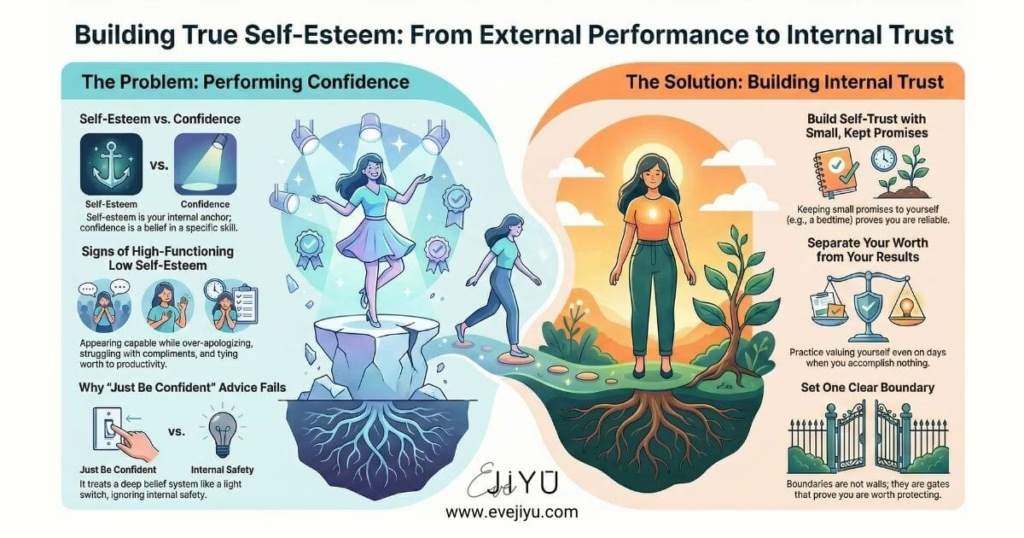
Self-esteem is not confidence. Confidence is situational. It’s the belief that you can do something well based on past experience or skill. You can be a confident public speaker and still have low self-esteem. You can be excellent at your job and still feel unworthy of rest.
Self-esteem is deeper. It’s the quiet belief that you are okay as you are, independent of what you achieve, how you look, or who approves of you. It’s the internal anchor that keeps you steady when things go wrong. Research published in the Journal of Personality and Social Psychology found that self-esteem shows substantial stability over time, comparable to core personality traits. This research confirms that building genuine self-esteem creates lasting internal security rather than temporary confidence boosts.
When people talk about low esteem meaning, they’re usually describing a state where your worth feels conditional. You feel valuable when you’re productive, helpful, or liked. When those conditions aren’t met, your sense of self collapses.
This isn’t a character flaw. It’s a learned pattern. And patterns can be unlearned.
For a deeper look at how self-esteem differs from confidence, read Difference Between Self-Esteem and Self-Confidence.
Signs You Might Have Low Self-Esteem (Even If You Appear Confident)
Low self-esteem doesn’t always look like someone hiding in a corner. Often, it looks like someone who appears to have it together.
You might be the friend everyone calls for advice. The employee who never misses a deadline. The woman who seems calm and capable. But inside, you’re exhausted. You say yes when you mean no. You second-guess every decision. You feel like you’re one mistake away from being exposed as inadequate.
This is high-functioning low self-esteem. It’s when you perform confidence externally while feeling fragile internally.
Common patterns include:
- Over-apologizing for things that don’t require an apology
- Struggling to accept compliments without deflecting or minimizing
- Feeling responsible for other people’s emotions
- Seeking reassurance repeatedly before making decisions
- Difficulty setting boundaries without feeling guilty
- Comparing yourself constantly to others
- Feeling like you have to earn the right to rest
These behaviors aren’t weakness. They’re adaptations. You learned to protect yourself by becoming useful, likable, or invisible. But protection isn’t the same as safety.
If these patterns feel familiar, explore the full list of Symptoms of Low Self-Esteem.
Why “Just Be Confident” Advice Fails
You’ve heard it before. Fake it till you make it. Just believe in yourself. Think positive.
This advice fails because it treats self-esteem like a light switch you can flip on. It assumes the problem is your thinking, not the deeper beliefs running beneath your thoughts.
Confidence without self-esteem is exhausting. You’re constantly performing. You walk into a room and tell yourself you belong there, but your nervous system is screaming the opposite. You force yourself to speak up in meetings, but afterward you replay every word, convinced you said something wrong.
This is why affirmations often feel hollow. You can repeat “I am enough” a hundred times, but if your body doesn’t believe it, the words are just noise.
Self-esteem isn’t about convincing yourself you’re confident. It’s about building internal safety so confidence becomes a natural byproduct. It’s about learning to trust yourself even when things don’t go perfectly. It’s about knowing you can handle disappointment without collapsing.
That kind of trust doesn’t come from motivational quotes. It comes from small, consistent actions that prove to yourself that you’re reliable.
How to Build Self Esteem: 8 Proven Ways
1. Stop Treating Your Inner Critic as a Reliable Narrator
Your inner critic isn’t telling you the truth. It’s telling you a story designed to keep you safe through control and perfectionism.
That voice that says “You’re not good enough” or “Everyone is judging you” isn’t giving you accurate information. It’s an old survival mechanism trying to protect you from rejection by making you smaller.
The first step in learning how to build self esteem is recognizing that voice as a pattern, not a fact.
You don’t need to fight it. You don’t need to replace it with positive affirmations. You just need to notice it and create space between the thought and your reaction.
Try this:
Next time your inner critic speaks, imagine it as a separate character. Give it a name. Notice what it says and how it says it. Then ask yourself: “Is this actually true, or is this fear talking?”
Write down the critic’s script. What are the repetitive phrases it uses?
- “Who do you think you are?”
- “You should have done better.”
- “Everyone else is ahead of you.”
Once you see the pattern, it loses some of its power.
2. Build Self-Esteem Through Small, Kept Promises
Self-esteem is built through trust. And trust is built through consistency.
Every time you make a small promise to yourself and keep it, you’re proving to your nervous system that you’re reliable. This is how you fix low self esteem from the inside out.
It doesn’t have to be big. It can be as simple as:
- Drinking water first thing in the morning
- Journaling for five minutes
- Going to bed by a certain time
- Not checking your phone for the first hour after waking
The size of the promise matters less than the act of keeping it. Your brain starts to recognize: “I said I would do this, and I did it. I can trust myself.”
Discipline isn’t about punishment. It’s about self-respect. It’s about showing up for yourself the way you show up for others.
This is why motivation fails. Motivation is a feeling. Discipline is a practice. And self-esteem grows through practice, not inspiration.
3. Learn How to Improve Self-Esteem by Separating Worth From Results
If your worth is tied to your productivity, your self-esteem will always be fragile.
You’ll feel good when you accomplish something and worthless when you rest. You’ll believe you’re valuable only when you’re useful to others. You’ll equate failure with being a failure.
This is one of the most damaging patterns for high-achieving women. You learned that love and approval came through performance. You learned that your worth had to be earned.
But worth isn’t something you earn. It’s something you are.
Separating your worth from your results means learning to value yourself on days when you accomplish nothing. It means recognizing that your existence has value independent of your output.
Reflection questions:
- What would it feel like to be worthy simply because you exist?
- If you produced nothing today, would you still deserve kindness?
- What parts of you have value that have nothing to do with productivity?
This isn’t about lowering your standards. It’s about building a foundation that doesn’t collapse when things go wrong.
4. Rewrite the Stories That Quietly Run Your Life
Most of your beliefs about yourself aren’t actually yours. They’re narratives you absorbed from your parents, teachers, peers, or culture.
“I’m too much.” “I’m not smart enough.” “I have to work harder than everyone else to be accepted.”
These stories feel like truth because you’ve been repeating them for years. But repetition doesn’t make something true.
Rewriting these stories is how you improve self esteem at the root level. It’s not about positive thinking. It’s about questioning the origin of the belief and deciding if it still serves you.
Try this exercise:
Pick one belief you hold about yourself. Write it down.
- Where did this belief come from? Whose voice is this?
- What was happening in my life when I first believed this?
- Is this belief still true, or is it an old story I’m carrying?
Now write an updated version. Not a fake affirmation, but a more honest, adult perspective.
For example:
- Old story: “I’m difficult to love if I have needs.”
- Updated truth: “Having needs is part of being human. The right people won’t see my needs as a burden.”
This process is explored in depth in Self-Belief Shifts That Change Your Self-Image.

5. Use Self-Reflection Instead of Self-Judgment
Journaling is one of the most effective tools for building self-esteem, but only if you approach it with curiosity instead of criticism.
Self-reflection means looking at your thoughts and behaviors without making yourself wrong. It’s asking “What was I protecting myself from?” instead of “Why am I so messed up?”
When you journal with self-compassion, you start to see patterns you couldn’t see before. You notice when you’re people-pleasing. You recognize when your boundaries are weak. You catch yourself shrinking to make others comfortable.
This awareness doesn’t come from harsh self-analysis. It comes from gentle, consistent observation.
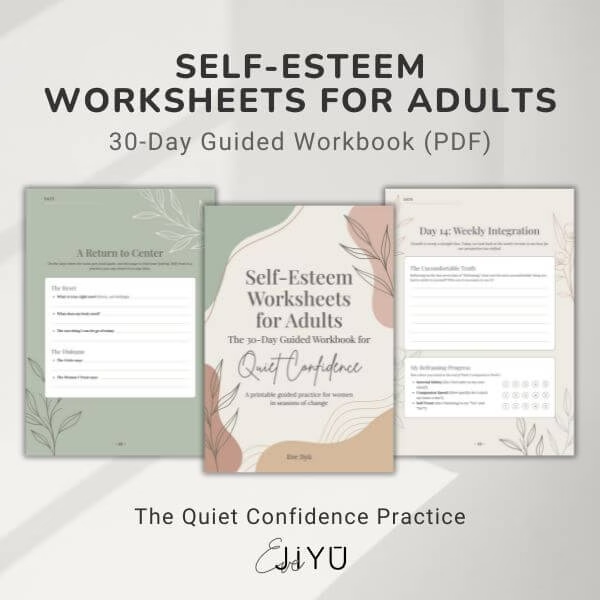
This is where structured guidance can help. The Self-Esteem Worksheets for Adults (PDF) is a 30-day guided journal designed to rebuild self-trust through intentional daily reflection. It walks you through awareness, reframing, boundaries, and integration without forcing positivity or pushing you to perform confidence you don’t feel.
Daily practice:
Spend 10 minutes writing about one of these prompts:
- What did I notice about myself today?
- Where did I feel most like myself?
- What boundary did I want to set but didn’t?
- What story am I telling myself about why I’m stuck?
6. Learn How to Boost Your Self Esteem by Setting One Clear Boundary
Boundaries are not walls to keep people out. They’re gates that keep you safe within your own life.
Every time you say yes when you mean no, you’re teaching yourself that other people’s needs matter more than yours. Every time you allow someone to cross a line, you’re reinforcing the belief that you’re not worth protecting.
Setting boundaries is how you prove to yourself that you matter.
You don’t need to set ten boundaries at once. Start with one. Pick the area of your life where you feel the most resentment or exhaustion.
Examples:
- Not responding to work emails after 7 PM
- Not explaining your decisions to people who aren’t involved
- Not attending events that drain you just to avoid disappointing someone
- Not apologizing for things that aren’t your fault
Boundaries feel scary at first because you’ve been trained to prioritize other people’s comfort over your own. But discomfort doesn’t mean you’re doing something wrong. It means you’re doing something new.
You don’t need to announce your boundaries dramatically. You just need to hold them quietly and consistently.
7. Replace Comparison With Self-Orientation
Comparison is the fastest way to erode self-esteem. When you measure your worth by looking at other people, you’re giving away your power.
Social media makes this worse. You see everyone’s highlight reel and compare it to your behind-the-scenes. You see someone’s promotion and forget they’ve been working at that company for five years. You see someone’s vacation photos and feel like you’re falling behind. A 2022 study published in BMC Psychology found that problematic social media use was directly linked to increased upward social comparisons, which then mediated the relationship between social media use and depression. The research showed that people who compared themselves negatively to others on social media experienced both lower self-esteem and higher depression scores.
But there’s no universal timeline. There’s no correct way to live. And other people’s lives have nothing to do with your worth.
Learning how to boost your self esteem means redirecting your attention inward. It means asking “What do I actually want?” instead of “What should I be doing?”
Practical steps:
- Limit social media to one hour a day
- Unfollow accounts that make you feel inadequate
- When you catch yourself comparing, pause and ask: “What need is this comparison trying to meet?”
- Shift the question from “Am I ahead or behind?” to “Am I aligned with what matters to me?”
Comparison keeps you focused on external metrics. Self-orientation brings you back to your own life.
8. Strengthen Self-Esteem With Repeatable Inner Practices
Self-esteem isn’t built through one breakthrough moment. It’s built through small, daily practices that become habits.
This is why journaling, boundary-setting, and self-reflection need to be repeatable. You can’t think your way into self-esteem. You have to practice it.
The women who successfully rebuild their self-esteem don’t do it by reading one book or attending one workshop. They do it by showing up for themselves consistently, even on the days when it feels pointless.
This is where tools like the Self-Esteem Worksheets for Adults (PDF) help. They turn insight into a daily habit instead of a temporary realization. They give you a structure to return to when motivation fades.
Simple daily routine:
- Morning: Write three things you’re grateful for that have nothing to do with productivity
- Midday: Check in with your body and ask what it needs
- Evening: Reflect on one moment where you honored yourself today
Repetition is how self-esteem becomes your default state instead of something you have to force.
How Long Does It Take to Build Self-Esteem?
There’s no fixed timeline. Self-esteem isn’t a destination you arrive at and stay forever.
Some people notice shifts within weeks. They catch their inner critic faster. They set boundaries without as much fear. They feel less fragmented.
Others need months or longer, especially if they’re undoing decades of conditioning.
Progress isn’t linear. You’ll have days where you feel solid and days where you feel like you’re back at the beginning. That’s normal. Growth doesn’t erase hard days. It just gives you better tools to navigate them.
The goal isn’t to reach a place where you never doubt yourself. The goal is to build enough internal safety that doubt doesn’t destabilize you.
You’re not trying to become someone new. You’re trying to trust the person you already are.
Self-Esteem Is a Skill You Can Practice
If you made it this far, you already know something important: you’re willing to do the work.
You’re not looking for quick fixes or empty affirmations. You’re looking for real tools that help you feel steady inside your own life.
That’s what learning how to build self esteem looks like. It’s not dramatic. It’s not fast. But it’s possible.
You don’t need to wait until you “fix” yourself to start honoring yourself. You don’t need to earn the right to set boundaries or take up space. You’re allowed to exist imperfectly and still be worthy of kindness.
Self-esteem grows when you stop performing and start practicing. When you stop waiting for external validation and start trusting your own internal compass. When you stop believing you’re too much or not enough and recognize you’re exactly what you need to be.
Nothing is wrong with you. You’re just learning to relate to yourself differently.
And that starts with one small practice, repeated daily, until it becomes who you are.
Want a Simple Place to Start?
The Self-Esteem Worksheets for Adults (PDF) offers a 30-day structure to help you build quiet confidence, emotional stability, and self-trust without forcing positivity. It’s designed for women who want practical tools, not motivational slogans.
⬇⬇⬇Pin or save to read later ⬇⬇⬇
0 Comments