
In This Article
The inbox notification glowed at 2 AM last Tuesday. Another productivity guru promised that buying their planner system would finally help me finish my novel. I closed my laptop and stared at the half-finished painting leaning against my bedroom wall, two years in progress and still not “ready.”
That moment revealed the real problem: my discipline was fine, but the goals themselves were completely wrong.
Traditional goal-setting advice is built for corporate quarterly reviews, not creative souls. SMART goals might work for sales targets, but they suffocate authentic expression—the spark that emerges when you stop performing and start creating.
Setting an ambitious creative goal only to abandon it within weeks doesn’t mean you’re lazy or lacking willpower. You’re simply using a framework designed to crush your creative voice rather than nurture it through sustainable practices.
This article introduces a different approach to creative goal setting that serves your well-being and artistic identity instead of just padding your portfolio. We’ll explore a sustainable framework and examine five creative goals examples that build genuine momentum without the pressure or burnout that comes from conventional achievement metrics.
The difference becomes clear quickly: these goals won’t make you feel like a failure when life gets messy or complicated. They won’t demand perfection at every turn. They definitely won’t require a 5 AM wake-up routine or any other hustle-culture nonsense that ignores your actual human needs.
The Anti-Hustle Framework: How Creative Goal Setting Works Without Burnout
Most conventional goal-setting advice treats you like a machine that just needs better programming or optimization. Creative work doesn’t respond to productivity hacks the way data entry or email management does. Real creative work responds to care, curiosity, and honest self-reflection about what you actually need.
Here’s what actually works when you want to set goals without burnout while building a sustainable creative practice.
The Purpose Pivot: Moving From “What” to “Why”
Stop asking yourself “What do I want to achieve?” and start asking “What do I need this creative pursuit to give me?” This shift in perspective transforms everything about how you approach your work.
When I finally admitted I wanted to paint not to become a gallery artist but because the act itself made me feel alive and connected to something larger than daily obligations, all the pressure dissolved like sugar in hot water. The goal stopped being about external validation from critics or Instagram followers and became about internal nourishment that I could control and cultivate.
This represents intentional goal setting at its core—you’re not chasing someone else’s definition of success or following a path that doesn’t actually fit your life. You’re building a creative practice that aligns with your actual values and energy patterns rather than some idealized version of what an artist “should” do.
Try this reflection exercise: Sit quietly with your most ambitious creative dream for five full minutes. Now ask yourself honestly: Am I excited about the daily work itself, or just the imagined outcome and recognition? If you only want the outcome, you’ll burn out long before you get there because the journey will feel like drudgery. If you genuinely want the process and the small discoveries it brings, you’ve found something truly sustainable.
The Process Focus: Prioritizing Actions Over Outcomes
Outcome goals sound inspiring when you first write them down. “Publish a book.” “Have a gallery show.” “Build a following of engaged readers.” They give you something concrete to aim toward.
The problem? These outcomes sit completely outside your control, no matter how talented or dedicated you are.
You can write every single day for a year and still not get published because the market shifted or your manuscript didn’t land on the right desk at the right moment. You can create stunning work and still not land a gallery show because timing and connections matter as much as quality. You can share authentically and consistently and still not grow an audience because algorithms favor certain content types over others.
Process goals, in contrast, rest entirely within your power to control and complete.
Instead of “Publish a book,” try “Show up to write for one focused hour, three mornings per week, regardless of quality.” Instead of “Have a gallery show,” try “Complete one painting per month that I’m genuinely proud of, regardless of whether anyone else sees it or validates it.” Instead of “Build a following,” try “Share one piece of honest work each week that represents my actual perspective.”
The outcome might still happen as a natural byproduct of consistent work. Your sense of success just doesn’t depend on it anymore, which removes the anxiety that kills most creative projects before they fully develop.
Research in the Journal of Personality and Social Psychology shows process-focused mental simulations enhance studying, reduce anxiety, and improve performance more than outcome fixation—your brain thrives on controllable wins.

The Anti-Perfectionism Metric: The “Good Enough” Rule
Perfectionism functions as the creative killer no one talks about with real honesty in most creative communities.
We frame perfectionism as having high standards or being detail-oriented, but perfectionism actually represents fear wearing a fancy outfit. Fear that if the work isn’t absolutely flawless, it proves we’re not talented enough, smart enough, or worthy of taking up space with our voice and vision.
The “Good Enough” rule breaks this destructive cycle by establishing clear completion criteria.
Set a specific definition of “done” before you even start a project. For writing, maybe completion means “first draft with a beginning, middle, and end that tells a complete story.” For painting, maybe it means “canvas filled with intentional marks, composition balanced according to basic principles.” For music, maybe it means “recorded from start to finish, even with technical mistakes that show the human behind the performance.”
When you hit that predefined completion point, you stop working on that piece. The work has reached done status, not perfect status.
This approach doesn’t mean lowering your standards forever or accepting mediocrity as your permanent baseline. The distinction matters: you’re separating the creation phase from the refinement phase rather than demanding both happen simultaneously. Make the thing first without judgment. Improve it later during revision if you want to invest that energy. Give yourself full permission to complete imperfect work that exists in the world rather than perfect work that stays trapped in your imagination.
Finished and flawed beats perfect and imaginary every single time because only finished work can teach you what you need to learn for the next piece.
Creative Goal Setting Examples: 5 Inspiring Ways to Build Momentum Without Pressure
Theory provides helpful frameworks, but concrete examples work better for most people trying to understand how creative goal setting actually functions in real life rather than just in motivational social media posts.
Here are five sustainable creative goals for creative people that actually work when you’re juggling a full life, not just when you’re on a retreat or vacation.
Goal 1: The “100-Day Tiny Wins” Goal
The Structure: Choose one small creative action that takes less than 30 minutes. Do it every single day for 100 days without exception. Track your progress visually using a calendar or app that gives you satisfaction from seeing your streak build.
Why It Works: This goal builds genuine mastery through consistency rather than intensity or marathon sessions. You’re training your brain to associate creativity with daily ritual and routine rather than occasional bursts of inspiration that feel unreliable. The small daily commitment removes the barrier of “not enough time” that kills most creative practices before they gain momentum.
Real Example: Write three morning pages every day for 100 days without fail. Not novel chapters or polished essays. Not even particularly good sentences that would impress anyone. Just three pages of stream-of-consciousness thought before your brain wakes up enough to activate your internal critic and start judging every word.
Julia Cameron introduced this practice in “The Artist’s Way” decades ago, and it remains one of the most effective tools for unlocking creative flow and clearing mental clutter. The magic doesn’t live in the content you produce during those pages. The transformation happens in showing up before perfectionism has time to arrive and shut you down.
How to Start: Pick something so ridiculously small you literally cannot fail unless you choose not to try. Draw one simple shape. Write one paragraph about anything. Practice one musical scale. Make the barrier to entry laughably low so your brain can’t generate excuses. The momentum and confidence build naturally from that foundation of tiny successes.
Goal 2: The “Just for Me” Goal
The Structure: Create an entire body of work that no one else will ever see or evaluate. Not your partner who supports your creativity. Not your friends who ask about your projects. Definitely not social media followers looking for content to consume.
Why It Works: When you completely remove the audience from the equation, you simultaneously remove performance anxiety and the pressure to make work that serves anyone’s needs but your own. This represents creative goal setting stripped down to its essential purpose: making something for the pure joy of making it rather than for approval or recognition.
Real Example: Keep a secret sketchbook filled with deliberately terrible drawings that break every rule you learned in art class. Paint ugly color studies that explore combinations you’d never show publicly. Write poems that would embarrass you if anyone read them because they’re too raw or honest or weird.
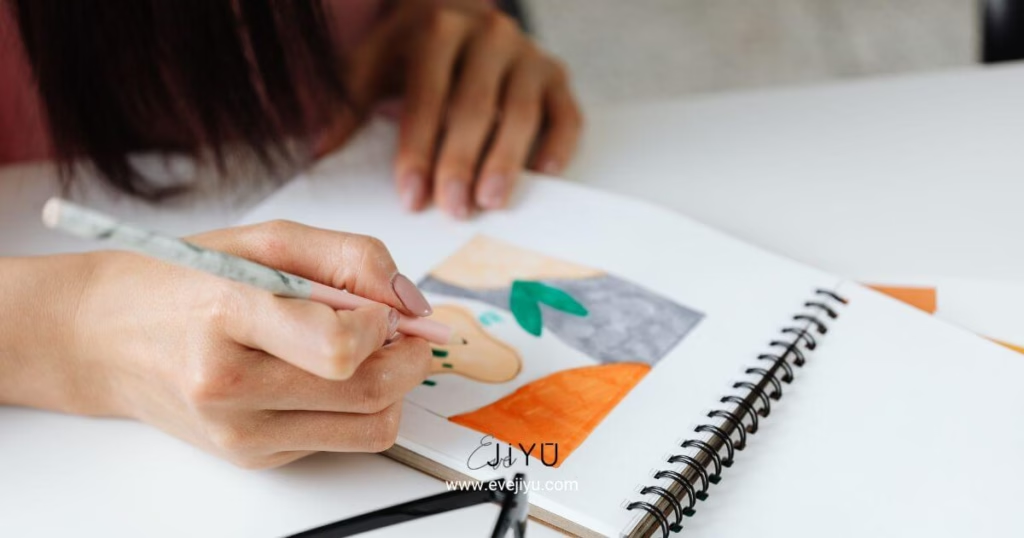
This private work doesn’t function as practice for “real” work you’ll eventually share. This becomes the real work itself, freed completely from the burden of being impressive or marketable or socially acceptable.
I started doing this two years ago with acrylic paints experiments after reading about the concept in a creativity workshop. I bought the cheapest paper I could find specifically so I wouldn’t feel precious about wasting it or making mistakes. Some paintings turned out genuinely terrible by any objective standard. Some surprised me with unexpected beauty or interesting accidents. All of them taught me something about color, composition, or my own preferences that I couldn’t learn while trying to make “good” art that other people would appreciate.
How to Start: Buy a journal or sketchbook that feels affordable rather than precious. Write “PRIVATE” on the cover in permanent marker so you’re not tempted to share excerpts later. Give yourself explicit written permission to make bad art in this space without any pressure to improve or show progress. The goal here involves freedom and experimentation, not quality or achievement.
Goal 3: The “Deep Dive, Not Deadline” Goal
The Structure: Spend three full months exploring one specific topic, technique, or theme with genuine curiosity and no pressure to produce finished work. No output requirements or quotas. No showcase at the end where you display what you learned. Just sustained attention to something that fascinates you.
Why It Works: Depth builds real expertise and authentic confidence in ways that breadth and scattered learning never can replicate. When you give yourself actual time to truly understand something complex rather than rushing through surface knowledge, you develop a unique perspective and intuitive understanding that becomes part of your distinctive creative voice.
Real Example: Spend three months learning everything you can about color theory through whatever methods appeal to you. Read books that explain the technical principles. Watch video tutorials that demonstrate practical applications. Experiment constantly with your own projects. At the end of that period, you won’t just know color theory as abstract information. You’ll have internalized the principles in a way that permanently changes how you see and interpret the world around you.
A landmark study in Psychological Review found that deep, focused ‘deliberate practice’—with specific feedback and attention to improvement—builds expert-level skills far better than scattered practice, creating real competence that transfers across contexts.
How to Start: Choose something you’re genuinely curious about exploring rather than something you think you “should” learn because it’s trendy or marketable. Set a calendar reminder to spend two uninterrupted hours every Saturday morning on this exploration without multitasking. Don’t worry about achieving mastery or becoming an expert. Focus entirely on maintaining fascination and following questions wherever they lead you.
Goal 4: The “Resistance Audit” Goal
The Structure: Track carefully when, where, and why you avoid your creative work for two full weeks without trying to fix anything yet. Notice emerging patterns without judgment or self-criticism. Then address the top three practical obstacles that show up most consistently in your notes.
Why It Works: Most creative blocks don’t stem from lack of talent or insufficient discipline like we typically assume. Blocks usually come from unexamined friction in your environment or process that you can fix once you identify the specific problem clearly. Maybe your workspace feels chaotic and overstimulating. Maybe you only try to create when you’re already exhausted from work. Maybe you’re still carrying harsh criticism from a teacher 15 years ago that surfaces every time you start something new.
Real Example: I discovered through tracking that I never painted in the evenings despite having free time because my studio stayed cold and poorly lit during those hours. I didn’t need more motivation or better time management skills. I needed a space heater and better lighting fixtures that created an inviting atmosphere. Once I fixed the physical environment, painting became almost effortless because the resistance disappeared completely.
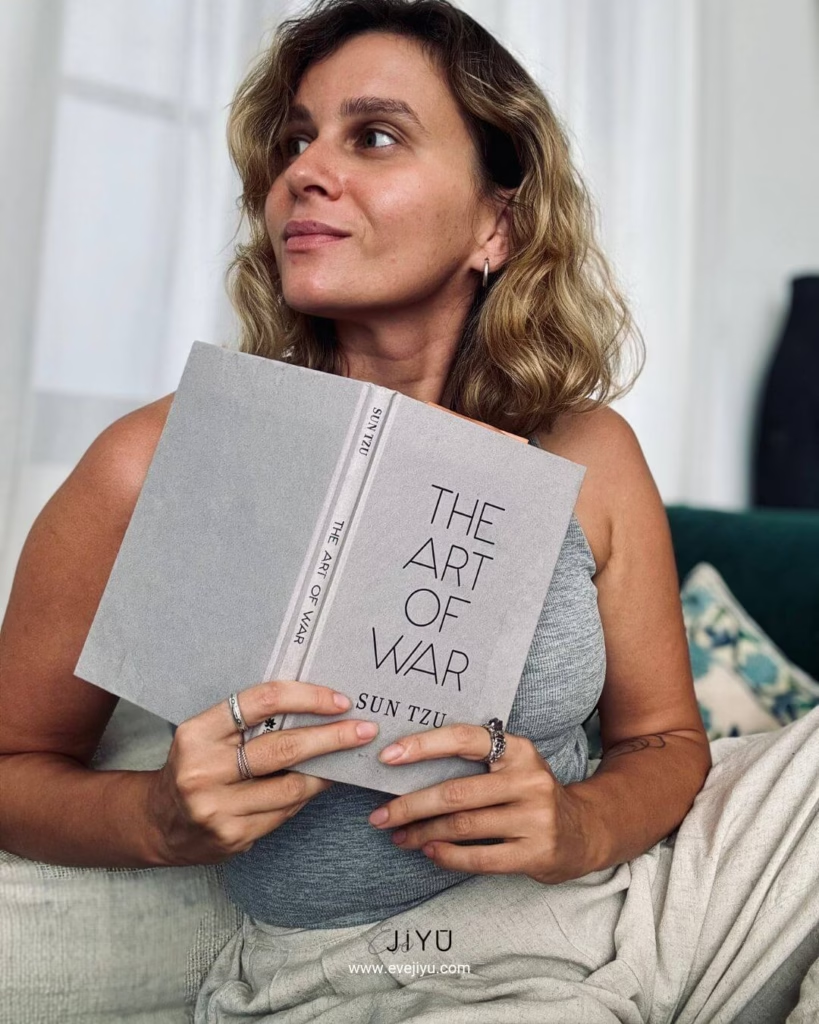
Steven Pressfield explores this concept extensively in “The War of Art,” calling it “Resistance”—the force that keeps you from doing your most important creative work. Resistance isn’t mystical or psychological in most cases. Usually it stems from extremely practical problems you can solve once you identify them clearly.
How to Start: Every single time you think about your creative work but don’t actually do it, write down what stopped you in that moment. “Too tired to think clearly.” “Didn’t have the right materials ready.” “Felt overwhelmed by the scope of the project.” After two weeks of honest tracking, clear patterns will emerge from your notes. Fix the top three obstacles you identify. Watch what happens to your creative output when those barriers disappear.
Goal 5: The “Collaboration Over Competition” Goal
The Structure: Reach out to one creative person per month whose work you genuinely admire. Not to network strategically or promote yourself or build business connections. Simply to have a genuine conversation about their process, their struggles, their small victories that don’t make it to social media.
Why It Works: Creative work feels inherently lonely when you’re working in isolation without community or connection to others doing similar work. Building authentic relationships with other creators reminds you that everyone struggles with doubt, everyone faces the blank page with some version of fear, everyone questions whether they’re good enough to continue.
Real Example: Send a thoughtful message to an artist whose work moves you emotionally rather than just impresses you technically. Ask one specific question about their process that shows you’ve actually looked at their work carefully. Most people respond with surprising generosity when approached with genuine curiosity rather than transactional networking energy that feels manipulative.
Last year I connected with a writer whose personal essays I had admired quietly for months. We talked for over an hour about creative blocks and imposter syndrome and the gap between our internal experience and external perception. That single conversation gave me more clarity and permission than six months of solo journaling because sometimes you need another human to reflect your experience back to you and confirm you’re not alone in what you’re feeling.
How to Start: Make a list of five creatives you admire who aren’t massive celebrities but feel potentially reachable. Not Beyoncé or Stephen King, but people with a few thousand followers or a modest body of published work. Send one message this week that’s short, specific about what you appreciate, and genuinely curious about their experience. See what happens when you approach connection without agenda.
From Ambition to Action: Reframing Goals For Creative People
Big ambitious goals feel intoxicating when you first imagine them or write them down in a fresh journal. They make you feel like you’re going somewhere important and meaningful.
They also trigger crushing imposter syndrome approximately 10 minutes after you announce them publicly or commit to them seriously.
The solution doesn’t involve abandoning ambition or settling for less than what you truly want. The path forward requires translating ambition into sustainable daily action that you can actually maintain without destroying your mental health or relationship with creativity.
Here’s how to reframe common high-achieving goals that creative people set into process-based approaches that won’t destroy you through unsustainable pressure:
| Traditional Outcome Goal | Sustainable Process Goal | Why This Works Better |
|---|---|---|
| Become a full-time professional artist | Treat creative work like a non-negotiable part-time job for six months—show up for 20 hours per week, regardless of whether money comes in yet | Builds the discipline and routine of a professional without the financial pressure that makes most artists quit before they build momentum |
| Grow my social media following | Share one piece of authentic creative work three times per week, then log off the app immediately without checking metrics or engagement | Focuses on expression and healthy boundaries rather than validation, building a body of work that represents your actual voice instead of algorithmic performance |
| Master every creative medium | Dedicate one hour every Saturday morning to experimenting with a new medium with zero expectation of output or expertise—pure play and exploration | Prioritizes curiosity over achievement, helping you discover what genuinely excites you versus what you think you “should” be good at based on external pressures |
| Have my own gallery show | Reach out to one gallery owner or curator each month to ask a thoughtful question about their work, with no pitch or request for your own exhibition | Builds authentic relationships and understanding of the art world ecosystem, so when you eventually have work to show, you know who to approach and how to frame it effectively |
Your Turn: Reframe Your Scariest Goal
Take your biggest, most intimidating creative ambition right now. The one that makes your stomach flip uncomfortably when you say it out loud to another person who might judge you.
Now break that massive goal down into three tiny, immediate process goals that would start you on that path today rather than someday when conditions are perfect.
“Make a comic book” transforms into:
- Sketch three rough character designs this weekend based on people you know
- Write one page of rough dialogue every morning for one week
- Research five comic artists whose visual style resonates with your sensibility
“Paint a mural” transforms into:
- Take photos of 10 walls in your neighborhood that could physically work for a mural
- Create five thumbnail sketches of composition ideas in a notebook
- Practice painting a small test section on cardboard to understand the scale
The difference becomes immediately clear: the big goal stays alive as a direction and possibility. You’re just not measuring success by whether you achieved the massive outcome. You’re measuring success by whether you showed up to the work that moves you toward it, one small action at a time.

Your Quietly Authentic Success
Creative goal setting doesn’t demand that you hustle harder or dream bigger than you already do. The practice centers on aligning your ambitions with your actual life, your actual energy patterns, your actual values and needs as a whole human being rather than just a productive creative machine.
The goals that stick and sustain you over time make you feel more like your authentic self, not less like the person you recognize in the mirror. They invite you to show up consistently rather than demanding that you perform at peak capacity. They measure success by presence and honest effort rather than perfection or external validation from gatekeepers.
You don’t need a viral moment or prestigious gallery opening or book deal to be a real creative person making meaningful work. You need a practice that feels sustainable over years and decades. Work that matters to you personally regardless of whether anyone else notices or cares. Tiny wins that compound into something you’re genuinely proud of when you look back.
That represents the kind of success that lasts beyond temporary trends and recognition. Not because the results impress other people, but because the practice stays true to who you are and what you need from your creative work.
What Comes Next
Ready to go deeper? Your next step depends on where you are right now:
- If you’re ready to fully own your creative path and develop the authentic expression that’s been waiting for permission, explore the complete guide to finding your creative voice with practical and psychological tools.
- If you’re realizing your goals have been leading you toward exhaustion rather than fulfillment, you might recognize yourself in one of the five patterns that keep women stuck. Take the quiz to identify which pattern runs your life, then learn exactly how to break free.
- Start with one goal from this article today. Pick the one that feels most doable right now. Share your process in the comments below so we can support each other.
You’re not starting from zero or from some imagined ideal position. You’re starting from here, from this exact moment of honest recognition that something needs to change in how you approach your creative work.
That awareness alone represents exactly where every meaningful transformation begins.
Frequently Asked Questions
What are some creative goals examples for artists or writers?
Focus on process-based goals like “Write for 30 minutes three times per week” or “Complete one painting per month” rather than outcome goals like “Get published” or “Sell work.” This sustainable creative goals approach builds genuine confidence through consistent action you can directly control rather than depending on external validation or market conditions beyond your influence.
How can I avoid burnout when setting creative goals?
The key involves intentional goal setting that aligns with your well-being and energy patterns, not just your ambition or what others expect from you. Set small, process-focused goals that honor your actual capacity. Build in rest and reflection periods between intense creative phases. Give yourself explicit permission to complete “good enough” work instead of demanding perfection at every stage. Remember that creativity thrives in spaciousness and ease, not constant pressure and anxiety about performance.
What is a “Creative Voice” goal?
A Creative Voice goal prioritizes authentic expression over external validation or market appeal. Instead of “Build a large following,” try “Create work that genuinely represents my perspective, even if it’s not trendy or commercially viable right now.” This type of goal focuses on developing your unique artistic identity and point of view rather than chasing metrics, approval, or someone else’s definition of success.
What are artistic goals examples that focus on sustainable growth?
Artistic goals that support sustainable growth include daily practice rituals like sketching for 15 minutes each morning, monthly experimentation with new techniques without pressure to create finished pieces, quarterly deep dives into specific art history periods or contemporary artists who inspire you, and building genuine relationships with other artists through regular studio visits or honest conversations about creative process and challenges.

0 Comments