
In This Article

Set goals that actually stick without sacrificing your sanity. Learn a sustainable goal setting framework built for high-achievers who refuse to burn out by February.
You wake up on January 2nd with a pristine planner and three color-coded spreadsheets detailing exactly how you’ll transform your entire life by March. I’ve been that woman more times than I care to admit.
The one who sets 17 goals, joins two gym memberships, downloads four productivity apps, and then spends Valentine’s Day face-down in a pint of ice cream wondering why she can’t just get her life together. Here’s what nobody tells you about new year goals that last without burnout: they look nothing like the goals you’ve been setting.
The problem isn’t your discipline or your willpower. The problem is that most goal-setting advice was written for people who don’t already push themselves to the edge of exhaustion on a regular Tuesday. Goal setting for high-achievers requires a completely different approach that starts with subtraction instead of addition and treats rest as a strategy rather than something you earn after you’ve already collapsed.
This article walks you through the Resilience-First Framework, a six-step process I built after burning out twice trying to follow traditional goal-setting advice. You’ll learn how to choose values-driven goals that align with what actually matters to you, build in recovery before you need it, and create a monthly review system that doesn’t make you feel like garbage. No vision boards or hustle required—just honest work that produces new year goals that last without burnout.
Goal Setting for High-Achievers: De-Cluttering the ‘Shoulds’
Most of us don’t actually set goals when we sit down in January. We collect obligations and call them ambitions. I spent many years setting goals based on what I thought successful women were supposed to want: the promotion, the side business, the perfectly curated home, the effortlessly toned body, the thriving social life.
Every January, I’d write them all down with genuine enthusiasm. Every March, I’d quietly delete the list and pretend it never existed. The issue wasn’t the goals themselves but rather that none of them actually belonged to me. This is the first challenge in creating new year goals that last without burnout: distinguishing between what you want and what you think you should want.
The Anti-Cliché Checklist: What to Remove First
Before you add anything to your goal list this year, run it through this filter and cross off any goal that exists because someone else has it. If your goal showed up after scrolling Instagram or attending a friend’s promotion party, pause and ask yourself if you actually want this thing or if you just want to stop feeling behind. Remove goals that make you feel anxious when you think about them because real goals energize you, even when they’re hard. Goals based on external pressure drain you before you even start.
Watch for the word “should” because this is the most reliable detector of a goal that doesn’t belong to you. “I should start a business” or “I should lose weight” or “I should be further along by now” aren’t goals at all—they’re internalized judgments. Finally, eliminate anything that requires you to become a different person because goals work best when they’re extensions of who you already are rather than rejections of your current self.
I cut my goal list from 12 items to 2 when I ran this filter honestly, and those two goals are the only ones I actually completed that year. This ruthless elimination is essential for goal setting for high-achievers because we tend to overcommit and then burn out trying to do everything at once.

Step 1: Discover Your Core Values (The North Star)
Most goal-setting systems start with outcomes by asking where you want to be in five years, what you want to accomplish, or how much money you want to make. Values-driven goals start somewhere else by asking who you want to be. This sounds abstract until you try it because values aren’t personality traits or aspirations—they’re the principles you want your life to reflect.
When I ask workshop participants to list their values, they usually say things like “success” or “happiness,” but these aren’t values at all. Values answer a different question: What kind of person do you want to be when things get hard? Try this instead by thinking about the last time you felt genuinely proud of yourself, not accomplished but proud. What were you doing and what quality were you embodying?
For me, it was the day I said no to a lucrative project that would have required me to compromise my boundary around weekend work. I felt proud because I chose integrity over opportunity, and that’s a value that I could name and use. Once I named it, every goal I set started to make more sense because I had a clear filter for decision-making. This clarity is fundamental to creating new year goals that last without burnout because when your goals align with your values, you don’t need willpower to sustain them.
Reflective questions to clarify your values:
- What makes you angry about the world right now, given that anger often points to violated values?
- When have you felt most like yourself in the past year? What would you want people to say about you at your retirement party?
- If you could only teach your younger self one principle, what would it be?
Common values that show up for high-achieving women include autonomy, creativity, connection, growth, integrity, peace, contribution, and authenticity, though yours may look completely different. Once you identify your top three values, every goal you set should connect back to at least one of them. If a goal doesn’t connect to your core values, it doesn’t belong on the list. This is how you build values-driven goals that sustain your energy instead of depleting it.
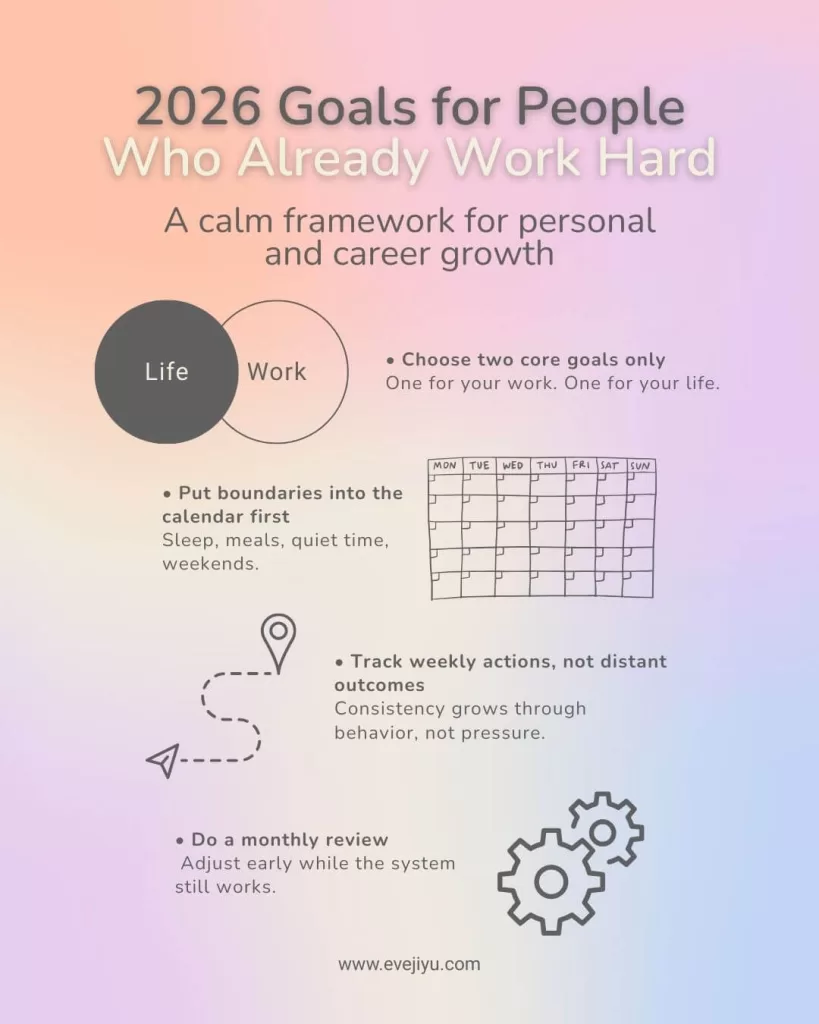
Step 2: The Two-Goal Rule (Strategic Limitation)
Here’s where I’m going to lose half of you: you’re only allowed two primary goals for the year, with one being professional and one being personal. I can already hear the protests about wanting to grow your business AND write a book AND get healthy AND improve your relationships AND learn Spanish. I wanted all of that too, but the problem is that high-achievers are exceptionally good at starting things and exceptionally bad at finishing them. We treat our lives like buffets where we pile our plates high and then wonder why we feel sick.
The two-goal rule forces you to prioritize because not everything can be equally important. When everything is a priority, nothing receives the focused attention it needs to actually succeed. Research from the Dominican University of California found that people who wrote down their goals, made commitments, and shared progress with a friend reported significantly higher goal achievement than people who only thought about their goals, highlighting the power of focused, specific goals plus accountability. The advantage came from having concrete, clearly defined goals that were tracked and revisited, rather than vague intentions held in your head.
The two-goal rule doesn’t mean you ignore the other areas of your life. You choose two things to actively build and let the rest exist in maintenance mode. I chose to grow my writing practice and repair my relationship with rest during one particularly difficult year. Everything else was maintenance, which meant I still showed up to work, still saw friends, and still exercised, but I wasn’t trying to transform those areas while also transforming two others.
The result? I actually finished something for the first time in five years, and that completion built momentum I’d never experienced before. This strategic limitation is crucial for creating new year goals that last without burnout because it prevents the overwhelm that leads to abandoning all your goals by March.
How to choose your two goals:
Write down every goal you’re considering and be honest by including the ones you think you “should” want. Cross out anything that doesn’t connect to one of your core values. Of what remains, ask which of these will you regret not pursuing one year from now. Choose one professional goal and one personal goal from what’s left. Put the rest in a “future goals” list where they’re not gone but simply not now.
This process feels painful, and that’s how you know the prioritization is actually working. The discomfort means you’re making real choices instead of keeping all options open, which is how we usually avoid January burnout without realizing it.
How to Avoid January Burnout: The Anti-Perfectionism Protocol
January burnout doesn’t happen because you’re lazy but rather because you’re trying to run a marathon at sprint pace. High-achievers set goals the same way they approach everything else: with maximum intensity, minimal rest, and an unspoken belief that if they’re not suffering, they’re not working hard enough. I used to start every year with a brutal schedule that required waking up at 5 AM, meditating for 30 minutes, journaling for 20, working out for an hour, making a green smoothie, responding to emails before 7, and writing for two hours before work—all while maintaining this routine every single day without exception.
By January 15th, I was sleeping through my alarm. By February, I’d abandoned the whole thing and spent three weeks in a shame spiral wondering what was wrong with me. The problem wasn’t my lack of discipline but rather my refusal to build in recovery from the start. This is the critical insight for goal setting for high-achievers: we need to design our goals around our human limitations rather than pretending those limitations don’t exist.

Step 3: Integrate Your Boundaries First
Most people set goals and then try to fit their life around them, but a sustainable goal setting framework flips this entirely. You protect your boundaries first, then build your goals around what remains. Your boundaries are the non-negotiable practices that keep you functional: sleep, meals, movement, downtime, connection, and whatever else you need to not fall apart. These aren’t rewards you earn after you hit your goals but rather the foundation that makes goal pursuit possible in the first place.
Before I set my writing goal one year, I identified my non-negotiables: 7 hours of sleep, one full day off per week, daily walks, and no work after 6 PM. Then I looked at my calendar and asked a simple question: Given these boundaries, how much time do I actually have for my writing goal? The answer was less than I wanted—about 90 minutes four days a week.
I could either respect that reality or set an unrealistic goal and burn out trying to meet it, so I chose to respect it. I set a goal of writing 500 words four times a week, which wasn’t sexy or impressive but was doable within my actual life. I hit that goal for nine months straight, making it the first goal I’d ever sustained past March. This boundary-first approach is essential for creating new year goals that last without burnout because it acknowledges that rest isn’t optional—it’s the foundation of sustainable achievement.
Practical exercise: Build your boundary scaffold
List your non-negotiable practices by identifying the ones you know you need to function. Mark them in your calendar first, before anything else gets scheduled. Look at what time remains because that’s your available capacity for goal pursuit. Set goals that fit within that space rather than goals that require you to eliminate your boundaries.
If your goals don’t fit within your available capacity, either reduce the scope of your goals or extend your timeline accordingly. This feels like giving up at first, but you’re actually giving up the fantasy of infinite capacity so you can work with your actual human limits. This realistic assessment is how you avoid January burnout before it even starts.
Step 4: The Power of Committed Action (The ACT Principle)
Traditional goal-setting focuses on outcomes like losing 20 pounds, making six figures, or writing a book. The problem with outcome-focused goals is that you don’t control outcomes, so you can do everything right and still not get the result you want. When that happens, you either blame yourself or quit entirely. Committed action works differently by focusing on the behavior you can control rather than the outcome you can’t control.
Instead of “lose 20 pounds,” the committed action becomes “move my body four times a week in ways that feel good.” Instead of “make six figures,” it becomes “pitch two clients every week and track my follow-up.” Instead of “write a book,” it becomes “write 500 words four days a week.” The outcome might still happen, but your sense of success doesn’t depend on it. You succeed every time you take the action, regardless of the result.
This shift in focus is crucial for goal setting for high-achievers because we’re conditioned to measure ourselves by outcomes, which creates anxiety and perfectionism. When you measure yourself by committed actions instead, you build consistency and reduce the psychological pressure that leads to burnout. Think of it like a river versus a waterfall because a waterfall is dramatic and powerful, but it crashes hard. A river moves slowly and steadily without needing force—just consistency.
Your new year goals that last without burnout should feel like rivers rather than waterfalls. They should be sustainable, steady, and grounded in behaviors you can control regardless of external circumstances or outcomes.
Reflective questions for committed action:
- What specific behavior can I commit to, regardless of outcome?
- How often can I realistically do this behavior given my current life?
- What will I do when I miss a day, because you will miss days?
- How will I know I’m succeeding, even if I don’t see results yet?
Step 5: Self-Compassion as a Performance Metric
High-achievers treat themselves like machines by expecting perfect performance, flawless execution, and no margin for error. Then we’re shocked when we burn out despite all our careful planning. Self-compassion isn’t about lowering your standards but rather about treating yourself like someone you’re trying to keep alive for the long term.
When you miss a workout, you don’t spiral into self-criticism. You ask what got in the way and what you need to adjust. When you fall behind on your goal, you don’t quit in shame. You pause and recalibrate your approach. When your plan stops working, you don’t blame yourself. You change the plan based on new information.
Research on self-compassion shows it’s strongly associated with emotional wellbeing—including greater happiness, life satisfaction, and motivation. Contrary to popular belief, self-compassion doesn’t lead to complacency but rather increases personal initiative and resilience when facing difficulties.[attached_file:1] The ability to adjust your strategy without destroying your self-worth is the most important skill for making New Year’s goals that last without burnout.
I started tracking this as a metric by marking every time I encountered a setback and responded with curiosity instead of criticism. Some months, that was my only measurable progress, and it was enough to keep me going. This approach is fundamental to a sustainable goal setting framework because it acknowledges that perfection isn’t possible and that flexibility is a strength rather than a weakness.
Practical exercise: The self-compassion audit
When you notice you’re off track, pause before reacting automatically. Ask what you would say to a friend in this situation. Say that to yourself instead of your usual self-criticism. Adjust your plan based on what you learned rather than based on what you think you “should” do. Track how many times you do this in a month and celebrate that number.
This practice helps you avoid January burnout by removing the shame cycle that causes most people to abandon their goals entirely. When you can adjust without self-punishment, you stay engaged with your goals even when progress isn’t linear.
Making New Year Goals That Last: The Monthly Audit
Goals don’t fail in December but rather in February when nobody’s checking in anymore. Most goal-setting systems front-load all the energy into January with big plans, fresh starts, and maximum motivation. Then silence takes over. By March, you’ve either quietly given up or you’re clinging to a plan that stopped working weeks ago.
The Resilience-First Framework treats monthly reviews as the most important part of the process because this is where you catch drift before it becomes a crash. This ongoing accountability is what transforms aspirational goals into new year goals that last without burnout because it provides regular opportunities for course correction before small problems become major obstacles.

Step 6: The Mid-Month Check-In (Accountability Without Shaming)
Traditional check-ins ask whether you hit your target, which creates a binary where you either succeeded or failed. For high-achievers, that binary usually triggers shame, and shame triggers avoidance. The Resilience-First check-in asks different questions that focus on alignment rather than achievement. This reframing is essential for goal setting for high-achievers because we’re already prone to perfectionism and self-criticism.
Was my action aligned with my core value?
Even if you didn’t hit your target, did you take action that reflected who you want to be? If yes, that’s success while the outcome is secondary. This question reconnects you to your values-driven goals instead of external metrics of achievement.
What got in the way?
Ask this not as self-criticism but as data collection. Did you underestimate the time required, did something unexpected happen, or did you need more rest than you planned for? This information tells you what to adjust moving forward. The goal is to gather information about your patterns and capacity, not to find evidence of your inadequacy.
What support do I need?
Most of us try to solve goal problems by working harder, but the better question is what resource, system, or support would make this easier. Maybe you need accountability, a different time of day, or a reduced scope that better matches your capacity. This question acknowledges that struggling doesn’t mean you’re weak—it means you need different support structures.
Am I still interested in this goal?
Give yourself permission to admit when something isn’t working because just because you wanted it in January doesn’t mean you have to want it in April. This question is crucial for creating new year goals that last without burnout because it allows you to pivot before resentment builds and leads to complete abandonment.
I do this check-in on the 15th of every month, and it takes about 30 minutes. I write my answers in a document so I can see patterns over time. Last year, I noticed I consistently fell behind on my goals during the first two weeks of my cycle. Once I saw the pattern, I adjusted my expectations for those weeks by planning less rather than trying harder. That one shift doubled my consistency.
The ‘Pivot’ vs. The ‘Failure’: Giving Yourself Permission to Change Course
High-achievers hate quitting because we see it as weakness or proof that we weren’t disciplined enough. There’s a difference between quitting because something is hard and pivoting because something isn’t serving you. Quitting is reactive—you’re frustrated, so you give up. Pivoting is strategic—you’ve gathered data, and the data says this path isn’t working for you.
I started a podcast last year, and by month three, I dreaded every recording session. I kept going because I didn’t want to be someone who quits. At my monthly review, I asked whether this goal was still aligned with my values. The honest answer was no because I’d started the podcast thinking I “should” have one rather than because I wanted it.
I retired the goal without shame and instead with clarity. That freed up energy for a goal that actually mattered: launching my journaling framework. This ability to pivot is a key element of a sustainable goal setting framework because it acknowledges that not all goals deserve to be finished, and that discernment is a valuable skill.
Reflective questions for pivoting:
- Does this goal still align with my core values?
- Am I avoiding this goal because the work is hard or because the goal doesn’t actually belong to me?
- What would I do if I gave myself full permission to change my mind?
- If I were starting over today, would I choose this goal again?
Pivoting isn’t failure—it’s intelligence in action. It’s how you avoid January burnout by refusing to pour energy into goals that no longer serve you just because you declared them important three months ago.
Automating Recovery Before You Need It
The final element in the monthly audit is the most overlooked: scheduling your recovery in advance. Most of us rest when we collapse by waiting until we’re so exhausted that we have no choice. By then, the damage is done because you’re not recovering—you’re repairing. The sustainable goal setting framework builds rest into the system from the start as a required element rather than an optional reward.
At the end of every monthly check-in, I schedule my recovery for the next month: one full day off per week, one long weekend per quarter, and one week completely off per year. These are marked in my calendar before I schedule any work, and they’re treated as non-negotiable commitments. When I skip them, my performance drops within two weeks. When I protect them, I stay consistent for months.
This proactive approach to rest is essential for new year goals that last without burnout because it acknowledges that recovery isn’t a luxury you indulge in after you’ve already accomplished something—it’s the fuel that makes accomplishment possible in the first place.
Practical exercise: Pre-schedule recovery
Look at your calendar for the next three months. Mark one full day off per week with no work, no email, and no goal-related activity. Mark one long weekend per quarter for deeper rest. Mark one full week off in the next 12 months. Treat these dates as seriously as you’d treat a client meeting. When someone tries to schedule over them, say no without guilt.
This feels indulgent at first, but you can’t sustain goal pursuit without regular recovery. This is how you avoid January burnout not just in January but throughout the entire year.
Beyond the Finish Line: What Success Actually Looks Like
I used to think success meant hitting every goal I set with perfect execution and flawless follow-through. Now I think success means still liking myself at the end of the year. Success means I pursued goals that actually mattered to me rather than goals I thought would make me impressive to others. Success means I adjusted my plans when they stopped working instead of forcing myself to keep going out of stubbornness. Success means I rested before I broke instead of after.
New year goals that last without burnout aren’t about achieving more but rather about building a relationship with goal-setting that doesn’t destroy you in the process. You’ll miss days, fall behind, and have months where nothing goes according to plan. The question isn’t whether you’ll face obstacles but rather how you’ll respond when you do. Will you spiral into shame and quit, or will you pause, adjust, and keep going? Resilience matters more than perfection.
This shift in perspective is what makes goal setting for high-achievers sustainable over the long term. When you measure success by your ability to stay engaged with your goals rather than by perfect execution, you build the kind of consistency that actually produces results. When you prioritize values-driven goals over impressive-sounding goals, you create intrinsic motivation that doesn’t require constant willpower to maintain.
Summary of the Resilience-First Framework:
Start with values rather than outcomes by choosing goals that reflect who you want to be. Limit yourself to two primary goals—one professional and one personal. Protect your boundaries before setting your goals because rest isn’t optional. Focus on committed actions you can control rather than outcomes you can’t. Treat self-compassion as a performance metric where adjustment without shame equals success. Conduct monthly check-ins that focus on alignment rather than just achievement. Pre-schedule recovery before you need it because rest is strategy rather than reward.
If you’re ready to figure out exactly where you’re getting stuck, take the Stuck in Life Quiz for Women. The quiz helps you identify your specific pattern and gives you a starting point for the work ahead. And if burnout is already knocking on your door, start here: The Busy Woman’s Guide to Stress Management & Burnout Recovery.
You don’t need another year of trying harder—you need a system that works with your actual life instead of demanding you sacrifice it. The Resilience-First Framework gives you that system by creating new year goals that last without burnout through strategic limitation, boundary protection, and ongoing compassion. This approach to goal setting for high-achievers acknowledges both your ambition and your humanity, creating space for sustainable achievement that doesn’t cost you your wellbeing. When you build values-driven goals using a sustainable goal setting framework, you create lasting change that feels like expansion rather than exhaustion.
About Eve Jiyū
I create calm, grounded content for women who are done performing and ready to start living. If you’re tired of hustle culture and looking for a more honest approach to self-discovery, you’re in the right place. Find more at evejiyu.com.







0 Comments