
In This Article
Discover practical, grounded meditation techniques that actually work for busy, overthinking minds—even if you’ve tried meditation before and thought it wasn’t for you.
I used to think meditation was something other people did. The kind of people who woke up at 5 AM without an alarm, who could sit cross-legged for an hour without their legs falling asleep, who never felt the urge to check their phones mid-practice.
I tried meditation once in my early twenties. I sat on a cushion, closed my eyes, and waited for the calm everyone promised. Instead, my mind produced a grocery list, replayed an awkward conversation from three days earlier, and reminded me of seven unfinished tasks. After ten minutes of mental chaos, I decided meditation just wasn’t for me.
What I didn’t understand then: meditation isn’t about having a quiet mind. It’s about learning to be with your mind exactly as it is.
If you’re skeptical about whether meditation actually works, I get it—I used to think meditation was pseudoscience until neuroscience proved me wrong.
The techniques in meditation I’ll share aren’t about achieving some enlightened state or becoming a different person. They’re about finding small pockets of calm in the middle of your actual life. Some will resonate immediately. Others might feel awkward at first. That’s normal. The goal isn’t perfection—it’s finding what works for you.
What Are Techniques in Meditation? (And Why They Matter)
When most people say “I can’t meditate,” what they really mean is: “I tried one approach once, and it didn’t work.”
Meditation isn’t a single practice. It’s a collection of techniques, each designed to work with different aspects of your experience. Some focus on the breath. Others use movement, visualization, or even sound. The technique you choose matters less than finding one that feels accessible to your nervous system right now.
Think of meditation techniques like different ways to exercise. Running works for some people. Others need yoga or swimming. All of them build physical health, but the path looks different depending on your body, your preferences, and what you’re working with.
The same applies to learning how to do meditation. There’s no universal “right way.” There are only practices that either meet you where you are or ask you to be someone you’re not yet ready to become.
The Difference Between Technique and State
A meditation technique is the method—the specific thing you do. Breath counting, body scanning, repeating a phrase. These are techniques.
The state is what sometimes happens as a result: calm, clarity, presence. But here’s the part that trips people up. The state isn’t guaranteed, and it’s not the goal. You don’t fail at meditation because you didn’t achieve a particular feeling. You practice the technique, and over time, your nervous system learns to regulate itself more easily.
This distinction matters because it removes the pressure. You’re not trying to force calm. You’re practicing a skill that makes calm more accessible.
The 9 Proven Techniques in Meditation
Each of these techniques works differently. Some will feel natural immediately. Others might feel strange or uncomfortable at first. That’s information, not failure. Pay attention to what draws you in and what makes you resistant. Both responses are useful.
1. Breath Awareness Meditation (The Foundation)
This is where most people start when they learn how to do mindfulness meditation, and for good reason. Your breath is always available. You don’t need special equipment, a quiet room, or a specific posture. You just need to notice what’s already happening.
Breath awareness works because it gives your mind something neutral to focus on. When you’re anxious, your thoughts spiral into worst-case scenarios. When you’re overwhelmed, your attention fragments into a thousand directions. The breath becomes an anchor—not because breathing is magical, but because it’s simple and repetitive.
Neuroscience studies show that mindful attention to the breath engages prefrontal regions involved in attention and self‑regulation and reduces amygdala activation during emotional stress, making mindfulness a biological emotion‑regulation tool rather than mysticism.
How to practice:
- Sit somewhere comfortable. You don’t need to sit cross-legged on the floor. A chair works fine.
- Close your eyes or soften your gaze downward.
- Notice your breath without trying to change it. Feel the air entering your nostrils, filling your lungs, leaving your body.
- When your mind wanders (it will), gently bring your attention back to the breath. This isn’t failure. This is the practice.
- Start with three minutes. That’s enough.
Who this is for:
Anyone new to meditation. Anyone who needs a simple, portable practice. Anyone whose mind feels too loud to sit with silence.
2. Body Scan Meditation (For Stress You Carry Physically)
Stress doesn’t just live in your thoughts. It lives in your shoulders, your jaw, the tight knot between your shoulder blades. You might not even notice how much tension you’re holding until you stop and check in.
Body scan meditation is one of the most effective mindfulness practices for people who feel disconnected from their bodies. It teaches you to notice sensation without judgment and to release tension you didn’t realize you were carrying.
If anxiety shows up as physical tension—tight chest, racing heart, shallow breathing—this practice works especially well alongside these mindfulness exercises specifically designed for anxiety.
I started practicing body scans during a period of intense burnout. I thought I was managing stress fine, but my body told a different story. My shoulders were permanently hunched. My jaw ached from clenching. I had tension headaches three times a week. The body scan didn’t fix everything overnight, but it taught me to notice the warning signs before they became unbearable.
How to practice:
- Lie down or sit in a comfortable position.
- Close your eyes and take three deep breaths.
- Starting at the top of your head, slowly move your attention down through your body. Notice your forehead, your jaw, your neck, your shoulders. Don’t try to change anything. Just notice.
- When you find tension, breathe into that area. Imagine the breath softening the tightness.
- Continue down through your chest, your arms, your abdomen, your legs, all the way to your feet.
- This usually takes 10 to 20 minutes, but even a five-minute version works.
Who this is for:
People who carry stress physically. People recovering from burnout. People who feel numb or disconnected from their bodies.
If you struggle with anxiety that shows up as physical symptoms—racing heart, tight chest, shallow breathing—this technique can help you interrupt the cycle before it spirals.
3. Mindfulness of Thoughts (Without Trying to Control Them)
This is the technique that changed how I understood meditation. For years, I thought the goal was to stop thinking. Every time a thought appeared, I saw it as proof that I was doing it wrong.
Then I learned that thoughts aren’t the problem. Fighting them is.
Mindfulness of thoughts teaches you to observe your thinking without getting pulled into the storyline. You watch thoughts appear and disappear like clouds passing through the sky. You don’t judge them, suppress them, or believe everything they say. You just notice them.
This is how you practice mindfulness in daily life, not just during formal meditation. When you catch yourself catastrophizing about a work deadline or replaying an awkward conversation, you can pause and think: “That’s a thought. It’s not necessarily true.”
How to practice:
- Sit quietly and close your eyes.
- Instead of focusing on your breath or body, let your attention rest on the flow of thoughts.
- When a thought appears, silently label it. “Worry.” “Planning.” “Memory.” “Judgment.”
- Don’t engage with the content. Just notice the thought, label it, and let it pass.
- If you get pulled into a thought (you will), that’s fine. Notice that you got pulled in, and gently come back to observing.
Who this is for:
Overthinkers. People who struggle with repetitive negative thoughts. People who want to build more space between their thoughts and their reactions.
4. Loving-Kindness Meditation (When Self-Criticism Is Loud)
If your inner voice sounds more like a harsh critic than a supportive friend, loving-kindness meditation can help soften that relationship.
This practice involves directing phrases of goodwill toward yourself and others. It sounds simple, but for many women, saying kind words to themselves feels awkward or even impossible at first. We’ve been conditioned to be hard on ourselves, to push through, to never quite be enough.
Loving-kindness meditation works by gently rewiring those patterns. Research on loving‑kindness meditation shows it reshapes brain networks by reducing connectivity in default‑mode regions tied to self‑referential thinking and enhancing engagement of regions involved in emotion processing and empathy, supporting shifts away from ‘am I good enough?’ loops toward compassionate relating.
How to practice:
- Sit comfortably and close your eyes.
- Start by directing kind phrases toward yourself. You can use traditional phrases like “May I be safe. May I be healthy. May I be at peace.” Or create your own.
- If it feels too vulnerable to start with yourself, begin by thinking of someone you love—a friend, a pet, a child. Send those phrases to them first.
- Gradually expand the circle. Send kindness to someone neutral (a cashier you saw today), then to someone difficult, then to all beings.
- Even five minutes of this practice can shift your emotional tone for the day.
Who this is for:
People with loud inner critics. People who struggle with self-compassion. People recovering from perfectionism or people-pleasing patterns.
5. Guided Meditation (For Busy or Overthinking Minds)
Sometimes the hardest part of meditation is deciding what to do. Should I focus on my breath? Do a body scan? Count something? The decision fatigue alone can keep you from starting.
Guided meditation removes that barrier. Someone else provides the structure. You just follow along.
I resisted guided meditations for a long time because I thought they were “cheating.” I believed real meditation meant sitting alone in silence. But guided practices aren’t less legitimate. They’re just different. And for many people, they’re the most accessible entry point.
How to practice:
- Find a guided meditation app or recording. Youtube, Insight Timer, Calm, and Headspace all offer free options.
- Choose a length that feels manageable. Even three minutes counts.
- Sit or lie down, press play, and follow the instructions.
- If your mind wanders, that’s normal. The guide will bring you back.
Who this is for:
Beginners. People who struggle to meditate alone. People who need structure and don’t want to figure it out themselves.
6. Walking Meditation (For People Who Hate Sitting Still)
Not everyone can sit still for ten minutes. Some bodies need movement. Some nervous systems regulate better when they’re in motion.
Walking meditation is one of the types of meditation that bridges formal practice with daily life. You’re not sitting in a special position or closing your eyes. You’re just walking, but you’re doing it with full attention.
I practice walking meditation on days when sitting feels impossible. When my mind is too restless or my body too tense. I walk slowly through my neighborhood or along the beach, noticing each step, each breath, each shift in weight.
How to practice:
- Find a place where you can walk slowly without worrying about traffic or obstacles. Your living room works fine.
- Start walking at a natural pace, then gradually slow down.
- Notice the sensation of each foot lifting, moving through space, and touching the ground.
- Feel the weight shifting from one leg to the other.
- When your mind wanders (it will), bring your attention back to the physical sensation of walking.
- Even five minutes of this can reset your nervous system.
Who this is for:
People who find sitting meditation uncomfortable. People with restless energy. People who want to practice mindfulness while moving through their day.
7. Visualization Meditation (Using the Mind as an Ally)
Your brain doesn’t always distinguish between something you vividly imagine and something you actually experience. This is why visualization works so well for calming the nervous system.
Visualization meditation involves creating a detailed mental image of a peaceful place or a desired outcome. It’s not about escapism. It’s about giving your nervous system a felt sense of safety and calm.
Athletes use visualization to improve performance. Therapists use it to treat anxiety and PTSD. You can use it to create a mental refuge when life feels overwhelming.
How to practice:
- Sit or lie down in a comfortable position.
- Close your eyes and take a few deep breaths.
- Imagine a place where you feel completely safe and at peace. It could be a real place (a beach you visited once, your grandmother’s kitchen) or an imaginary one.
- Engage all your senses. What do you see? What sounds do you hear? What does the air feel like on your skin? What scents are present?
- Spend five to ten minutes in this imagined space.
- When you’re ready, take a few deep breaths and slowly return to the room.
Who this is for:
People with vivid imaginations. People who struggle with intrusive thoughts. People who need a mental refuge during difficult times.
8. Mantra Meditation (Focus Through Repetition)
Mantra meditation uses repetition to quiet the mind. You choose a word or phrase and repeat it silently, over and over, until it becomes a kind of anchor.
The word doesn’t have to be spiritual or Sanskrit. It can be anything that feels neutral or calming. “Peace.” “Breathe.” “I am here.” The meaning matters less than the rhythm.
When I first tried mantra meditation, I chose the word “enough.” I repeated it slowly, letting it settle into my body. After a few minutes, the word stopped being just a concept. It became a felt sense. A reminder that I didn’t need to earn my worth through constant productivity.
How to practice:
- Sit comfortably and close your eyes.
- Choose a word or short phrase.
- Repeat it silently in time with your breath. Inhale: “I am.” Exhale: “here.”
- If your mind wanders, gently return to the mantra.
- Start with five minutes and gradually increase the time as it feels comfortable.
Who this is for:
People with racing thoughts. People who find breath awareness too abstract. People who like structure and repetition.
9. Micro-Meditation (1–5 Minute Practices That Actually Stick)
Most people abandon meditation because they think they need to do it for 20 or 30 minutes every day. That’s not true. Even one minute of intentional breathing can shift your nervous system.
Micro-meditations are practices short enough that you can’t talk yourself out of them. They fit into the cracks of your day—before a meeting, in the bathroom, while waiting for your coffee to brew.
I use micro-meditations more than any other technique. Three deep breaths before I open my laptop. One minute of body awareness before I get out of bed. Thirty seconds of noticing sounds while I’m stopped at a red light.
These tiny practices add up. They train your brain to return to the present moment more easily, even when you’re not formally meditating.
How to practice:
- Set a timer for one minute.
- Choose one thing to focus on: your breath, the sensation in your hands, the sounds around you.
- Bring all your attention to that one thing for the full minute.
- When the timer goes off, move on with your day.
- Repeat whenever you remember.
Who this is for:
Busy people. Skeptics who think they don’t have time. People who want to build consistency without pressure.
How to Choose the Right Meditation Technique for You
You don’t need to try all nine techniques at once. Start with one that matches where you are right now.
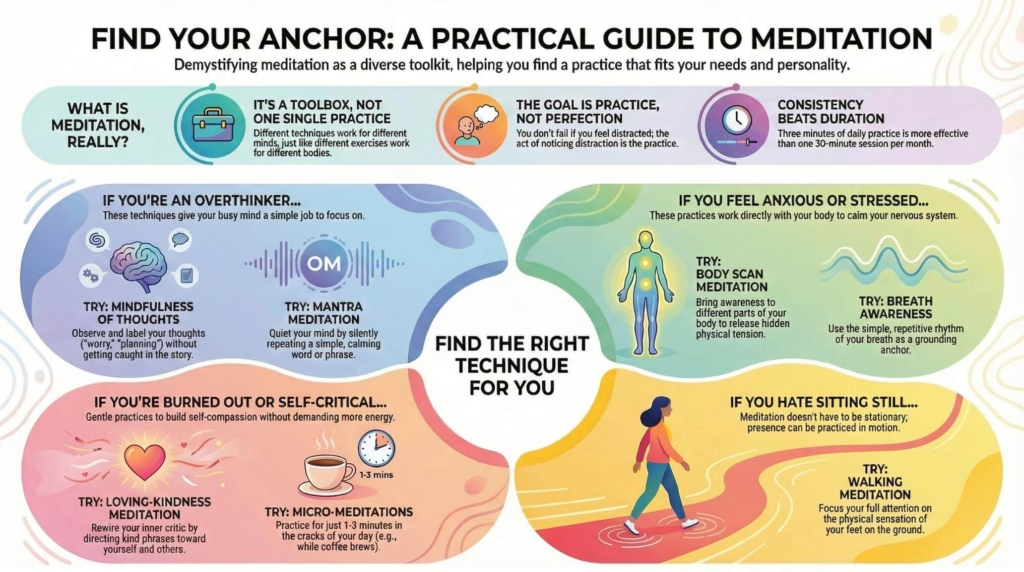
- If you’re an overthinker: Try mindfulness of thoughts or mantra meditation. These practices give your mind something specific to do instead of spinning in circles.
- If you’re anxious: Body scan meditation and breath awareness both calm the nervous system directly. They work with the physical symptoms of anxiety, not just the mental ones.
- If you’re burned out: Loving-kindness meditation and micro-meditations are gentle enough for exhausted nervous systems. They don’t ask you to do more—they ask you to be kinder.
- If you’re emotionally numb or disconnected: Body scan meditation and walking meditation help you reconnect with physical sensation and presence.
- If you’re new to meditation: Guided meditation and breath awareness are the most accessible starting points. They require the least decision-making and provide the most structure.
There’s no hierarchy here. Breath awareness isn’t “better” than walking meditation. Visualization isn’t more advanced than loving-kindness. The best technique is the one you’ll actually practice.
How to Build a Sustainable Meditation Practice (Without Forcing It)
Consistency matters more than duration. Meditating for three minutes every day will change your brain more than meditating for 30 minutes once a month.
The trick is making it easy. Don’t rely on motivation. Build it into your existing routine.
Pair meditation with something you already do. Meditate right after you brush your teeth. Practice breath awareness while your coffee brews. Do a body scan before you get out of bed in the morning.
These small anchors make meditation automatic. You’re not trying to remember to do it. It’s just part of how your morning (or evening, or lunch break) works.
Meditation works best when it’s woven into a larger rhythm of presence—these daily mindfulness and gratitude practices show you how to build that foundation.
When meditation becomes part of a larger mindful rhythm, it stops feeling like one more task on your to-do list. It becomes a way of being present with yourself throughout the day.
Common Meditation Mistakes (That Make People Quit Too Soon)
Most people quit meditation because they’re measuring success by the wrong standard.
- Mistake 1: Expecting instant calm.
Meditation isn’t a light switch. It’s not: sit down, close your eyes, feel peaceful. Some sessions will feel calm. Others will feel restless or frustrating. Both are part of the practice. - Mistake 2: Judging the practice.
If you spend ten minutes noticing how distracted you are, you haven’t failed. You’ve practiced awareness. That’s the whole point. - Mistake 3: Overcomplicating techniques.
You don’t need a meditation cushion, incense, or a perfect quiet space. You need a few minutes and a willingness to try. The simpler you make it, the more likely you are to keep going. - Mistake 4: Thinking “I’m bad at this.”
There’s no such thing as being bad at meditation. If you showed up and tried, you succeeded. The quality of your experience doesn’t determine the value of the practice.
Meditation Isn’t About Becoming Someone Else
I don’t meditate to become calmer or more enlightened or less human. I meditate because it helps me recognize when I’m not present. It reminds me that I have a choice about where I put my attention.
The techniques in meditation I’ve shared aren’t about fixing what’s wrong with you. They’re about coming back to yourself when the world pulls you in too many directions.
Try one technique this week. Not because you have to, but because you’re curious. Notice what happens. Notice what doesn’t happen. Both are useful information.
You don’t need to do all nine. You don’t need to meditate every day. You don’t need to be good at it.
You just need to be willing to try.
Which technique resonates most with you? Have you tried meditation before and struggled? Let me know in the comments—I’d love to hear what’s working (or not working) for you.
If you found this helpful, explore more grounded practices for self-discovery and mindful living in my other articles on creating daily rituals that actually stick.
⬇⬇⬇Pin or save to read later ⬇⬇⬇










0 Comments