
In This Article
Discover the hidden symptoms of low self-esteem that keep high-achieving women feeling disconnected, plus practical tools to rebuild self-trust without toxic positivity or hustle culture.
You look capable on the outside. Your resume is solid. You show up for others. You answer emails at midnight and apologize for taking up space in meetings.
But inside, there’s a quiet hum of not-enough that never fully turns off.
Low self-esteem doesn’t always look like visible insecurity. It often hides behind high performance, people-pleasing, and the carefully curated version of yourself you present to the world. You function well enough that most people would never guess how fragile you feel inside.
This article walks through 11 symptoms of low self-esteem that many women ignore or normalize. These aren’t character flaws. They’re patterns shaped by years of conditioning, unmet needs, and the exhausting work of trying to earn your own approval.
You’ll also find grounded tools to begin rebuilding self-trust. Not through affirmations or motivation. Through awareness, reflection, and the kind of quiet consistency that actually changes the relationship you have with yourself.
Low Self-Esteem Definition (Without the Therapy Speak)
Low self-esteem isn’t just feeling bad about yourself occasionally. It’s a persistent, internalized belief that your worth must be earned through achievement, approval, or perfect behavior.
It’s the voice that says you’re only valuable when you’re producing something. That your needs are too much. That love is conditional on how well you perform.
Most definitions of low self-esteem focus on “negative self-perception.” But that misses the nuance. You can appear confident, articulate, and successful while simultaneously believing you’re never quite enough.
The low self esteem definition that matters most is this: it’s the gap between who you actually are and who you believe you need to be in order to matter.
That gap creates a constant undercurrent of anxiety. You second-guess decisions. You compare yourself to others. You apologize for existing too loudly or taking up too much space.
This isn’t about lacking confidence in specific situations. Confidence is situational. Self-esteem is foundational. It’s the steady, internal belief that you’re worthy of care, rest, and honest expression even when you’re not producing anything impressive.
For many women in their late twenties through early forties, low self-esteem developed slowly. It wasn’t one traumatic event. It was a thousand small moments where your instincts were questioned, your needs were minimized, or your worth was tied to how useful you were to others.
You learned to measure your value externally. And now, years later, you’re exhausted from the endless audition for your own approval.
11 Brutal Symptoms of Low Self-Esteem You Might Be Ignoring
These symptoms of low self-esteem often go unnoticed because they blend into daily life. You might recognize all eleven or just a few that cut particularly deep.
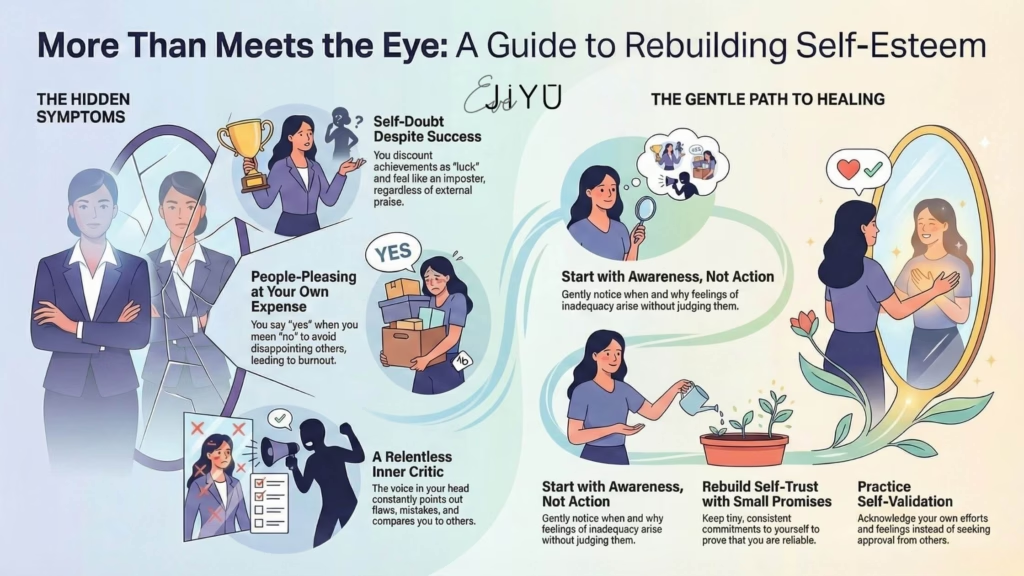
1. Constant Self-Doubt Even After Achievements
You finish a project. It goes well. People praise your work.
And your first thought is: “I got lucky. Someone else could have done it better.”
This isn’t humility. It’s a refusal to claim your competence. You discount evidence of your ability because accepting it would mean trusting yourself, and that feels too risky.
The doubt persists regardless of external validation. You could win awards and still feel like an imposter waiting to be exposed.
2. Overthinking Conversations Long After They End
You replay exchanges for hours. Did you say the wrong thing? Were you too much or not enough? Did that comment sound stupid?
This mental loop happens because you’re constantly assessing whether you met some invisible standard of acceptability. Your brain treats every interaction like a performance review.
Normal social mistakes feel catastrophic. A misunderstood joke or an awkward pause becomes evidence that you’re fundamentally flawed.
3. People-Pleasing at the Cost of Your Own Needs
You say yes when you mean no. You overextend to avoid disappointing others. You shape yourself around what you think people want from you.
This pattern shows up everywhere. At work, you take on extra tasks you don’t have capacity for. In relationships, you suppress your preferences to keep things smooth. At home, you prioritize everyone else’s comfort before considering your own.
People-pleasing feels like kindness, but it’s actually a survival strategy. You learned that your worth depends on being useful, easy, and undemanding.
The cost is high. Resentment builds. Your identity becomes blurry. You lose touch with what you actually want because you’ve spent so long trying to anticipate what others need.
4. Feeling “Not Enough” No Matter What You Do
This is the core symptom of low self-esteem. The goalposts keep moving. You achieve something and immediately focus on the next thing you’re lacking.
You’re not thin enough, successful enough, creative enough, present enough, productive enough. The standards are impossible because they’re designed to keep you striving rather than arriving.
This feeling isn’t about laziness or lack of ambition. It’s about the mistaken belief that your worth is something you have to continuously earn rather than something you inherently possess.

5. Fear of Being Seen, Judged, or Misunderstood
Visibility feels dangerous. You’d rather stay small and safe than risk criticism or rejection.
You keep your opinions vague. You don’t share your creative work. You avoid situations where you might be evaluated or misunderstood.
This fear isn’t about shyness. It’s about the belief that if people truly saw you, they’d find you lacking. So you edit yourself down to a version that feels manageable and unthreatening.
The irony is that this self-protection also prevents genuine connection. People can’t know you if you’re constantly performing a carefully controlled version of yourself.
6. Difficulty Setting Boundaries
Boundaries feel mean. You worry that saying no will make you selfish, difficult, or unlikeable.
So you let people overstep. You accept last-minute requests. You tolerate behavior that drains you because saying something feels riskier than staying silent.
Low self-esteem convinces you that your needs are negotiable. That other people’s comfort matters more than your own. That protecting your time and energy is an act of selfishness rather than self-respect.
Research shows that people with lower self-esteem are less likely to assert boundaries in relationships, leading to increased stress and resentment over time.
7. Harsh Inner Critic That Never Switches Off
The voice in your head is relentless. It points out every flaw, mistake, and imperfection. It compares you unfavorably to others. It tells you that you’re behind, failing, or fundamentally broken.
You would never speak to a friend the way you speak to yourself. But that critical voice feels so familiar that you mistake it for truth.
This inner critic isn’t trying to motivate you. It’s trying to keep you safe by preemptively rejecting yourself before anyone else can. It’s a defense mechanism that has long outlived its usefulness.

8. Comparing Yourself to Other Women Constantly
You scroll social media and feel the familiar ache. She has it together. She’s doing more. She’s further along.
Comparison is the thief of presence. When you measure your worth against someone else’s highlight reel, you stop paying attention to your own life.
This habit intensifies when self-esteem is low because you’re constantly looking outside yourself for evidence of whether you’re acceptable. You use other people as a yardstick instead of developing your own internal sense of worth.
9. Downplaying Your Success
Someone compliments you. Your immediate response: “Oh, it was nothing” or “Anyone could have done it.”
You deflect praise because accepting it feels uncomfortable. You minimize your accomplishments to avoid seeming arrogant or self-absorbed.
But deflection also reinforces the belief that you don’t deserve recognition. Every time you dismiss a compliment, you’re training your brain to discount your value.
10. Staying in Situations That No Longer Serve You
You remain in the job that drains you. The relationship that feels one-sided. The friendship where you’re always the one making effort.
Low self-esteem keeps you stuck because leaving would require believing you deserve better. And that belief feels out of reach.
So you stay. You tell yourself it’s not that bad. You rationalize the discomfort. You wait for conditions to improve rather than trusting yourself to make a change.
11. Feeling Disconnected From Your True Self
You’re not sure what you actually want anymore. Your preferences feel murky. You’ve spent so long adapting to others that you’ve lost touch with your own voice.
This disconnection is one of the quietest but most devastating symptoms of low self-esteem. When your worth feels conditional, you stop consulting your own instincts. You outsource decision-making to avoid the risk of choosing wrong.
You become a stranger to yourself. And that distance grows until you’re living a life that looks fine on paper but feels hollow inside.
How Low Self-Esteem Quietly Shapes Your Life
These symptoms don’t exist in isolation. They ripple out into every area of your life, shaping choices you might not even realize you’re making.
In relationships, low self-esteem shows up as over-giving, difficulty receiving care, and a persistent fear that you’re too much or not enough. You attract partners who confirm your worst beliefs about yourself or you stay in dynamics where your needs remain perpetually unmet.
At work, it manifests as imposter syndrome, chronic overworking, and an inability to advocate for yourself. You underprice your services. You stay silent in meetings. You say yes to projects that drain you because saying no feels impossible.
In creativity and self-expression, low self-esteem keeps your voice small. You don’t share your writing. You don’t post your art. You don’t pursue the projects that light you up because the risk of judgment feels too high.
The reason traditional “confidence tips” don’t work is because they treat self-esteem as a skill to develop rather than a relationship to repair. Affirmations and power poses can’t address the underlying belief that your worth is conditional.
Real change requires something slower and deeper. It requires looking at the patterns you’ve been running, understanding where they came from, and gently building a new foundation.
How to Fix Low Self-Esteem (What Actually Helps)
Fixing low self-esteem isn’t about becoming more confident or forcing yourself to think positively. It’s about rebuilding trust with yourself.
Awareness Before Action
You can’t change what you can’t see. The first step is simply noticing the symptoms of low self-esteem as they show up in real time.
When do you apologize unnecessarily? When do you shrink? When does the inner critic get loudest?
Journaling is one of the most effective tools for this kind of self-observation. Not journaling about what you did today, but journaling to uncover the patterns beneath your behavior.
Questions like “What am I afraid people will think about me?” or “When did I last feel genuinely proud of myself?” create space to see yourself more clearly.
This isn’t about finding everything that’s wrong with you. It’s about understanding the conditioning that shaped your self-perception so you can begin to question it.
Rebuilding Self-Trust (Not Fake Confidence)
Self-trust is built through small, consistent actions. It’s keeping promises to yourself. It’s honoring your needs even when it’s inconvenient. It’s choosing emotional honesty over performance.
Start with one tiny commitment. Maybe it’s writing for ten minutes each morning. Maybe it’s saying no to one thing this week that you don’t have capacity for.
Self-trust grows when you prove to yourself that you’re reliable. That your instincts matter. That you’re capable of making aligned decisions even when they’re uncomfortable.
This process is slow. There’s no shortcut. But every time you choose yourself, the foundation gets a little sturdier.
Why Self-Esteem Is Built Quietly, Not Loudly
Real self-esteem doesn’t announce itself. It’s not about becoming the most confident person in the room or posting daily affirmations.
It’s the quiet knowledge that you’re allowed to take up space. That your needs are valid. That you don’t need anyone’s permission to exist as you are.
You build it in private moments. In the way you speak to yourself after a mistake. In the boundaries you set even when they feel scary. In the choices you make that prioritize alignment over approval.
Consistency matters more than intensity. Small daily practices accumulate into a fundamentally different relationship with yourself.
A Gentle Way to Start Rebuilding Self-Esteem
If you’re reading this and feeling overwhelmed by where to begin, I want to offer you a structured but emotionally safe starting point.
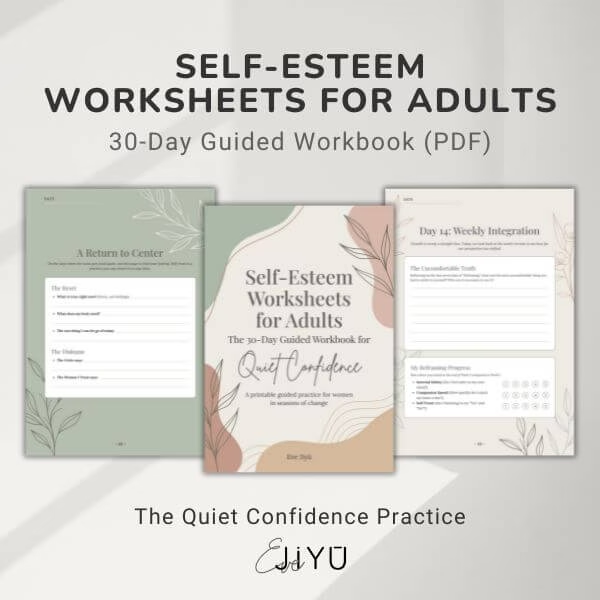
I created the Self-Esteem Worksheets for Adults specifically for women who are tired of feeling like they’re constantly working on themselves but never truly feeling secure inside.
This isn’t another confidence challenge. It’s not about forcing positivity or hustling your way to self-worth.
It’s a 30-day guided journal designed to help you understand the patterns beneath your low self-esteem, reframe old beliefs, and build genuine self-trust through reflection rather than performance.
The workbook includes daily prompts that take about ten minutes, weekly integration practices, and grounding tools you can return to whenever the noise gets too loud.
It’s designed to be done privately, at your own pace, without pressure to share or perform your progress for anyone else.
For women navigating the symptoms of low self-esteem while managing full lives, demanding careers, and the weight of constant self-improvement expectations, this offers a different path. One that’s slower, gentler, and actually sustainable.
How to Build Self-Esteem (Daily Practices That Stick)
Building self-esteem requires consistent, small actions that shift your internal narrative over time. These aren’t quick fixes. They’re practices that accumulate into a fundamentally different relationship with yourself.
Track Emotional Patterns Without Judgment
Start noticing when the symptoms of low self-esteem show up most intensely. Is it Sunday nights before the work week? Is it after scrolling social media? Is it in certain relationships or environments?
Write down what you notice. Not to fix it immediately, but to understand the landscape of your inner world.
Over time, patterns emerge. You begin to see that your self-doubt isn’t random. It’s often triggered by specific situations, people, or unmet needs.
This awareness alone creates distance between you and the critical voice. You start recognizing it as a pattern rather than truth.
Rewrite Inner Narratives Through Reflection
The stories you tell yourself about your worth were written years ago. Most of them aren’t even yours. They’re borrowed from parents, teachers, early relationships, and a culture that profits from your insecurity.
Reflective journaling helps you identify these narratives and question their validity.
Ask yourself: Where did I learn that my needs are too much? Who told me I have to earn rest? What would change if I believed I was already enough?
The Self-Esteem Worksheets for Adults structure this process across 30 days, guiding you through awareness, reframing, boundaries, and integration so you don’t have to figure it out alone.
Each day includes prompts that help you uncover limiting beliefs, practice self-compassion, and build trust in your own instincts.
Practice Self-Validation Instead of Seeking External Approval
External validation is temporary. It feels good in the moment but doesn’t create lasting self-esteem because your worth remains dependent on others’ opinions.
Self-validation means acknowledging your own efforts, feelings, and needs regardless of whether anyone else notices or agrees.
It sounds like: “I did my best today with the capacity I had.” Or: “My feelings are valid even if they’re inconvenient.“
This practice feels awkward at first. You’re so used to looking outside yourself for confirmation that trusting your own perspective feels risky.
But self-validation is how you stop outsourcing your sense of worth. You become your own steady reference point.

How to Boost Your Self-Esteem When You’re Mentally Tired
Burnout and low self-esteem often coexist. When you’re exhausted, the inner critic gets louder and your capacity for self-compassion shrinks.
Traditional advice tells you to “work on yourself” or “practice self-care.” But when you’re depleted, even those suggestions can feel like another task you’re failing at.
Here’s what actually helps when you’re too tired to do much of anything.
Lower the Bar for What Counts as Progress
On low-energy days, progress might look like writing three sentences in your journal instead of three pages. Or noticing one negative thought pattern instead of actively reframing it.
You don’t need to be consistent with high-intensity practices. You need to be consistent with showing up in whatever capacity you have.
The Self-Esteem Worksheets are designed with this reality in mind. Each daily prompt takes about ten minutes and meets you where you are. Some days you’ll write more. Some days, a few words. Both count.
Prioritize Presence Over Productivity
When self-esteem is low and energy is depleted, the instinct is often to push harder. To prove your worth through output.
But productivity won’t fill the gap. Presence will.
Spend ten minutes sitting with your feelings without trying to fix them. Notice what’s true right now without labeling it as good or bad.
This kind of presence gradually shifts your relationship with yourself. You stop treating your inner world as something to manage and start treating it as something to know.
Use Grounded Rituals to Anchor Your Nervous System
When everything feels chaotic internally, small rituals create a sense of safety. Not elaborate self-care routines. Simple, repeatable actions that signal to your nervous system that you’re okay.
It might be making tea in the same mug each morning. Writing one sentence about how you feel. Taking three deep breaths before bed.
These rituals become anchors. On days when you don’t trust yourself, they offer something steady to return to.

How to Overcome Low Self-Esteem Long-Term
Overcoming low self-esteem isn’t a destination. It’s an ongoing practice of choosing yourself, over and over, in small and unremarkable ways.
You won’t wake up one day and never doubt yourself again. You’ll have hard weeks. You’ll revert to old patterns. You’ll feel like you’re starting from scratch.
That’s normal. Growth isn’t linear.
Build Self-Esteem Through Self-Understanding
The women who successfully shift their relationship with themselves aren’t the ones who follow the most motivational accounts or repeat the most affirmations.
They’re the ones who get curious about their patterns. Who ask hard questions. Who sit with uncomfortable truths about how they’ve been living.
Self-understanding creates space for choice. When you know why you people-please or why you dismiss compliments, you can begin responding differently.
This is why structured reflection matters. It’s easy to recognize symptoms of low self-esteem in theory. It’s much harder to see how they’re operating in your specific life unless you’re actively paying attention.
The 30-day structure in the Self-Esteem Worksheets guides this process intentionally. It moves you through awareness, reframing, boundary-setting, and integration so you’re not just noticing patterns but actually shifting them.
Consistency Over Intensity
You don’t need to overhaul your entire life. You need to show up for yourself consistently in one small way.
Maybe it’s journaling every morning for ten minutes. Maybe it’s honoring one boundary per week. Maybe it’s speaking to yourself with the same kindness you’d offer a close friend.
These small practices compound. Six months from now, you won’t remember the specific day things shifted. You’ll just notice that the critical voice is quieter. That you trust yourself more. That you’re making decisions based on what feels right rather than what feels safe.
Give Yourself Permission to Be a Work in Progress
Low self-esteem often comes with the belief that you should be further along than you are. That everyone else has figured it out and you’re the only one still struggling.
You’re not.
Most women navigating their late twenties through early forties are quietly wrestling with the same questions. The same doubt. The same exhaustion from trying to earn their own approval.
You’re allowed to be figuring this out. You’re allowed to take your time. You’re allowed to need support.
Real confidence isn’t the absence of doubt. It’s the willingness to keep showing up for yourself even when doubt is present.
What Comes Next
Low self-esteem isn’t a character flaw. It’s a learned pattern. And what was learned can be unlearned.
The symptoms we’ve walked through—constant self-doubt, people-pleasing, harsh self-criticism, comparison, disconnection—aren’t permanent. They’re signs that you’ve been measuring your worth by the wrong metrics.
You don’t need to fix yourself. You need to rebuild trust with yourself. You need to practice noticing your patterns, questioning old narratives, and making aligned choices even when they’re uncomfortable.
This work is quiet. It’s private. It doesn’t look impressive from the outside.
But it changes everything.
If you’re ready to start, the Self-Esteem Worksheets for Adults offer a structured, gentle way to begin. Thirty days of prompts designed to help you see yourself clearly, speak to yourself kindly, and build the kind of self-trust that doesn’t require external validation.
You were always enough. You just forgot. This is how you remember.
What’s one symptom of low self esteem that resonates most with you right now? Let me know in the comments.
⬇⬇⬇Pin or save to read later ⬇⬇⬇












0 Comments