
You’ve heard about shadow work maybe in a podcast, a late-night scroll through self-growth content, or a conversation with a friend who swears it changed their life.
And now you’re curious. But also? A little intimidated.
That’s completely normal.
Shadow work sounds intense because, well, it can be. But it doesn’t have to feel like excavating your entire psyche with a pickaxe. At its core, shadow work is simply the practice of exploring the parts of yourself you’ve hidden, suppressed, or learned to push away. These aren’t “bad” parts, they’re just the pieces of you that didn’t feel safe or acceptable at some point in your life.
Carl Jung, the psychologist who introduced the concept of the “shadow self,” believed that these unconscious aspects of our personality hold the key to psychological wholeness. Not because we need to fix ourselves, but because understanding and integrating all parts of who we are, the messy, the uncomfortable, the contradictory, is what makes us fully human.
Now here’s what shadow work isn’t: it’s not about dwelling in darkness or beating yourself up for your flaws. It’s not therapy (though it can complement it beautifully). And it’s definitely not about forcing yourself into painful territory before you’re ready.
The prompts in this guide are designed as gentle entry points. Think of them as doorways, not deep dives. They start with external observations; what you notice in the world around you, before gradually inviting you inward.
This progression matters because it helps you build tolerance for self-reflection without overwhelming your system.
A gentle reminder as you begin: if deeper wounds or trauma surface during this work, that’s a sign to seek support from a therapist or counselor. Shadow work can open doors, but you don’t have to walk through them alone.
Approach this practice with the same patience and compassion you’d offer a dear friend. Because that’s exactly who you’re meeting here: yourself, in all your complexity.
1. Explore What You Judge in Others
The Challenge It Solves
Ever notice how certain people just get under your skin? Maybe it’s the coworker who’s “too loud” about their achievements, or the friend who seems “overly emotional,” or the stranger on social media who’s “attention-seeking.” These strong reactions are mirrors, not randomly occurring.
When someone irritates you disproportionately, it’s often because they’re expressing something you’ve learned to suppress in yourself. This is what Jung called “projection”, we disown certain traits and then spot them (and judge them) in others.
How It Works In Real Life
This prompt invites you to pay attention to the mirror principle: the qualities that trigger your judgment are often the disowned parts of yourself waiting to be acknowledged. Maybe you learned that being “too much” wasn’t acceptable, so now you bristle when others take up space. Maybe you were taught that emotions were weakness, so you judge those who express them freely.
The beauty of this entry point is that it starts outside yourself. You’re not diving straight into your own psyche, you’re observing your reactions to the world.
This creates just enough distance to explore without feeling exposed. If you’re ready to go deeper with this type of exploration, deep shadow work prompts can help you uncover more layers once you’ve built this foundation.
This isn’t about excusing genuinely harmful behavior in others. It’s about noticing when your reaction feels disproportionate to the situation. That emotional charge is the clue.
Implementation Steps
-
Write down three qualities in others that consistently irritate or bother you. Be specific: not just “annoying” but “talks about themselves constantly” or “never seems to struggle with anything.”
-
For each quality, ask yourself: “When was I taught that this trait was unacceptable?” Maybe you learned that needing attention was selfish, or that showing confidence was arrogant, or that struggling openly was shameful.
-
Gently explore: “Is there a part of me that wants to express this quality but feels unsafe doing so?” Journal freely without censoring yourself. Let whatever comes up land on the page.
Pro Tips
Start with mild irritations, not your deepest triggers. This is about building your capacity for self-reflection and not jumping into the deep end right away as it might be overwhelming.
Notice if you feel defensive when doing this work, that’s normal. Defensiveness is just your system trying to protect you. Acknowledge it with kindness: statements like “I see you trying to keep me safe. Thank you. I’m okay to explore this gently” can be a nice inner touch.
2. Revisit Your Childhood ‘Should Nots’
The Challenge It Solves
Most of us carry invisible rulebooks written in childhood. They’re the subtle (and sometimes not-so-subtle) messages about what parts of ourselves were acceptable and what parts needed to be hidden.
“Don’t be so sensitive.” “Stop showing off.” “Good girls don’t get angry.” “Boys don’t cry.” Im sure we all had such moments.
The thing is that these early “should nots” become the blueprint for your shadow. The parts of you that didn’t fit the script learned to hide, but they didn’t disappear. They’re still there, waiting to be acknowledged.
The Strategy Explained
This prompt invites you to excavate those early messages, not to blame anyone, but to understand how you learned to fragment yourself.
Maybe you learned that your creativity was impractical, your emotions were too much, your needs were burdensome, or your ambition was unseemly.
The goal isn’t to judge your caregivers or your younger self. Most of these messages came from people doing their best with their own unhealed wounds. This is simply about seeing clearly: here’s what I learned to hide, and here’s how it’s still shaping my life today.
When you can name these early “should nots,” you create the possibility of choosing differently now.
This kind of inner excavation is central to understanding how to work on yourself in meaningful ways.
Implementation Steps
-
Complete this sentence five to ten times: “When I was young, I learned that I should not be…” Let your pen move freely. Don’t overthink it. first thoughts are often truest.
-
For each “should not,” ask: “Who taught me this? What happened when I expressed this part of myself?” Write down specific memories if they surface, but don’t force it. Sometimes the feeling is enough.
-
Reflect on how these messages show up in your adult life. Do you still suppress these parts of yourself? Do you judge them in others? Do they emerge in unexpected ways when you’re stressed or vulnerable?
Pro Tips
This prompt can bring up tender feelings about your childhood. Have a grounding practice ready, maybe a cup of tea, a walk, or a few minutes of deep breathing.
Remember that recognizing these patterns isn’t about dwelling in the past but it’s also about freeing yourself in the present. You’re not the child who had to hide anymore. You’re the adult who gets to choose which parts of yourself to reclaim.
3. Uncover Your Hidden Needs
The Challenge It Solves
There are needs you express freely, for food, sleep, basic respect. And then there are the needs you’ve learned to bury so deep you might not even recognize them as needs anymore.
The need for rest without earning it. The need for attention without performing. The need for help without being in crisis first.
These hidden needs live in your shadow because at some point, expressing them felt unsafe. Maybe you were called needy, demanding, or high-maintenance. Maybe you learned that your needs were too much for the people around you to handle. So you learned to minimize them, dismiss them, or pretend they didn’t exist.
The Strategy Explained
This prompt helps you identify the needs you feel ashamed to acknowledge, the ones that feel “too much” or “not allowed.” These are legitimate human needs that got labeled as problems, theyre not bad or frivolous as others made them to be.
The practice here is twofold:
-
first, naming the need without judgment.
-
then exploring the story you tell yourself about why that need is unacceptable.
Often, you’ll find that the shame isn’t really yours, it’s inherited from messages you absorbed long ago. Working through journal prompts for self love can help you rebuild a compassionate relationship with these hidden parts.
When you can acknowledge your hidden needs, you stop expecting yourself to function while running on empty. You stop resenting others for not meeting needs you never admitted you had.
Implementation Steps
-
Write down three needs you feel uncomfortable expressing or admitting to yourself. Examples might include: – the need for alone time, the need for physical affection, the need for creative expression, the need to be seen and celebrated, the need to rest without justification.
-
For each need, complete this sentence: “I feel ashamed of this need because…” Be honest. Maybe it’s because you were told it was selfish, or because you saw someone else punished for expressing it, or because it makes you feel vulnerable.
-
Now rewrite the story: “This need is actually…” Offer yourself the compassion you’d give a friend. This need is actually human. This need is actually reasonable. This need is actually a sign of health, not brokenness.
Pro Tips
If you struggle to identify hidden needs, pay attention to your resentments.
Often, what we resent in others points directly to our unmet and unacknowledged needs. Do you resent people who set boundaries easily? You might need permission to do the same. Do you resent people who rest without guilt? That’s your clue.
Your resentment is trying to tell you something important about what you’re denying yourself.
4. Examine Your Emotional Triggers
The Challenge It Solves
You know that feeling when someone says something seemingly innocuous and suddenly you’re flooded with anger, shame, or defensiveness? When your reaction feels way bigger than the situation warrants? That’s a trigger, and it’s also a doorway.
Triggers aren’t weaknesses or flaws. They’re your psyche’s way of saying: “Hey, there’s something unhealed here. Something that needs your attention.”
The problem is, most of us have been taught to suppress our triggers, manage them, or feel ashamed of having them in the first place.
The Strategy Explained
This prompt helps you to get curious about your emotional triggers instead of trying to make them go away. When you’re triggered, there’s usually a younger part of you that’s been activated, a part that experienced something painful and is trying to protect you from experiencing it again.
The practice isn’t about eliminating triggers. It’s about understanding what they’re protecting and what they’re pointing toward. What old wound is being touched? What belief about yourself is being activated? What part of you is asking to be seen and healed?
If you find yourself caught in repetitive thought loops after being triggered, learning how to stop ruminating can help you process without spiraling.
This approach transforms triggers from embarrassing overreactions into valuable information about your inner landscape.
Implementation Steps
-
Identify a recent situation where you felt triggered, where your emotional response felt disproportionate to what actually happened. Describe the situation factually, without judgment: “When this person said this thing, I felt this way.”
-
Ask yourself: “What did this situation make me feel or believe about myself?” Did it make you feel unseen? Unimportant? Criticized? Controlled? Not good enough? Name the core feeling beneath the reaction.
-
Trace it back: “When is the first time I remember feeling this way?” You might not find a specific memory, and that’s okay. But often, current triggers echo old patterns. Journal about what this feeling reminds you of, even if the connection isn’t immediately clear.
Pro Tips
Work with triggers after the emotional intensity has passed, not in the heat of the moment. You need some distance to reflect with curiosity rather than defensiveness.
Also, remember that understanding your triggers doesn’t mean you have to tolerate genuinely disrespectful behavior.
This work is about your internal landscape, not about excusing others’ actions. Sometimes the most healing thing you can do is both understand your trigger and set a boundary.
5. Meet Your Inner Critic
The Challenge It Solves
There’s a voice in your head that knows exactly what to say to make you feel small. It’s the one that tells you you’re not good enough, that you’re doing it wrong, that you should be further along by now. It’s harsh, unrelenting, and often sounds like it’s telling you the truth.
Most of us try to silence this inner critic or argue with it. But here’s the sad thing: that critical voice is a part of you, and it’s trying to protect you in the only way it knows how.
It learned, usually early in life, that if it kept you small, criticized you first, or held you to impossible standards, maybe you’d be safe from rejection or failure.
The Strategy Explained
What this prompt sets you to is to meet your inner critic not as an enemy to defeat, but as a part of your shadow that needs understanding.
When you can see where this voice came from and what it’s actually trying to do, it begins to lose its power over you.
The practice is about dialogue, not debate. You’re not trying to prove your inner critic wrong, you’re trying to understand what it’s protecting you from and what it needs in order to soften.
This process is deeply connected to learning how to accept yourself fully, including the parts that feel broken.
Often, beneath the harshest criticism is a terrified part of you that’s just trying to keep you from getting hurt. When you can meet that part with compassion instead of shame, transformation becomes possible.
Implementation Steps
-
Write down the most common criticisms your inner voice directs at you. What does it say when you make a mistake, try something new, or don’t meet your own expectations? Get specific with the language it uses.
-
Ask this voice directly: “What are you trying to protect me from?” Then write the answer from the critic’s perspective. Let it speak. You might be surprised by what emerges, often it’s trying to protect you from rejection, failure, abandonment, or being “too much.”
-
Respond with compassion: “Thank you for trying to keep me safe. I understand you’re scared of [whatever it named]. But I’m an adult now, and I can handle [that fear] differently. You don’t have to work so hard anymore.” Write this as a letter to your inner critic, acknowledging its intention while gently setting a boundary.
Pro Tips
This prompt can feel strange at first, talking to a part of yourself like it’s a separate entity. That’s normal. You’re not developing multiple personalities; you’re just acknowledging that different parts of your psyche have different agendas.
Also, don’t expect your inner critic to disappear after one conversation. This is an ongoing relationship. The goal here is to simply shift from harsh criticism to supportive guidance. Over time, that voice can become your ally instead of an adversary.
6. Acknowledge Your Envy
The Challenge It Solves
Envy is one of those emotions we’re taught to hide at all costs. It feels petty, small, and shameful. So when it shows up, when you see someone living a life you want or expressing a quality you wish you had, the instinct is to push it down, rationalize it away, or judge yourself for feeling it.
But envy, when examined honestly, is one of the most valuable compasses you have. It points directly toward the desires and qualities you’ve suppressed or denied yourself.
It shows you what you want but feel you can’t have, what you long for but don’t feel worthy of, what parts of yourself you’ve hidden because they didn’t feel safe to express.
The Strategy Explained
This prompt transforms envy from a source of shame into a tool for self-discovery.
Instead of beating yourself up for feeling envious, you get curious about what the envy is revealing. What unexpressed desire is trying to get your attention? What part of yourself is asking to be acknowledged?
The practice isn’t about comparing yourself to others or trying to become someone you’re not. It’s about recognizing that the qualities and experiences you envy in others are often the ones you’re not allowing yourself to pursue or embody.
Using journal prompts for self growth alongside this work can help you translate envy into actionable insights.
When you can name your envy without shame, you reclaim the parts of yourself that have been living in shadow, the ambitious part, the creative part, the free-spirited part, the confident part. Whatever you’ve been denying yourself permission to be.
Implementation Steps
-
Make a list of three people (real or public figures) whose lives, qualities, or achievements trigger envy in you. Be specific about what exactly you envy, not just “their success” but “their confidence in sharing their work” or “their ability to rest without guilt.”
-
For each item, ask: “What does this person have or express that I want for myself but don’t feel I can have?” Write freely. Maybe it’s freedom, creativity, financial security, ease in relationships, permission to take up space, or something else entirely.
-
Now the crucial question: “What story am I telling myself about why I can’t have this?” Often you’ll uncover beliefs like “I’m not talented enough,” “It’s too late for me,” “People like me don’t get to have that,” or “Wanting this makes me selfish.” Write down the story, then gently question its truth.
Pro Tips
Distinguish between envy (wanting what someone else has) and jealousy (fear of losing what you have).
This prompt focuses on envy because it reveals your hidden desires. Also, remember that you don’t have to want exactly what the other person has, you’re using their life as a mirror to see what’s possible for you.
Maybe you don’t want their specific career, but you want the sense of purpose they seem to have. That’s the real information. Use envy as a map, not a measuring stick.
7. Write a Letter to Your Younger Self
The Challenge It Solves
There’s a version of you, maybe at seven, or twelve, or sixteen, who learned that certain parts of themselves weren’t acceptable.
That version of you made the best decision they could at the time: they hid those parts away. They learned to be smaller, quieter, more palatable, more acceptable.
That younger you is still inside you, carrying the weight of those early decisions. And often, the harshness you direct at yourself now is the same harshness that was directed at that younger version.
You’ve internalized the critical voices, the dismissals, the messages that you were too much or not enough.
The Strategy Explained
This prompt creates a bridge between your present self and your past self, specifically, the version of you who first learned to suppress parts of who you were.
Writing a letter to your younger self is an act of integration: you’re acknowledging what that child or teenager went through, offering them the compassion they needed then, and reclaiming the parts they had to hide.
This isn’t about dwelling in the past or blaming anyone. It’s about healing the fracture that happened when you learned you had to be someone other than yourself to be loved or safe. When you can offer your younger self the acceptance they needed, you begin to offer it to yourself now.
The letter becomes a container for grief, for validation, for reconnection with the parts of you that have been waiting to be seen. If you want to explore more ways to connect with your inner world through writing, our complete guide to journaling for self discovery offers additional frameworks.
Implementation Steps
-
Choose a specific age or moment from your past when you remember learning to hide a part of yourself. Maybe it was the day you were told to stop crying, or when your creativity was dismissed, or when you learned that your needs were too much. Picture that younger version of you as clearly as you can.
-
Write them a letter. Start with: “Dear [your name at that age], I see you…” Tell them what you wish someone had told you then. Acknowledge what they were going through. Validate the feelings they had to suppress. Offer them the compassion, understanding, and permission they needed but didn’t receive.
-
Close the letter by telling them what you know now that they couldn’t have known then. Maybe it’s that they didn’t do anything wrong, that they were enough exactly as they were, that the hiding wasn’t their fault, or that they get to reclaim those lost parts now. Make it personal and true to your experience.
Pro Tips
This prompt often brings up emotion, tears, grief, tenderness. That’s a sign you’re touching something real and youre doing it right.
Let the feelings move through you. Have tissues nearby. Consider doing this work when you have space afterward to rest and integrate.
You might also write multiple letters to different ages or versions of yourself over time. Each one is a piece of reclamation, a step toward wholeness. It might take some time, but thats part of it.
Putting It All Together
Shadow work isn’t a destination. It’s not something you complete and check off your list. It’s a lifelong practice of coming home to yourself, all of yourself, again and again.
You don’t need to work through all seven of these prompts at once. In fact, please don’t. Choose one that resonates with where you are right now.
Maybe it’s the one that makes you slightly uncomfortable but not overwhelmed. That’s your sweet spot, the edge of your comfort zone where growth happens without re-traumatization.
Work with it for a week, a month, or however long it takes. Return to it when new layers emerge. Shadow work is spiral, not linear. You’ll revisit the same themes at different depths as you grow.
A few reminders as you continue this journey: Discomfort is normal. Feeling tender, vulnerable, or a bit raw after shadow work is part of the process.
But it should never feel unsafe or retraumatizing. If you find yourself overwhelmed, that’s a sign to slow down, seek support, or work with a therapist who can hold space for deeper healing.
Pair this work with practices that ground and nourish you. Shadow work can be intense, so balance it with things that help you feel safe and embodied, walks in nature, creative expression, time with people who see and accept you, or whatever helps you return to your body and the present moment.
Be patient with yourself. The parts of you that live in shadow didn’t get there overnight, and they won’t integrate overnight either.
This is tender, courageous work. Every moment you spend meeting yourself with curiosity instead of judgment is meaningful. Every time you acknowledge a hidden part of yourself, you become a little more whole.
Approach this practice the way you’d approach a dear friend who’s sharing something vulnerable: with gentleness, without rushing, with full permission to take breaks, to feel whatever comes up, to move at the pace that feels right.
You’re not broken. You never were. You’re just human, complex, contradictory, and worthy of being fully known. Shadow work is how you get there, one gentle prompt at a time.
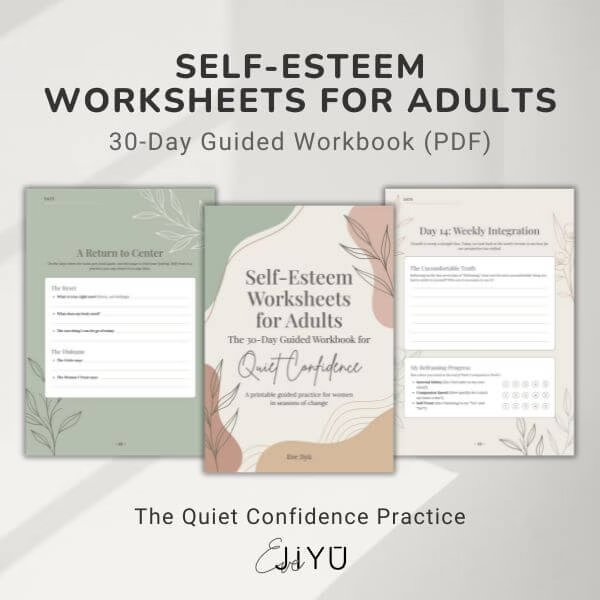
If you’re looking for more support on your inner journey, you may like the following tools and resources designed to help you explore your inner landscape with the same gentleness and authenticity you deserve.







0 Comments