
In This Article
A grounded guide to building self belief through reflection, self-trust, and small consistent actions that rewire how you see yourself.
There’s a specific kind of loneliness that comes with looking capable on the outside while feeling completely uncertain on the inside. You know what you’re supposed to do—set boundaries, speak up, trust your instincts—but when the moment arrives, doubt floods in and you second-guess everything.
I spent years in that gap between knowing and trusting. I had the tools, the education, the supportive people around me. What I didn’t have was self belief. Not the loud, performative kind that announces itself in every room, but the quiet internal trust that says, “I can handle this. I can trust my own judgment.”
Self belief isn’t about pretending you have all the answers or forcing yourself into a confidence you don’t feel. It’s about building a relationship with yourself that can withstand doubt, mistakes, and the messy process of becoming who you’re meant to be. This article shares seven shifts that helped me move from chronic self-doubt to a steadier, more grounded confidence—even when my self-esteem was at its lowest.
These aren’t quick fixes or motivational slogans. They’re the internal recalibrations that changed how I relate to myself, and they can do the same for you.
What Self Belief Actually Means (And Why Surface-Level Advice Doesn’t Work)
Most advice about confidence tells you to “believe in yourself” as if that’s a switch you can flip. But when you’re dealing with low self-esteem, that phrase feels hollow. How do you believe in yourself when your internal dialogue is a running list of everything you’ve done wrong?
Self belief isn’t about convincing yourself you’re perfect or silencing every critical thought. It’s the ability to trust yourself even when things don’t go as planned. It’s knowing that you can make a decision, learn from it, and adjust without collapsing into shame.
Research in Self and Identity confirms self-esteem ties closely to self-consistency, where actions aligning with values and self-concept maintain stable worth and reduce distress. High self-esteem individuals prioritize consistency for psychological coherence. When there’s a gap between who you are and who you think you should be, confidence erodes. Self belief grows when you start closing that gap through honest reflection and consistent action.
Affirmations alone don’t work because they try to override your internal evidence. Your brain has been collecting data about you for years. If that data says “I don’t follow through” or “I always choose other people’s needs over mine,” a sticky note that says “I am confident” won’t compete with that history.
What does work is creating new evidence. Small, repeated actions that show yourself you can be trusted. That’s where these seven shifts come in.
Shift #1: Stop Waiting to Feel Confident Before You Act
For years, I believed confidence was a prerequisite for action. I thought I needed to feel ready, certain, and self-assured before I could take meaningful steps in my life. So I waited. I waited to apply for opportunities, to have difficult conversations, to make decisions that mattered.
What I didn’t understand then is that confidence doesn’t show up before action. It shows up because of it.
Every time you act despite uncertainty, you’re teaching your nervous system that you can handle discomfort. You’re building a track record of evidence that says, “I showed up even when I was scared. I can do hard things.” That evidence becomes the foundation of self belief.
This doesn’t mean charging into situations that feel dangerous or overwhelming. It means recognizing that the feeling of readiness you’re waiting for might never arrive on its own. You build it by moving forward in small, manageable ways.
Think about a recent situation where you postponed something important because you didn’t feel confident enough. What would have happened if you’d taken one small step anyway? That step doesn’t have to be perfect. It just has to exist.
Reflection prompt: Where am I currently postponing my life until I feel “ready”? What’s one micro-action I could take this week that doesn’t require confidence, just commitment?
Shift #2: Treat Self-Esteem as a Skill, Not a Personality Trait

One of the most damaging myths about confidence is that some people are just naturally self-assured while others aren’t. We look at people who seem comfortable in their own skin and assume they were born that way, or that they’ve always had supportive environments.
But self-esteem isn’t a fixed trait you either have or don’t have. It’s a set of skills you can develop: self-awareness, emotional regulation, self-compassion, and the ability to challenge unhelpful thoughts.
When you view self-esteem as a skill, it becomes something you can practice. You’re not broken if you struggle with it. You’re simply learning something that nobody taught you directly.
I started approaching my self-esteem the way I would approach learning a language. I didn’t expect fluency immediately. I practiced small components—noticing my self-talk, catching patterns of comparison, naming my emotions with more precision. Over time, those small practices accumulated into something that felt like confidence.
Skills need repetition, not pressure. You wouldn’t expect to speak French fluently after one lesson, and you shouldn’t expect to rebuild your self belief after one journaling session. What matters is showing up consistently, even when progress feels slow.
Reflection prompt: What specific skills related to self-esteem do I need to develop? (Examples: setting boundaries, managing criticism, trusting my decisions.) Which one feels most important to practice right now?
Shift #3: Identify the Hidden Patterns That Undermine Self Belief
Low self-esteem doesn’t exist in a vacuum. It’s usually reinforced by patterns you might not even realize you’re running: perfectionism that makes every mistake feel like proof of inadequacy, people-pleasing that erodes your sense of self, conditional self-worth that ties your value to achievement.
These patterns operate quietly in the background, shaping how you interpret events and how you treat yourself. Until you can see them clearly, they’ll continue to undermine your confidence no matter how much motivational content you consume.
For me, the pattern was conditional self-worth. I only felt good about myself when I was productive, when I was helping someone, or when I received external validation. Rest felt like failure. Saying no felt selfish. My self belief was entirely dependent on factors outside my control.
Recognizing that pattern didn’t fix it overnight, but it gave me something to work with. I could see when it was happening and start questioning whether it was true. That awareness was the first step toward change.
Structured journaling was the first low self-esteem remedy that actually helped me see my patterns instead of drowning in them. Blank pages felt overwhelming—I didn’t know what to focus on or how to make sense of my thoughts. Guided prompts gave me a framework to work within, questions that directed my attention to the patterns I needed to see.
Reflection prompts:
- What pattern shows up most often when my self-esteem dips? (Perfectionism, comparison, over-responsibility, etc.)
- When did I first learn this pattern? What purpose did it serve then?
- Is this pattern still serving me, or is it time to interrupt it?
Shift #4: Build Self Belief Through Small, Kept Promises

Confidence isn’t built through grand gestures or dramatic transformations. It’s built through micro-trust—the accumulation of small promises you make to yourself and actually keep.
Every time you do what you said you would do, even in the smallest way, you’re sending a message to your nervous system: “I can trust this person. She follows through.” That trust becomes the foundation of self belief.
This doesn’t have to be complicated. It can be as simple as:
- Drinking water first thing in the morning because you said you would
- Writing for five minutes every day, even when you don’t feel inspired
- Going to bed at the time you set for yourself instead of scrolling
The content of the promise matters less than the consistency of keeping it. You’re training your brain to see you as someone who honors commitments to yourself, not just to other people.
I started with absurdly small promises. Five minutes of journaling. One chapter of a book. A ten-minute walk. These weren’t impressive goals, but they were achievable. And every time I kept one, I was building evidence that I could be trusted.
Research shows self-control and follow-through build stable self-esteem independent of external validation through consistent intention alignment. When you consistently act in alignment with your intentions, you develop a more stable sense of self-worth that isn’t dependent on external validation.
Practice exercise:
- Choose one small promise you can make to yourself this week
- Make it specific and realistic (not “exercise more,” but “walk for 10 minutes on Tuesday and Thursday”)
- Keep track of whether you follow through
- Notice how it feels when you do
Shift #5: Learn to Separate Your Worth From Your Outcomes
One of the deepest threats to self belief is the tendency to tie your value to your results. When things go well, you feel good about yourself. When they don’t, your entire sense of worth collapses.
This creates an unstable foundation. You’re constantly at the mercy of circumstances you can’t fully control, and your confidence becomes a roller coaster tied to external validation and visible success.
Learning to separate who you are from what you produce or achieve is one of the most important shifts you can make. Your worth is inherent. It doesn’t increase when you succeed or decrease when you fail.
I used to believe that if I wasn’t accomplishing something, I wasn’t valuable. Rest felt like wasted time. Mistakes felt like proof that I wasn’t good enough. My self-esteem was a performance review that never ended.
Therapy helped, but so did a simple reflection practice: after something didn’t go as planned, I would write down what stayed true about me despite the outcome. My kindness. My effort. My willingness to try. Those things didn’t change based on results.
Reflection prompts:
- What stayed true about me even when things didn’t work out the way I hoped?
- Am I treating myself differently now because of a recent outcome? What would change if I extended the same compassion to myself that I would to a friend?
Shift #6: Use Reflection to Rewire Self-Talk (Not Silence It)

The voice in your head that says you’re not enough, not ready, not capable—it’s not going anywhere. Trying to silence it or override it with positive affirmations rarely works for long.
What does work is learning to challenge it. Not with aggression, but with curiosity. You start asking questions: Is this thought true? Is it helpful? What evidence contradicts it?
Written reflection slows down your emotional reactions. When you’re caught in a spiral of negative self-talk, it moves faster than you can process. Writing forces you to pause, to examine each thought individually instead of letting them blur together into one overwhelming feeling.
I used to think journaling meant venting or documenting my day. But the kind of reflection that actually changed my self belief was more structured. It wasn’t just “what happened today” but “what did I tell myself about what happened, and is that story accurate?”
Guided reflection helped me see patterns I couldn’t see when I was just writing freely. Questions like “What am I making this mean about me?” or “What would I tell a friend in this situation?” gave me a way to step outside my own perspective and see my thoughts for what they were—thoughts, not facts.
This is where a structured system becomes valuable. Random journaling can be helpful, but when you’re trying to rebuild self belief, you need prompts that direct your attention to the specific thoughts and patterns that undermine it.
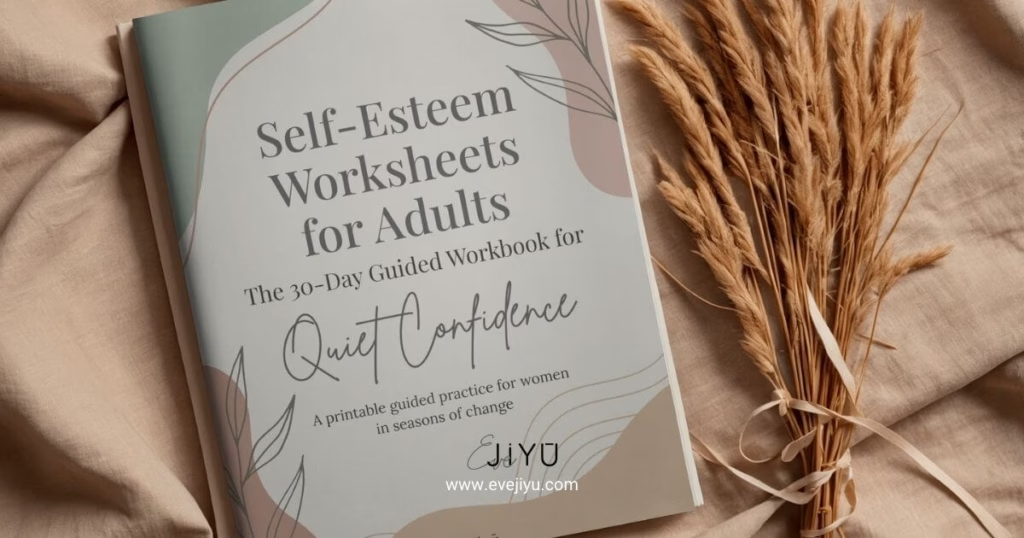
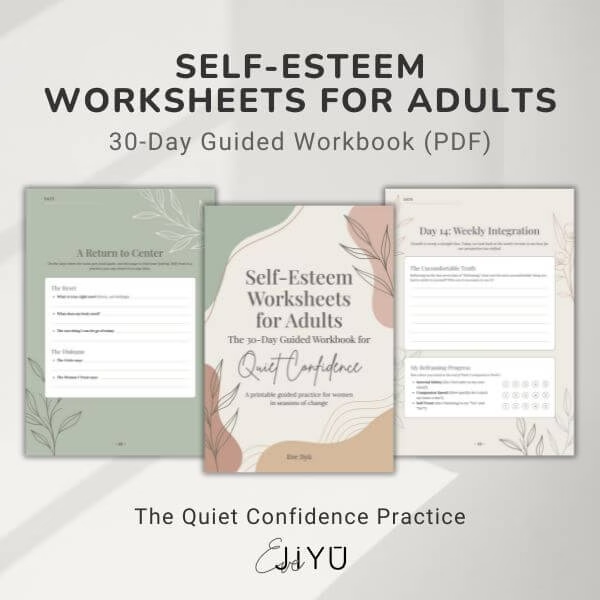
The Self-Esteem Worksheets for Adults were designed for exactly this purpose. Instead of staring at a blank page wondering what to write, you have clear prompts that guide you through awareness, reframing, and building new patterns of self-trust. It’s 30 days of structured reflection that helps you see yourself more clearly and challenge the stories that keep you stuck.
Reflection prompts:
- What’s the harshest thing I’ve told myself this week? If I heard a friend say that about herself, what would I tell her?
- What evidence do I have that contradicts my negative self-talk?
Shift #7: Create Daily Proof That You Can Trust Yourself
Self belief isn’t built through occasional moments of clarity. It’s built through daily, repeated evidence that you are someone you can count on.
This is why 30-day practices work. Not because 30 days is a magic number, but because consistent action over time creates a new baseline. Your brain starts to see you differently. The data shifts.
Daily check-ins don’t have to be elaborate. They can be as simple as:
- Naming one thing you’re proud of today
- Identifying one emotion you felt and why
- Noticing one moment where you honored a boundary or made a self-honoring choice
These small observations compound. They create a record of who you actually are, not who you fear you are. And over time, that record becomes the evidence your brain needs to trust you.
I didn’t believe in daily practices until I tried one that actually worked. I had tried gratitude journals and habit trackers, but they felt performative. The shift happened when I started tracking my internal experience—not what I did, but how I related to myself while doing it.
Did I speak to myself kindly when I made a mistake? Did I notice my needs before I was completely depleted? Did I trust my instincts in a decision, even a small one? Those were the metrics that mattered.
A 30-day guided practice gives you structure without rigidity. You’re not reinventing the process every day. You’re showing up to prompts designed to help you build self-awareness, challenge unhelpful patterns, and create new evidence of your own trustworthiness.
Practice exercise:
- At the end of each day this week, write down one moment where you trusted yourself or acted in alignment with your values
- Notice what patterns emerge after seven days
- Celebrate the evidence you’re creating
Who This Approach Is For (And Who It’s Not)
This framework for rebuilding self belief is designed for women who are self-aware but stuck. You’ve done enough personal development to know what the problems are. You understand your patterns. You just haven’t found a way to actually shift them.
This is for you if:
- You’re tired of surface-level motivation and need depth
- You want practical tools, not just mindset shifts
- You prefer reflection and introspection over forced positivity
- You’re willing to show up imperfectly and consistently
This isn’t for you if:
- You’re looking for a quick fix or instant transformation
- You want someone to tell you exactly what to do
- You’re more comfortable with hustle-confidence culture than quiet self-trust
The Self-Esteem Worksheets for Adults work because they meet you where you are. They don’t assume you need to become someone new. They help you remember who you were before the world told you who to be, and they guide you through the process of trusting that person again.
Building Self Belief Is Quieter Than You Think
Confidence isn’t something you find. It’s something you build, one small kept promise at a time.
You don’t need to wait until you feel ready. You don’t need to fix everything about yourself before you start trusting yourself. You just need to begin where you are, with honesty and consistency.
The seven shifts in this article aren’t about becoming someone else. They’re about developing a relationship with yourself that can withstand doubt, change, and the inevitable messiness of being human.
Shift #1: Act despite uncertainty, because confidence follows action.
Shift #2: Treat self-esteem as a skill you can practice, not a personality trait you lack.
Shift #3: Identify the hidden patterns that undermine your self belief so you can interrupt them.
Shift #4: Build trust with yourself through small, kept promises.
Shift #5: Separate your worth from your outcomes so your value isn’t tied to performance.
Shift #6: Use written reflection to challenge negative self-talk instead of trying to silence it.
Shift #7: Create daily proof that you are someone you can trust.
Self belief grows in the quiet moments when you choose yourself, even when no one’s watching. It grows when you honor a boundary, name an emotion, or make a decision based on your values instead of fear. It grows when you stop performing confidence and start practicing trust.
If you’re ready to move from understanding your patterns to actually changing them, the Self-Esteem Worksheets for Adults offer a structured, gentle way to do that. Thirty days of guided reflection designed to help you see yourself clearly, challenge what’s not serving you, and build a foundation of self-trust that doesn’t depend on external validation.
Start where you are. Show up gently. Trust the process, even when it feels slow. You’re not broken. You’re just learning to believe in yourself again.
What’s one small promise you can make to yourself this week? Share in the comments below, or explore more grounded practices for self-discovery and confidence on the Eve Jiyū blog.
⬇⬇⬇Pin or save to read later ⬇⬇⬇












0 Comments