
In This Article
Discover practical mindful activities that respect your time, energy, and intelligence—no spiritual bypassing or forced “zen” required.
Beyond the “Zen” Cliché: Why Most Mindfulness Lists Miss the Mark
You’ve seen the articles. “50 Mindfulness Activities to Transform Your Life!” promises another wellness blog, complete with stock photos of women meditating on mountaintops at sunrise.
And you think: I can barely find time to eat lunch at my desk.
At a Glance: Mindfulness for the Overwhelmed
- Core Goal: Noticing the present moment without judgment through three elements—Observation, Description, and Participation.
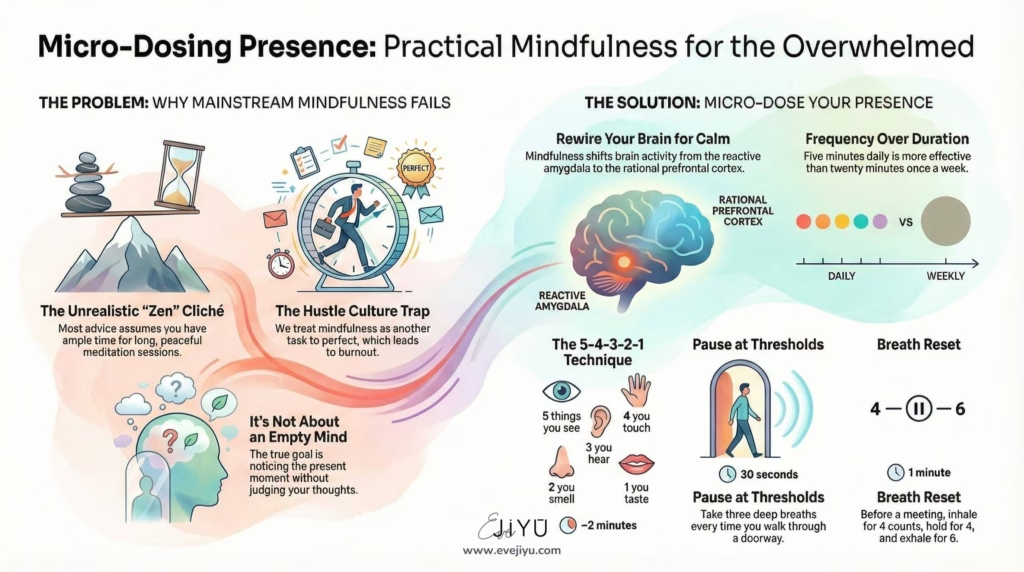
- The Neuroscience: Regular mindfulness practices shift brain activity from the reactive amygdala (threat detection) to the rational prefrontal cortex (emotional regulation and decision-making).
- Top Recommendation: Start with DBT-inspired grounding techniques like the 5-4-3-2-1 exercise or practice “micro-dosing presence” during daily transitions like walking through doorways or between meetings.
- Time Investment: Most activities take 1-10 minutes and fit into existing routines.
I’ve been there. Years ago, when burnout had me googling “how to feel something real” at 2 AM, I tried every mindfulness trend. I downloaded meditation apps. I bought crystals. I attempted morning routines that required waking at 5 AM to journal for an hour before work.
Nothing stuck. Not because mindfulness doesn’t work, but because most advice is written for people who already have spacious, uncluttered lives.
Here’s what changed for me: I stopped trying to win at mindfulness. I stopped treating presence as another performance to perfect. I learned that mindful activities aren’t about clearing your mind or achieving some blissed-out state. They’re about noticing the clutter without judgment. They’re about creating small pockets of awareness in a life that’s already full.
This article offers fifteen mindful activities designed specifically for women who are tired of performing wellness. These aren’t add-ons to an already overwhelming schedule. They’re gentle interruptions to the autopilot that keeps you stuck.
How Do You Practice Mindfulness? Understanding the Foundation
Before we dive into specific mindful activities, let’s clarify what mindfulness actually means. Because if you’re like most people, you’ve heard conflicting definitions that range from “empty your mind” to “just be present” to “focus on your breath.”
Mindfulness is the practice of paying attention to the present moment without judgment. That’s it. Not clearing your thoughts. Not achieving inner peace. Not floating above your problems. Just noticing what’s happening right now, in your body and mind, without labeling it as good or bad.
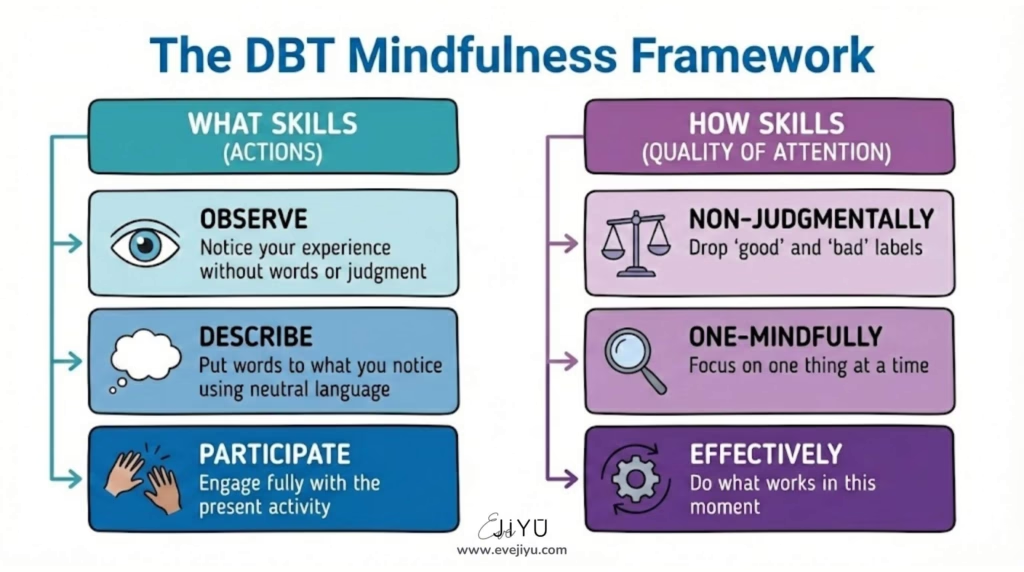
The practice rests on three core elements. First, observation means noticing sensations, thoughts, and emotions as they arise. Second, description involves labeling your experience in neutral terms. Third, participation asks you to engage fully with whatever you’re doing, even if that’s washing dishes or sitting in traffic.
Neuroimaging studies show that regular mindfulness practice produces measurable brain changes: prefrontal regions involved in decision‑making and emotion regulation become more engaged, while the amygdala—the brain’s threat‑detection center—shows reduced reactivity and stronger regulatory coupling with the prefrontal cortex.
If you’re skeptical about the spiritual claims often attached to mindfulness, I wrote about how neuroscience changed my mind about meditation. The science convinced me when the Instagram quotes couldn’t.
The Structure Behind Presence: DBT Mindfulness Exercises
Dialectical Behavior Therapy, or DBT, offers the most practical framework I’ve found for integrating mindfulness into real life. Originally developed for people with intense emotional dysregulation, DBT mindfulness exercises have become the gold standard for emotional grounding.
DBT breaks mindfulness into two skill categories. The “What” skills teach you what to do: observe your experience, describe it in words, and participate fully. The “How” skills teach you the quality of attention to bring: non-judgmentally, one-mindfully (focusing on one thing at a time), and effectively (doing what works rather than what feels righteous).
The DBT Mindfulness Framework
These aren’t abstract concepts. They’re specific techniques you can practice while commuting, cooking dinner, or scrolling through your phone. The goal isn’t to become a perfect meditator. The goal is to notice when you’ve checked out of your own life and gently check back in.
One of the most accessible DBT-inspired practices is the 5-4-3-2-1 sensory grounding technique. When anxiety spikes or you feel disconnected from your body, name five things you can see, four things you can touch, three things you can hear, two things you can smell, and one thing you can taste. This simple exercise interrupts the rumination loop and brings you back to physical reality.
For more structured approaches to managing anxiety through presence, I’ve written a detailed guide on mindfulness exercises specifically designed for anxiety.
How Do I Practice Mindfulness for Burnout? 15 Activities That Fit Your Actual Life
Let’s get specific. These activities are organized by context so you can choose what fits your current energy level and available time. Each practice addresses the core issue of burnout: the autopilot mode that keeps you producing without presence.
Creative and Reflective Practices
1. Micro-Journaling (3 minutes)
Set a timer for three minutes after you wake up. Write whatever comes to mind without editing, punctuation, or concern for grammar. This isn’t about producing beautiful prose. This is about emptying the mental clutter before it follows you into your day.
The practice works because it externalizes your internal noise. Once your thoughts are on paper, they lose some of their urgency. You’ll notice patterns. The same worries on repeat. The same self-criticism in slightly different words.
2. The Color Walk (10 minutes)
Choose one color before you leave your house. During your walk, notice every instance of that color. A red car. A red stop sign. A red flower in someone’s garden. The specific hue of red brick against afternoon light.
This exercise trains your attention to be deliberately selective. You’ll be amazed how much you normally miss. Color walks taught me that presence isn’t about seeing everything at once. Presence is about seeing one thing completely.
3. Mindful Doodling (5 minutes)
Grab a pen and paper. Focus entirely on the physical sensation of drawing. The friction of the pen against paper. The slight resistance when you change direction. The sound of the ink moving.
You’re not trying to create art. You’re practicing the feeling of creating without attachment to outcome. This is especially helpful for perfectionists who struggle to do anything unless it’s excellent.
4. Auditory Mapping (8 minutes)
Sit somewhere relatively quiet. Close your eyes. Identify the furthest sound you can hear. Maybe it’s traffic in the distance. Then find the closest sound. Your own breathing. The hum of the refrigerator.
Map the layers of sound between the furthest and nearest. This practice reveals how much sensory information your brain typically filters out. You’ve been hearing these sounds all along. You just weren’t listening.
Physical and Sensory Practices

5. Temperature Shifting (2 minutes)
Run cold water over your wrists for thirty seconds. Notice the shock of sensation. The way your body responds. The shift in your nervous system.
This is a direct neuroscience-backed intervention to reset the vagus nerve, which regulates your parasympathetic nervous system. Cold water activates what researchers call the “dive reflex,” immediately calming your fight-or-flight response. This isn’t just mindfulness for the sake of awareness. This is a practical tool for moments when anxiety makes your thoughts feel loud and your body feel unsafe.
6. Progressive Muscle Relaxation (7 minutes)
Lie down. Starting with your feet, tense each muscle group for five seconds, then release. Move up through your calves, thighs, abdomen, chest, arms, and finally your face.
Pay special attention to your jaw and shoulders. Most of us hold tension there without realizing it. The practice teaches you to recognize the difference between tension and relaxation. Once you can feel the difference, you can interrupt the pattern before it becomes chronic pain.
7. Savoring One Bite (3 minutes)
Choose one piece of food. Dark chocolate. A strawberry. A single almond. Place it in your mouth without chewing immediately. Notice the texture. The temperature. The way saliva changes the taste.
Chew slowly. Count twenty chews. Notice the impulse to swallow quickly and move on. This exercise reveals how rarely we actually taste our food. We eat while working, while scrolling, while planning the next task.
8. The Power of Pause at Thresholds (30 seconds)
Every time you walk through a doorway today, pause for three breaths. Feel your feet on the ground. Notice the transition between spaces.
Thresholds are natural boundaries in your day. Using them as mindfulness cues means you’re practicing presence during transitions rather than trying to carve out separate “mindfulness time.” This is mindfulness that respects the rhythm of your actual life.
Digital and Workplace Mindfulness

9. Single-Tasking Sprints (20 minutes)
Choose one task. Set a timer for twenty minutes. Do only that task. Notice every time your mind suggests checking email, opening a new tab, or starting something else.
You’re not trying to stop these impulses. You’re practicing awareness of how often they arise. Most of us underestimate how fragmented our attention has become. Single-tasking reveals the pattern so you can begin to interrupt it.
10. The Breath Reset Between Meetings (1 minute)
Before you click “join” on your next video call, take three deep breaths. Inhale for a count of four. Hold for four. Exhale for six.
This tiny practice creates a boundary between one demand and the next. Without it, your day becomes a seamless stream of obligations with no space to reset your nervous system. The longer exhale activates your parasympathetic response, signaling to your body that you’re safe enough to rest.
11. Digital Sunset (1 hour before sleep)
One hour before bed, put your phone in another room. Don’t check email. Don’t scroll social media. Just be present with the physical world around you.
If this feels impossible, that’s information worth noticing. What are you afraid you’ll miss? What are you avoiding by staying digitally engaged until the moment you close your eyes?
For more ideas on building sustainable mindfulness into your daily routine, I’ve written about how daily mindfulness and gratitude practices can shift your internal landscape.
Connection-Based Activities

12. Active Listening Without Advice (Conversation length)
The next time someone tells you about their day, practice listening without planning your response. Notice their tone. Their breath. The pauses between words.
Don’t offer solutions. Don’t share a similar story from your own life. Just listen. This is one of the hardest mindful activities on this list because our minds are trained to fix, compare, and respond.
13. Mindful Commute (Commute length)
No podcast. No music. No phone. Just you and the sounds of your commute.
I know this sounds boring. That’s the point. We’ve become so uncomfortable with boredom that we fill every gap with input. A mindful commute teaches you that your thoughts are interesting enough on their own. You don’t need constant distraction from yourself.
14. The Inner Critic Observation (5 minutes)
When you catch yourself in self-critical thought, pause. Label the thought as “just a thought” rather than truth. Notice where you feel the criticism in your body. Tight chest? Clenched jaw?
This practice creates distance between you and your automatic mental patterns. You begin to see that the inner critic is a voice, not a verdict. Most of us have been listening to that voice as if it were an objective narrator of our worth.
15. Gratitude Anchoring (30 seconds)
Link one daily habit to one thought of gratitude. Every time you brush your teeth, name one specific thing you’re grateful for today. Not generic gratitude. Specific gratitude.
“I’m grateful for the way morning light comes through my kitchen window at 7:15.” This grounds gratitude in sensory reality rather than abstract positivity. It trains your attention to notice small beauty instead of only registering what’s wrong.
Why Most Mindfulness Practices Fail and How to Make Them Stick
Here’s the uncomfortable truth: most people abandon mindfulness practices within two weeks. Not because mindfulness doesn’t work, but because we approach it with the same hustle mentality that burned us out in the first place.
We try to be perfect at presence. We set ambitious goals. Twenty minutes of meditation every morning. Daily gratitude journaling. Weekly yoga classes. And when life interrupts, when we miss a day or a week, we decide we’ve failed. We stop entirely.
This is the hustle culture trap applied to healing. We treat mindfulness as another metric of success rather than a gentle return to ourselves.
The alternative is micro-dosing presence. One minute of mindful breathing ten times a day is more sustainable than twenty minutes once a week. Pausing at doorways is more realistic than adding a morning meditation to an already packed routine.
The goal isn’t to become someone who never gets stressed or distracted. The goal is to notice when you’ve left the present moment and bring yourself back with kindness.
If you’re ready to deepen your practice beyond these activities, I’ve written about specific techniques in meditation that build on this foundation.
Frequently Asked Questions About Mindful Activities
How do you practice mindfulness when you’re too busy?
Focus on “threshold moments” rather than adding separate practice time. Pause for three breaths every time you walk through a door, before you join a meeting, or when you sit down at your desk. These micro-practices take less than thirty seconds but create dozens of mindfulness moments throughout your day. The goal is presence during transitions, not carving out extra time.
What are DBT mindfulness exercises?
DBT mindfulness exercises are evidence-based techniques developed through Dialectical Behavior Therapy. The most accessible is the 5-4-3-2-1 grounding exercise: name five things you see, four you can touch, three you hear, two you smell, and one you taste. These exercises are designed to regulate intense emotions, stop rumination, and bring you back to physical reality when your mind spirals.
Can mindfulness help with burnout?
Yes, but not in the way most people expect. Mindfulness won’t fix a toxic work environment or resolve systemic issues causing your exhaustion. What it does is train your brain to notice stress triggers before you react automatically. This awareness helps you preserve energy by interrupting the autopilot mode that leads to chronic depletion. Research shows that regular mindfulness practice reduces activity in the amygdala (your stress response center) while strengthening the prefrontal cortex (your decision-making and emotional regulation center).
How long does it take to see results from mindfulness practices?
Neuroscience studies have documented measurable brain changes—such as amygdala and hippocampal remodeling—after roughly eight weeks of consistent mindfulness practice, even though most people report feeling calmer and less reactive well before the two‑month mark. Within days, you might catch yourself pausing before reacting or noticing tension in your body earlier. The key is frequency over duration. Five minutes daily beats twenty minutes once a week. Start with one practice from this list and repeat it for three days before evaluating whether it fits your life.
Reclaiming Your Narrative Through Presence
Mindfulness isn’t a cure-all. It won’t fix a toxic work environment. It won’t resolve relationship conflicts. It won’t solve systemic problems that make your life harder than it needs to be.
What it will do is give you a moment of choice. A pause between stimulus and response. A chance to notice when you’re operating from old patterns rather than current truth.
You aren’t broken and needing fixing. You’re overwhelmed and needing presence.
The fifteen mindful activities in this article aren’t about achieving some elevated state of consciousness. They’re about recognizing when you’ve checked out of your own life and gently checking back in.
Choose one. Just one. Practice it for the next three days. Notice what shifts in your internal dialogue. Notice whether you feel slightly less at war with yourself.
That’s enough. That’s more than enough.
Which practice will you try first? I’d love to hear what resonates with you. Leave a comment below or reach out through my contact page. Your experience matters.
⬇⬇⬇Pin or save to read later ⬇⬇⬇












0 Comments