In This Article

Discover what are limiting beliefs and learn to identify the self limiting beliefs examples that keep you stuck in patterns of overthinking, people-pleasing, and playing small.
You tell yourself you’re not confident enough to make a change. You say you’re bad with money, terrible at boundaries, or just “not that kind of person.” These statements feel like facts about who you are, carved into stone somewhere during childhood or your first failed attempt at something new.
But they’re not facts. They’re beliefs, and most of them aren’t even yours.
Self limiting beliefs are the invisible mental rules that shape how you move through the world. They determine which opportunities you consider, which relationships you tolerate, and how much space you allow yourself to take up. The tricky part is that limiting beliefs don’t announce themselves. They masquerade as common sense, realism, or just “the way things are.”
This article will walk you through clear limiting beliefs examples so you can recognize which ones are running your life. You’ll learn what are limiting beliefs, why they feel so convincing, and how to start questioning them without falling into toxic positivity or forced affirmations. The goal isn’t to become someone new. It’s to stop letting outdated stories dictate your decisions.
What Are Limiting Beliefs? (And Why They Feel So Real)
A limiting belief is an assumption you hold about yourself, other people, or the world that restricts your choices and keeps you smaller than you need to be. These beliefs often sound reasonable on the surface. They might even sound like wisdom.
The problem is that they’re based on incomplete information, past pain, or cultural conditioning rather than present truth.
Most self limiting beliefs form during childhood, in moments when you were trying to make sense of the world with a child’s understanding. Maybe you learned that being “too much” led to rejection, so you developed a belief that your needs are burdensome. Or perhaps you failed at something once and decided you’re just not capable in that area.
Over time, these beliefs become part of your identity. You stop questioning them because they’ve been true for so long that they feel like facts.
But here’s the distinction that matters: a fact is objectively verifiable and doesn’t change based on context. A belief is an interpretation, and interpretations can shift when you bring awareness to them.
If you find yourself saying “I’m just not good at” or “I’ve always been this way,” you’re likely dealing with a limiting belief rather than a fixed truth about who you are.
Reflective question: What’s one thing you tell yourself about your personality or abilities that you’ve never actually tested?
How Self-Limiting Beliefs Quietly Shape Your Life
Self limiting beliefs don’t just live in your head. They show up in your behavior, your relationships, and the opportunities you avoid without consciously deciding to.
When you believe you’re not disciplined enough, you don’t start the project. When you believe other people have it more together than you, you stop trusting your own instincts. When you believe change is only possible for other people, you stop trying.
These beliefs operate like background code in your nervous system. They influence your decisions before you’re even aware you’re making one.
You might notice them in subtle patterns like chronic overthinking before taking action, apologizing excessively even when you haven’t done anything wrong, or staying in situations that drain you because you’re afraid of what leaving would say about you.
The reason motivation alone doesn’t fix self limiting beliefs is that motivation tries to push you forward while your beliefs are quietly pulling you back. It’s like trying to drive with the parking brake on. You can press the gas all you want, but you’re not going anywhere until you release what’s holding you in place.
Signs you’re operating from a limiting belief:
- You have the same internal argument with yourself every time an opportunity appears
- You feel stuck in a pattern but can’t identify what’s keeping you there
- You know what you want but find reasons why it’s not realistic for you
- You give advice to others that you refuse to take yourself

13 Brutal Limiting Beliefs Examples That Keep Women Stuck
These are the most common examples of limiting beliefs I see in women navigating their late twenties, thirties, and forties. Some will feel painfully familiar. Others might surprise you because you didn’t realize they counted as beliefs rather than just reality.
1. “I’m already too late to change my life.”
This belief roots itself in cultural timelines that tell women they should have figured things out by a certain age. You look around and see people who seem further along, and you interpret that as evidence that your window has closed.
The truth is that life doesn’t operate on a single timeline. People make significant changes at every age. The only thing this belief accomplishes is keeping you frozen while time continues to pass anyway.
2. “I need to be more confident before I start.”
Confidence is not a prerequisite for action. It’s a result of it. When you wait to feel ready, you’re waiting for a feeling that only shows up after you’ve already done the thing you’re afraid of.
This belief keeps you in a cycle of preparation without progress. You take another course, read another book, wait another year. Meanwhile, the version of you who would have learned through doing stays dormant.
3. “Other people are just naturally better than me.”
This is the belief that other people have access to some internal resource you lack. You see someone who seems confident, successful, or at ease, and you assume they were born that way.
What you’re actually seeing is the result of their choices, mistakes, and practice. You’re comparing your internal experience (full of doubt and fear) to their external presentation (which hides all of that).
4. “If I fail, it proves I’m not good enough.”
When failure becomes evidence of your worth rather than information about what didn’t work, you stop trying anything that carries risk. You stay in your comfort zone not because it’s comfortable, but because it’s predictable.
This belief treats your identity as fragile. It makes every attempt feel like a referendum on whether you deserve to exist. That’s too much weight to carry into any new endeavor.
5. “I should be grateful, not want more.”
Women learn this belief early. Wanting more gets interpreted as being ungrateful, selfish, or greedy. So you stay in jobs, relationships, and situations that no longer fit because you tell yourself you have no right to want something different.
Gratitude and desire are not opposing forces. You can appreciate what you have while also knowing you need something else. One does not negate the other.

6. “I don’t trust myself to make the right decision.”
This belief keeps you outsourcing your choices to other people. You ask for opinions, take polls, defer to what seems safest. You’ve learned to ignore your instincts because somewhere along the way, you decided they couldn’t be trusted.
The cost of this belief is that you spend your life living according to other people’s preferences while losing touch with your own.
7. “I’m bad with money / success / consistency.”
When you turn a behavior into an identity, you make it permanent. Saying “I’m bad with money” is different from saying “I haven’t learned financial systems yet.” One leaves room for change. The other treats your current state as a fixed trait.
These identity-based beliefs create self-fulfilling cycles. You believe you’re bad at something, so you don’t invest in learning it, which reinforces the belief that you’re bad at it.
8. “I have to do everything perfectly or not at all.”
Perfectionism is not about excellence. It’s about fear of judgment. When you can’t tolerate imperfection, you can’t start anything that requires learning, experimentation, or visibility.
This belief protects you from criticism by ensuring you never put yourself in a position to receive it. The cost is that nothing meaningful ever gets built.
9. “If I change, I’ll lose people.”
Growth can feel threatening to relationships that were built around who you used to be. This belief makes you choose belonging over authenticity because the fear of isolation feels unbearable.
But relationships that require you to stay small aren’t actually giving you belonging. They’re giving you conditional acceptance, and that comes with its own kind of loneliness.
10. “I’m not disciplined enough.”
Discipline is not a character trait. It’s the result of a nervous system that feels safe enough to move toward goals without constant reassurance. When you’re burned out, anxious, or running on empty, your body prioritizes survival over ambition.
This belief moralizes productivity. It treats rest as laziness and struggle as personal failure rather than recognizing that your nervous system is trying to protect you.
11. “Strong women don’t struggle like this.”
You see other women who seem to have it together, and you interpret your own difficulty as evidence that you’re uniquely flawed. This belief isolates you because it keeps you from talking about what’s actually happening.
The women you admire are struggling too. They’ve just learned not to broadcast it, which creates the illusion that they’re immune to doubt, fear, or exhaustion.

12. “Healing means I’ll finally be ‘fixed.'”
This belief turns self-improvement into a destination. You’re waiting for the moment when all your patterns are resolved, all your triggers are neutralized, and you finally feel complete.
That moment doesn’t come. Growth is not linear, and healing is not about reaching a state of permanent okayness. It’s about developing a better relationship with the parts of you that will always need care.
13. “This is just who I am.”
This is the most dangerous limiting belief because it sounds like self-acceptance. But there’s a difference between accepting your humanity and resigning yourself to patterns that no longer serve you.
When you say “this is just who I am,” you’re treating your current state as inevitable. You’re closing the door on the possibility that you could choose differently if you wanted to.
Reflective questions:
- Which of these beliefs felt uncomfortably familiar?
- Where did you first learn that belief?
- What would be possible if you didn’t believe it anymore?
Self Limiting Beliefs vs Reality: How to Tell the Difference
The challenge with self limiting beliefs is that they feel true. Your brain has been reinforcing them for years, finding evidence that supports them and filtering out anything that contradicts them.
So how do you tell the difference between a limiting belief and an accurate assessment of reality?
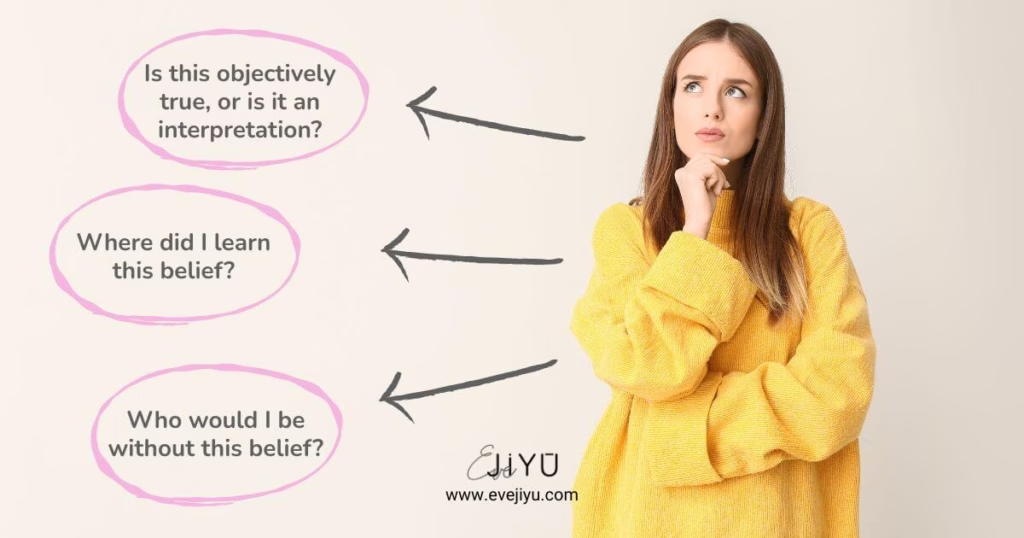
Start by asking yourself three questions:
1. Is this objectively true, or is it an interpretation?
Objective truth: “I applied for three jobs and didn’t get them.”
Limiting belief: “I’m unhireable.”
The first statement is verifiable. The second is a story you’re telling about what those rejections mean.
2. Where did I learn this belief?
Most self limiting beliefs come from somewhere outside of you. A parent’s offhand comment. A teacher’s criticism. A relationship that taught you to minimize your needs. When you trace the belief back to its source, you often realize it was never yours to begin with.
3. Who would I be without this belief?
This question, borrowed from Byron Katie’s inquiry work, helps you see what the belief is costing you. If you didn’t believe you were too old, too late, or too undisciplined, what would you do differently today?
The goal isn’t to replace limiting beliefs with positive affirmations. It’s to recognize them as assumptions rather than facts, which creates space for you to test whether they’re still accurate.
How to Start Breaking Self Limiting Beliefs (Without Forcing Positivity)
Breaking self limiting beliefs doesn’t mean repeating affirmations until you believe them. It means creating small experiences that contradict the belief so your nervous system can start to update its programming.
Here’s a grounded approach that doesn’t rely on mindset gymnastics:
Step 1: Name the belief without judging it.
Write it down exactly as it shows up in your head. “I’m not disciplined enough.” “I always sabotage good things.” Whatever the belief is, get it out of your head and onto paper where you can see it clearly.
Step 2: Rewrite it as an experiment instead of a fact.
Instead of “I’m not disciplined enough,” try “I haven’t yet found systems that work with my energy patterns.” Instead of “I always sabotage good things,” try “I’ve had experiences where I pulled back when things felt vulnerable.“
This small shift opens the door to curiosity instead of resignation.
Step 3: Gather behavioral evidence.
Limiting beliefs survive because we don’t test them. Start small. If you believe you can’t set boundaries, try saying no to one low-stakes request and notice what actually happens.
The point isn’t to prove the belief wrong. It’s to gather real data about what’s true now, rather than continuing to operate based on what was true ten years ago.
Step 4: Track the moments when the belief loosens.
Pay attention to situations where the limiting belief doesn’t show up. Maybe you’re disciplined about things that matter to you, even if you’re inconsistent with things you think you should care about. That information tells you something about the belief’s accuracy.
This process takes time. You’re not trying to overhaul your entire belief system overnight. You’re simply creating enough space to question whether the stories you’ve been telling yourself are still serving you.
Reflective questions:
- What’s one limiting belief you’re willing to test this week?
- What would count as evidence that the belief might not be completely true?
Why Journaling Is One of the Most Effective Tools for Limiting Beliefs
Journaling creates distance between you and your thoughts. When a belief lives only in your head, it feels like part of you. When you write it down, you can see it as something separate, something you’re thinking rather than something you are.
This is not the same as venting. Venting releases pressure but doesn’t necessarily create insight. Belief work through journaling involves asking yourself questions that interrupt automatic thinking patterns.
Pennebaker’s expressive writing research shows it processes experiences, regulates emotions, and reduces rumination—bringing limiting beliefs into conscious awareness for change. When you write about limiting beliefs specifically, you’re bringing unconscious patterns into conscious awareness, which is the first step toward changing them.
Prompts for working with limiting beliefs:
- If I didn’t believe this about myself, I would…
- This belief protects me from…
- The cost of keeping this belief is…
- I learned this belief when…
These prompts don’t force you toward optimism. They ask you to look honestly at what the belief is doing in your life, which is often enough to loosen its grip.
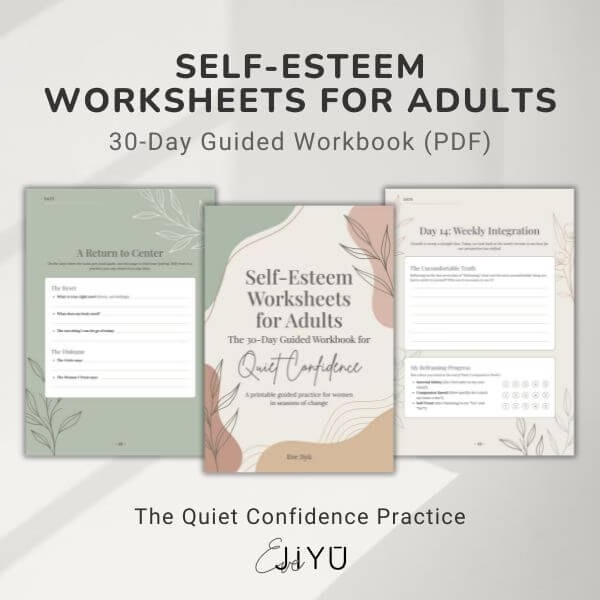
If you want structured support for this kind of reflection, the Quiet Confidence workbook offers thirty days of guided exercises specifically designed to help you identify and reframe the beliefs that keep you stuck.
Final Thought: You’re Not Broken, You’re Conditioned
Self limiting beliefs are not evidence of personal failure. They’re evidence that you absorbed messages from your environment and did what any intelligent person would do: you adapted to protect yourself.
The beliefs that kept you safe at fifteen might be suffocating you at thirty-five. That doesn’t mean you were wrong to develop them. It means you’ve outgrown them.
Breaking limiting beliefs is not about becoming a different person. It’s about remembering who you were before the world taught you to be smaller, quieter, or more convenient.
Awareness is already the beginning of freedom. You don’t have to have all the answers. You just have to be willing to question the beliefs that have been running your life without your permission.
If one of these limiting beliefs examples resonated with you, I’d love to hear which one and how it shows up in your life. Leave a comment below or explore more grounded guidance on self-discovery and belief work in the How to Find Your Creative Voice article.
⬇⬇⬇Pin or save to read later ⬇⬇⬇












0 Comments