
In This Article

Key Takeaways
- Self-love is a skill, not a state. Journaling transforms self-love from an abstract concept into a daily practice you can actually measure and refine.
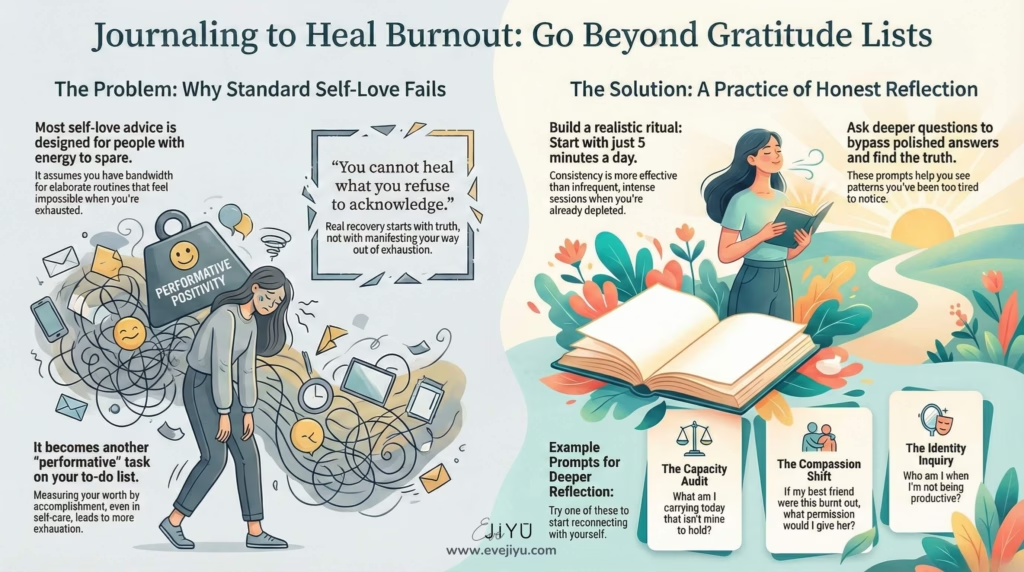
- Burnout recovery requires honest reflection. You cannot heal what you refuse to acknowledge. These prompts help you see patterns you’ve been too tired to notice.
- Consistency beats intensity. Five minutes of journaling each morning outperforms sporadic hour-long sessions when you’re already depleted.
- Self-discovery prompts for women work differently. The questions that matter most aren’t about productivity or achievement. They’re about permission, capacity, and remembering who you were before the world told you who to be.
Stop the cycle of exhaustion. Discover 11 authentic journal prompts for self love and burnout recovery designed for your creative life reinvention. Use these journal prompts for self love to deepen your practice and enhance your self-care journey.
Why Your Self-Love Ritual Keeps Failing
You’ve tried the gratitude lists. You’ve downloaded the meditation apps. You’ve bought the fancy journals with prompts that ask you to list three things that make you happy.
And yet here you are, still running on fumes, still saying yes when you mean no, still measuring your worth by how much you can accomplish before your nervous system starts screaming for a break.
The problem isn’t you. The problem is that most self-love advice was designed for people who have energy to spare. It assumes you have the bandwidth for elaborate morning routines and vision boards and affirmations that feel like lies when you’re too exhausted to believe them.
When I moved to Bali three years ago, I was the queen of “fine.” I had mastered the art of looking successful while feeling completely hollow. My journals from that time are full of to-do lists and goal-setting exercises, but almost nothing about how I actually felt or what I actually needed.
That version of self-love didn’t work because it was performative. It was another task to complete, another way to prove I was doing enough.
Real self-love starts with truth. And truth requires stillness. And stillness requires a practice that meets you where you are, not where you think you should be.
That’s what these journal prompts for self love are designed to do. They don’t ask you to be grateful for your burnout or to manifest your way out of exhaustion. They ask you to get honest about what you’re carrying, what you’re avoiding, and what you actually need to feel like yourself again.
Setting the Foundation: How to Start a Self-Love Journal
Before you dive into the prompts, you need a container for this work. Not a perfect system or an aesthetic setup. Just a sustainable practice that fits your actual life.

Choose Your Medium
Some people need the tactile experience of pen on paper. The physical act of writing slows down their thoughts and makes the reflection feel more real.
Others need the searchability and privacy of a digital journal. If you’re someone who revisits old entries to track patterns or who writes more honestly when you know no one can stumble across your notebook, a digital option makes sense.
I’ve used both. Right now, I journal digitally using Reflection.app because it lets me search past entries by emotion or theme. When I’m trying to understand why I feel stuck, I can pull up every time I’ve written about a specific pattern and see what was happening around it.
Build a Realistic Ritual
If your journaling practice requires 45 minutes of uninterrupted time, candles, and the perfect playlist, you’re setting yourself up to skip it the moment life gets messy.
Start with five minutes. That’s it. Five minutes in the morning with your coffee, or five minutes before bed when the house is finally quiet.
You’re not writing a memoir. You’re simply checking in with yourself before the day’s noise drowns out what you actually feel.
For a more detailed guide on building a sustainable journaling practice, read my article on how to start journaling. It covers everything from choosing prompts to dealing with resistance when your brain tells you this is a waste of time.
11 Deep Journal Prompts for Self Love and Reinvention
These aren’t surface-level questions. They’re designed to bypass the polished answers you give other people and get to the truth you’ve been too busy to face.
Work through them slowly. Some will land immediately. Others won’t make sense until three months from now when you’re in the middle of a breakdown and suddenly remember the question.
1. The Capacity Audit: What am I carrying today that isn’t mine to hold?
Burnout rarely comes from doing too much of what matters. It comes from carrying responsibilities, emotions, and expectations that were never yours in the first place.
Write down everything on your mental to-do list. Not just work tasks, but emotional labor. The worry about your friend’s relationship. The guilt about not calling your mother more often. The pressure to fix your colleague’s mistake.
Now circle only the things that are genuinely your responsibility. Everything else is weight you’re carrying out of habit or fear or the belief that your worth is tied to how much you can handle.
This prompt helps you see where you’re leaking energy. Once you see it, you can start putting it down.
2. The Joy Fragment: What is one small thing that made me feel alive this week?
When you’re burned out, joy feels like a luxury you can’t afford. You’re in survival mode, which means your brain is scanning for threats, not for moments of aliveness.
But joy doesn’t require big events or perfect conditions. It shows up in fragments. The way the light hit your coffee cup this morning. The song that came on while you were driving. The moment your shoulders relaxed when you finally sat down.
Write about one small thing from this week that made you feel something other than tired. Don’t overthink it. Just notice where your nervous system softened, even for a second.
This practice rewires your brain to look for moments of aliveness instead of only cataloging what’s wrong. Over time, it makes those moments easier to find.
3. The Compassion Shift: If my best friend were in my current state of burnout, what permission would I give her?
You would never tell your best friend to push through when she’s running on empty. You wouldn’t tell her that rest is laziness or that her needs are too much.
But you tell yourself those things all the time.
Write down what you would say to someone you love if they were exactly where you are right now. What permission would you give them? What truth would you remind them of?
Then read it back to yourself. Out loud if you can. Because the compassion you have for others is already inside you. You just need permission to turn it toward yourself.
For more on why self-compassion is a skill you can build, not a personality trait you either have or don’t, read my article on powerful ways to build love in yourself.
4. The Identity Inquiry: Who am I when I’m not being productive?
Most of us have built our entire sense of self around what we do. We’re the reliable one. The high achiever. The person who gets things done.
But productivity is not an identity. It’s a behavior. And when that behavior is the only thing holding up your sense of worth, burnout is inevitable.
Write about who you are when you’re not accomplishing anything. What do you care about when no one is watching? What makes you feel like yourself when there’s no project to complete or problem to solve?
If you don’t know the answer yet, that’s okay. This prompt isn’t about having clarity. It’s about noticing that you’ve been measuring your value by the wrong metric.
5. The “Happiness When” Trap: What can I celebrate about my current messy middle?
There’s a version of you that believes you’ll finally be happy when you hit the next milestone. When you get the promotion, lose the weight, finish the project, find the relationship.
But that version of happiness never arrives. Because the goal posts keep moving. There’s always another thing to achieve before you’re allowed to feel good about where you are.
Write about what’s worth celebrating right now, even if your life doesn’t look the way you thought it would. What are you learning? What are you surviving? What small wins are you ignoring because they don’t feel big enough?
This prompt helps you stop postponing your own approval. For a deeper dive into why “I’ll be happy when” thinking keeps you stuck, read my article on unconditional self-love.
6. The Sensory Check-In: Where do I feel safe in my body right now?
Burnout lives in your body before it shows up in your schedule. It’s the tightness in your chest when you wake up. The knot in your stomach when you check your email. The headache that won’t go away no matter how much water you drink.
Close your eyes for a moment. Scan your body from your head to your toes. Where do you feel tension? Where do you feel numb? And where, if anywhere, do you feel safe?
Write about what you notice. Don’t try to fix it. Just name it.
This practice helps you reconnect with your body’s signals instead of overriding them with willpower. Over time, it makes it easier to catch burnout before it flattens you.
7. The Boundary Blueprint: Where did I say yes this week when my soul meant no?
Every time you say yes when you mean no, you teach people that your boundaries are negotiable. And you teach yourself that your needs don’t matter as much as keeping the peace.
Think about the last week. Where did you agree to something that made your stomach drop? Where did you override your gut because you didn’t want to disappoint someone or seem difficult?
Write about what happened and what it cost you. Not in a self-blaming way, but in a data-collecting way. You’re simply noticing where your boundaries are weakest so you can start reinforcing them.
Setting boundaries isn’t about being harsh. It’s about being honest. And honesty is an act of self-love.
8. The Creative Spark: What idea keeps showing up that I’ve been too scared to explore?
Burnout often comes from living a life that’s safe but not true. You’ve built something stable, but somewhere along the way, you stopped listening to the quiet voice that whispers about what you actually want.
Write about the idea or dream or curiosity that keeps showing up when you’re driving or in the shower or lying awake at night. The thing you dismiss as impractical or unrealistic or too late.
You don’t have to quit your job or move to Bali to honor that voice. You just have to stop pretending it’s not there.
Sometimes self-love looks like finally admitting that the life you’ve built doesn’t fit anymore. And that’s okay. You’re allowed to want something different.
9. The Future Self Dialogue: What does the version of me who’s no longer burned out know that I don’t yet?
Imagine yourself one year from now. You’ve done the work. You’ve set the boundaries. You’ve stopped measuring your worth by how much you can endure.
What does that version of you know that you’re still learning? What did she have to let go of to get there? What permission did she finally give herself?
Write a letter from her to you. Let her tell you what she wishes she’d known sooner. Let her remind you that the path out of burnout isn’t about doing more. It’s about being honest about what you need and brave enough to honor it.
This prompt helps you see that the woman you’re becoming is already inside you. She’s just waiting for you to trust her.
10. The Forgiveness Letter: What part of myself am I still punishing for being human?
You’re probably carrying shame about something that wasn’t your fault. A relationship that ended. A job you left. A version of yourself who survived the only way she knew how.
Write a letter to the part of yourself you’re still punishing. The one who made the “wrong” choice or fell apart or couldn’t keep it together.
Tell her what you wish someone had told you back then. Tell her that surviving was enough. That she did the best she could with what she had.
This isn’t about excusing harm or pretending mistakes don’t matter. It’s about releasing the weight of shame that keeps you stuck in self-judgment instead of moving toward self-trust.
11. The Resilience Record: What is a failed moment that actually protected me?
Not every mistake is a failure. Sometimes the thing you think you got wrong was actually your nervous system protecting you from something worse.
Think about a moment this year that felt like failure. A project that didn’t work out. A boundary you set that made someone angry. A decision you made that looked like the wrong choice.
Now write about what that moment protected you from. What didn’t happen because you made that choice? What space did it create for something better to show up later?
This prompt helps you reframe failure as information instead of evidence of your inadequacy. And it reminds you that resilience isn’t about never falling apart. It’s about trusting that even your hardest moments are teaching you something.
Healing Burnout Through Journaling for Emotional Intelligence
There’s science behind why these self-help journal prompts work. Expressive writing has been shown to lower cortisol levels, improve immune function, and help regulate emotional responses.
When you write about what you’re feeling, you’re moving those feelings out of your amygdala (where your brain processes threat) and into your prefrontal cortex (where you process meaning). That shift alone can reduce the intensity of anxiety and overwhelm.
But the real power of journaling for emotional intelligence isn’t just in processing emotions. It’s in recognizing patterns.
When you journal consistently, you start to see the same thoughts, fears, and triggers showing up over and over. You notice that every time you feel stuck, you’re also saying yes to things you don’t want to do. Or that every time you feel anxious, you’re comparing yourself to someone on social media.
Those patterns are data. And data gives you leverage. Once you can see what’s draining you, you can start making different choices.
This is why reflective prompts for life reinvention work so well for women in their late twenties to forties. You’re not starting from scratch. You’re building on years of lived experience. You just need a way to organize that experience into something useful instead of letting it loop in your head.
If you’re ready to go deeper into the practice of self-love through journaling, start with my guide on how to love yourself. It walks through the foundational mindset shifts that make these prompts land differently.
Start Small, Stay Honest
Self-love isn’t a destination you arrive at after completing enough journal prompts. It’s a practice you return to when the world gets loud and you forget who you are underneath all the doing.
These 11 prompts are simply tools to help you remember. To help you see what you’re carrying that isn’t yours. To help you notice where joy still exists, even when you’re too tired to look for it.
You don’t have to do all of them at once. Pick one. Spend five minutes with it tomorrow morning. See what shows up.
The woman you’re becoming doesn’t need you to have all the answers. She just needs you to start asking better questions.
And these questions? They’re a good place to start.
Want more grounded support for your self-discovery journey? Join my weekly letters on living at a human pace, creative voice, and the beauty of the messy middle. Sign up at evejiyu.com/contact-self-growth-for-women.
A Note on Tools and Transparency
Throughout this article, I’ve mentioned Reflection.app as a digital journaling option.
Full transparency: this is an affiliate link. If you subscribe, I receive a small commission at no extra cost to you. I only recommend tools I actually use and believe in.
Reflection.app has genuinely helped me track patterns in my writing over time. When I’m trying to understand why I feel stuck, I can search past entries by emotion or theme and see what was happening around those moments. That kind of searchability makes it easier to spot the patterns I’d otherwise miss.
If you use my link, you’ll get 40% off an annual premium subscription.
But you don’t need any paid tool to benefit from these prompts. Pen and paper work beautifully. The medium is just a container. The practice is what matters.
⬇⬇⬇Pin or save to read later ⬇⬇⬇



0 Comments