
In This Article
Self-respect isn’t about becoming harder or colder. It’s about finally treating yourself the way you’ve been treating everyone else.
You’ve probably heard the advice a hundred times: “You need to respect yourself more.” But what does that actually mean when you’re sitting at your desk at 9 PM finishing someone else’s work? What does it look like when you’re explaining your boundaries for the third time to someone who still doesn’t listen?
Self-respect sounds simple until you try to practice it. Then it becomes one of the hardest things you’ll ever do.
I used to think self-respect meant being assertive or outspoken. I thought it was a personality trait some women naturally had while others didn’t. But after years of saying yes when I meant no, and justifying my needs to people who never asked for justification, I realized something crucial: self-respect isn’t about who you are. It’s about what you do.
This article explores four foundational truths about how to respect yourself in daily life. These aren’t motivational slogans or quick fixes. They’re the uncomfortable realizations that helped me stop betraying myself in small ways that added up to a life that didn’t fit.
If you’ve ever felt like you know what you want but can’t seem to honor it, this is for you.
What Does Self-Respect Mean—Beyond Self-Esteem and Confidence?
Before we can practice self-respect, we need to understand what it actually is. Most people use self-respect, self-esteem, and confidence interchangeably, but they’re different things that build on each other.
The Real Definition of Self-Respect
Self-respect is the consistent practice of honoring your own needs, values, and boundaries through your actions. It’s not how you feel about yourself (that’s self-esteem). It’s not what you believe you can accomplish (that’s confidence). Self-respect is what you do when no one is watching and nothing external rewards you for it.
You can have high self-esteem and still let people treat you poorly. You can be confident at work and still ignore your body’s signals that you need rest. But you cannot have self-respect without behavioral alignment between what you value and what you allow.
How Self-Respect Differs From Self-Esteem
Self-esteem is your internal sense of worth. It’s the voice that says “I matter” or “I’m enough.” Self-esteem can fluctuate based on mood, circumstances, or how others treat you.
Self-respect is more stable because it’s anchored in action. When you have self-respect, you treat yourself with care even when your self-esteem is low. You honor your boundaries even when you don’t feel particularly worthy.
Research shows people with high self-respect exhibit consistent value-aligned behavior regardless of external validation.
Why Self-Respect Is the Foundation
Think of it this way: self-esteem is how you feel about yourself. Confidence is what you believe you can do. Self-respect is the daily decision to treat yourself like someone who deserves both.
Without self-respect, self-esteem becomes dependent on external approval. Without self-respect, confidence becomes performance anxiety. Self-respect is the ground floor. Everything else you’re trying to build sits on top of it.
Many women skip this foundation entirely. We work on feeling better about ourselves or becoming more confident without addressing the fundamental question: am I treating myself with basic respect?
Reflection questions:
- When was the last time you honored a boundary even though it was uncomfortable?
- Do you treat yourself with the same care you extend to others?
- What would change if you measured your worth by your actions toward yourself instead of others’ opinions?
Truth #1: You Can’t Respect Yourself While Ignoring Your Own Boundaries
Boundaries are not walls you build to keep people out. They’re information about where you end and someone else begins. When you ignore your boundaries, you’re telling yourself that your needs don’t matter as much as someone else’s comfort.

Boundaries as Information, Not Barriers
A boundary is simply a clear statement about what works for you and what doesn’t. It’s not a punishment or a test. It’s not about controlling other people’s behavior. It’s about protecting your energy, time, and emotional capacity so you can show up as the person you want to be.
When you set a boundary, you’re giving someone accurate information about how to be in relationship with you. When you don’t set boundaries, you’re asking people to guess what you need and then resenting them when they get it wrong.
Why Explaining Boundaries Weakens Them
One of the biggest mistakes I made for years was over-explaining my boundaries. I thought if I could just make people understand why I needed something, they would respect it. But here’s what I learned: people who respect you don’t need lengthy explanations. People who don’t respect you won’t be convinced by them.
When you over-explain, you’re unconsciously seeking permission. You’re turning your boundary into a debate where the other person gets to decide if your reason is valid enough.
A boundary doesn’t need a justification. “I’m not available this weekend” is a complete sentence. “I don’t discuss my salary with coworkers” needs no elaboration. The more you explain, the more you signal that your boundary is negotiable.
Everyday Examples of Boundary Violations
Boundary violations aren’t always dramatic. They’re usually small, repetitive erosions that you don’t notice until you’re exhausted.
At work: Your manager asks if you can “quickly” handle something at 6 PM on Friday. You say yes even though you have plans. You tell yourself it’s just this once, but it happens every week.
In relationships: Your friend vents to you for an hour about the same problem she won’t take action on. You listen because you care, but afterward you feel drained. You never mention that you’re struggling too.
With family: Your mother criticizes your parenting choices every time she visits. You let it go because you don’t want conflict. The tension builds in your body instead.
Each time you ignore these moments, you’re practicing disrespect toward yourself. Your nervous system registers the betrayal even when your mind rationalizes it.
For more on recognizing these patterns, read my article on feeling not enough in a world that always wants more.
Reflection questions:
- Where in your life do you consistently ignore your own boundaries?
- What would you need to believe about yourself to enforce them?
- How do you feel in your body when someone crosses a line you didn’t defend?
Truth #2: Self-Respect Is Shown in What You Tolerate, Not What You Say
You can say you respect yourself all day long. You can write affirmations and set intentions and talk about your worth. But none of that matters if your actions show something different.
Self-respect lives in the gap between what you say matters to you and what you actually allow in your life.
Words Versus Standards
Standards are the behaviors and treatment you accept from yourself and others. They’re not aspirational. They’re operational. Standards show up in what you do when no one is looking and nothing is at stake except your integrity.
I used to say I valued my time, but I showed up late to meetings I set. I said I valued my health, but I skipped meals and stayed up scrolling. I said I valued honest communication, but I stayed silent when something bothered me.
The disconnect between my words and my standards was costing me my self-respect.
Why “Understanding” Often Turns Into Self-Betrayal
Women are conditioned to be understanding. We’re taught that empathy means absorbing other people’s emotions and accommodating their needs. But understanding someone’s behavior doesn’t mean you have to tolerate it.
You can understand why your colleague is stressed and still refuse to cover her work every week. You can understand why your partner is going through a hard time and still need them to speak to you with respect. Understanding is compassion. Tolerating mistreatment is self-abandonment.
Every time you prioritize someone else’s comfort over your own peace, you’re teaching yourself that your needs come second. That’s not kindness. That’s conditioning.
The Hidden Cost of Staying Silent
Silence isn’t neutral. When you don’t speak up about something that bothers you, you’re making a choice. You’re choosing short-term peace over long-term respect. You’re choosing to avoid discomfort in the moment at the expense of your integrity.
The cost shows up later. It shows up as resentment. As passive aggression. As burnout. As that tight feeling in your chest when you see their name on your phone.
Psychology researcher Dr. Harriet Lerner writes in The Dance of Anger that unexpressed anger doesn’t disappear—it transforms into anxiety, depression, or physical symptoms. Your body keeps the score even when your mouth stays quiet.
Practice exercise: The Tolerance Audit
Take out a piece of paper and write down three things you’re currently tolerating that don’t align with how you want to be treated. For each one, answer:
- How long have I been tolerating this?
- What am I afraid would happen if I stopped?
- What is this costing me emotionally, physically, or mentally?
This isn’t about blaming yourself. It’s about getting honest with the gap between what you deserve and what you’re accepting.
Reflection questions:
- What behavior have you normalized that you would never accept from a stranger?
- How often do you explain away mistreatment instead of addressing it?
- What would your life look like if your standards matched your words?
Truth #3: You Don’t Need More Confidence to Respect Yourself
One of the most paralyzing myths about self-respect is that you need to feel confident before you can act with respect toward yourself. This keeps women waiting indefinitely for a feeling that only comes after the action.
Why Waiting to “Feel Ready” Keeps You Stuck
Confidence is the result of repeated action, not the prerequisite. You don’t feel confident and then set a boundary. You set the boundary, survive the discomfort, and then confidence builds from the evidence that you can do hard things.
If you wait until you feel confident enough to respect yourself, you’ll wait forever. The feeling arrives after you’ve already started treating yourself differently.
I spent years waiting to feel “ready” to quit jobs that drained me, to end relationships that weren’t working, to say no to commitments I didn’t want. I thought I needed more courage or clarity or certainty. What I actually needed was to act despite the fear, not after it disappeared.
Self-Respect as a Decision, Not a Feeling
Self-respect is not an emotion you cultivate through meditation or affirmations. It’s a decision you make in ordinary moments when no one is watching and nothing guarantees success.
It’s the decision to leave the party when you’re tired instead of staying because everyone else is still there. It’s the decision to order what you want at dinner instead of what sounds least complicated. It’s the decision to stop mid-sentence and correct yourself when you’ve over-apologized.
These decisions don’t feel empowering in the moment. They feel awkward and uncomfortable and slightly rebellious. But each one is a deposit in your self-respect account. Over time, those deposits compound.
How Small Acts of Self-Trust Build Confidence
Confidence doesn’t come from big declarations or dramatic changes. It comes from keeping small promises to yourself. When you say you’ll take a lunch break and you actually do it, you’re building trust with yourself. When you say no to something you don’t want to do and the world doesn’t end, you’re gathering evidence that you can handle the discomfort of self-respect.
Every time you honor a small boundary, you’re training your nervous system to believe that your needs matter. Every time you speak up even though your voice shakes, you’re proving to yourself that you can survive the fear.
This is how to have self respect even when you don’t feel confident yet. You act first. The feeling follows.
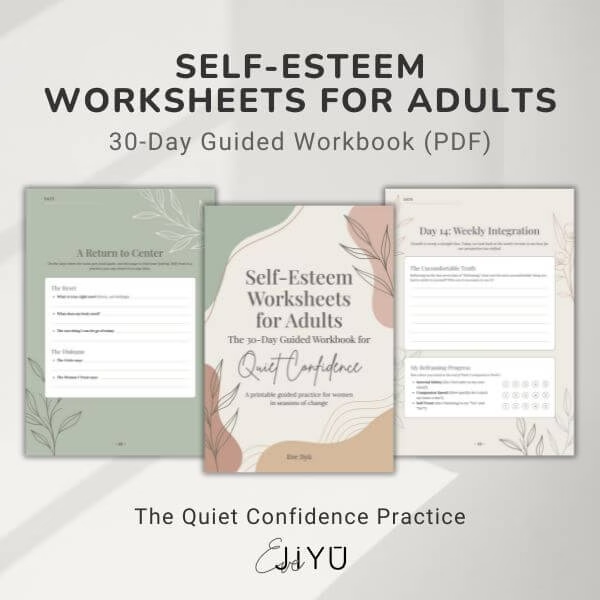
For more on building this kind of trust with yourself, read my guide on self-esteem worksheets for adults.
Practice exercise: The Self-Trust Tracker
For the next week, identify one small promise you can make to yourself each day and keep it. These should be simple, specific, and entirely within your control.
Examples:
- I will drink water before coffee
- I will take a 10-minute walk at lunch
- I will not check my phone for the first 30 minutes after waking
- I will say one thing I actually think in a meeting
Track each promise kept. Notice how it feels in your body to follow through.
Reflection questions:
- What small promise have you been breaking to yourself repeatedly?
- What’s one area where you consistently wait for confidence before acting?
- How would your life be different if you acted with self-respect before you felt ready?
Truth #4: Self-Respect Often Feels Uncomfortable at First
The uncomfortable truth about learning how to respect yourself is that it will make you uncomfortable. For a while, it will feel wrong. It will feel selfish. It will feel like you’re doing something bad even when you’re finally doing something right.

Why Early Self-Respect Triggers Guilt and Fear
If you’ve spent years prioritizing other people’s needs over your own, your nervous system has learned that safety comes from accommodation. When you start setting boundaries or saying no, your body interprets it as danger. You’re breaking an old pattern that kept you connected (even if that connection came at the cost of your wellbeing).
The guilt you feel isn’t evidence that you’re doing something wrong. It’s evidence that you’re doing something new.
Fear shows up too. Fear that people will be angry. Fear that you’ll be abandoned. Fear that you were only valuable because you were useful. These fears are not irrational—they’re based on real experiences where your worth was conditional.
But here’s the difference: now you’re choosing yourself not because others have earned your disrespect, but because you’ve finally earned your own respect.
Losing Approval Versus Losing Yourself
When you start respecting yourself, some people won’t like it. The ones who benefited from your lack of boundaries will feel the shift. They’ll call you selfish or difficult or changed. They’ll tell you you’re not the person they thought you were.
They’re right. You’re not.
You have a choice in these moments: lose their approval or lose yourself. You cannot keep both. The question is which loss you can live with.
I’ve lost friendships that only worked when I was available on demand. I’ve disappointed family members who expected me to show up in ways that drained me. I’ve been called “too much” and “not enough” in the same week. And every time, the discomfort was worth it because the alternative was abandoning myself.
Normalizing the Emotional Discomfort of Growth
Growth is not a peaceful process. It’s not candles and bubble baths and gentle affirmations. Real growth requires you to sit with the discomfort of disappointing people you care about. It requires you to tolerate the anxiety of being misunderstood. It requires you to trust that you will survive other people’s anger.
This discomfort is not a sign you’re doing it wrong. It’s a sign you’re doing it at all.
Your body will eventually adjust to the new normal. The guilt will fade. The fear will quiet. But only if you keep going. Only if you let the discomfort be there without running back to old patterns to escape it.
Practice exercise: The Discomfort Inventory
The next time you feel guilty or anxious after setting a boundary or saying no, try this:
- Name the feeling: “I feel guilty”
- Locate it in your body: “I feel it in my chest and throat”
- Ask: “Is this feeling telling me I did something wrong, or is it telling me I did something new?”
- Breathe and let the feeling exist without fixing it
You don’t have to make the discomfort go away. You just have to stop letting it make your decisions.
Reflection questions:
- When you think about setting a boundary, what emotion comes up first?
- Who in your life might resist your self-respect, and why does their approval matter?
- What would you be able to do if you could tolerate being temporarily uncomfortable?
How to Respect Yourself in Daily Life (Without Becoming Cold or Selfish)
One of the biggest fears women have about self-respect is that it will make them unkind. We’ve been taught that caring for ourselves means caring less about others. But that’s a false binary.
Self-respect doesn’t require you to become hard or distant. It requires you to become honest.
Self-Respect Versus Rigidity
Self-respect is flexible because it’s rooted in your values, not in rigid rules. It’s not about never helping anyone or always saying no. It’s about choosing when to give from a place of genuine care rather than obligation or guilt.
A rigid boundary sounds like: “I never work past 5 PM.” A respectful boundary sounds like: “I don’t work past 5 PM on weekdays, but I can stay late if there’s a true emergency and I have advance notice.”
The difference is intentionality. Rigidity is a defense mechanism. Self-respect is a conscious choice.

Warm Boundaries Versus People-Pleasing
You can set boundaries and still be kind. You can say no and still be generous. You can prioritize your needs and still care deeply about others.
Examples of warm boundaries:
- “I care about you and I don’t have the emotional bandwidth for this conversation right now. Can we talk tomorrow?”
- “I’d love to help with that project, but my plate is full. Have you considered asking Sarah?”
- “I need to leave by 8 PM tonight, so let’s make sure we cover the most important things first.”
These statements respect both you and the other person. They’re clear without being harsh. They make space for your needs without dismissing theirs.
Reframing “Selfish” as Self-Honoring
The word “selfish” has been weaponized against women who dare to have needs. But there’s nothing selfish about taking care of yourself so you can show up fully in your life.
Selfishness is taking without regard for others. Self-respect is giving yourself the same regard you give to everyone else. That’s not selfishness. That’s equity.
When you respect yourself, you become more capable of respecting others. You stop resenting people for asking because you’ve learned to say no. You stop over-giving because you’re no longer depleted. You show up as someone who has chosen to be there, not someone who had no choice.
Reflection questions:
- Where do you confuse self-respect with selfishness?
- What would it look like to set a warm boundary in one relationship this week?
- How might your relationships improve if you stopped resenting people for asking?
Common Myths About Self-Respect That Keep Women Stuck
Before you can practice self-respect, you have to dismantle the beliefs that make it feel impossible. These myths are so pervasive that most women don’t even realize they’re operating from them.
Myth #1: “If I Respect Myself, I’ll Be Alone”
This is the deepest fear. If you set boundaries, people will leave. If you stop over-giving, no one will stay. If you prioritize your needs, you’ll end up isolated.
But here’s the truth: the people who leave when you start respecting yourself were never there for you. They were there for what you could do for them. Losing them isn’t loss—it’s clarity.
The right people don’t need you to be small. They don’t need you to be accommodating or convenient. They want you as you are, boundaries and all.
Myth #2: “Good Women Are Flexible”
Flexibility is praised in women because it makes us easier to manage. We’re told that being adaptable means being mature. But there’s a difference between flexibility and self-erasure.
Flexibility is adjusting your plans when something unexpected comes up. Self-erasure is constantly adjusting yourself to fit what others need from you. One is responsiveness. The other is self-betrayal.
Good women are not doormats. Good women have spines.
Myth #3: “I Should Be More Understanding”
This is the most insidious myth because it sounds so reasonable. Of course you should be understanding. Of course you should give people the benefit of the doubt.
But understanding doesn’t mean accepting. You can understand why someone behaves the way they do and still refuse to tolerate it. You can have compassion for their struggle and still protect your peace.
Understanding without boundaries is just elaborate self-betrayal.
How These Beliefs Form (and How to Question Them)
These myths didn’t appear out of nowhere. They were taught to you through hundreds of small messages about what makes women valuable. You learned that your worth was tied to your usefulness. You learned that taking up space was selfish. You learned that your needs were less important than everyone else’s comfort.
But you can unlearn them. Every time you catch yourself thinking one of these thoughts, pause and ask: “Is this actually true, or is this what I was taught to believe?”
The answer will surprise you.
For more on identifying and challenging limiting beliefs, read my article on the chaos of self-discovery.
Reflection questions:
- Which of these myths shows up most often in your internal dialogue?
- Who taught you that self-respect was selfish, and do you still believe them?
- What evidence do you have that contradicts these myths?
Self-Respect Is a Practice, Not a Personality Trait
Self-respect is not something you either have or don’t have. It’s not a fixed quality that some women possess while others don’t. Self-respect is a practice—a series of small, repeated choices that compound over time.

Self-Respect Is Built Through Repetition
You don’t learn how to respect yourself by reading about it or thinking about it. You learn by doing it. Over and over. In small moments that no one sees and no one applauds.
You build self-respect by saying no when it would be easier to say yes. By leaving the conversation when it turns disrespectful. By honoring your need for rest even when your to-do list isn’t finished. By speaking up when you’d rather stay quiet.
Each repetition strengthens the neural pathway that says: my needs matter. Each time you choose yourself, you make it easier to choose yourself again.
One Honest Choice at a Time
You don’t have to overhaul your entire life overnight. You don’t have to set a hundred boundaries or quit everything that’s draining you. You just have to make one honest choice today.
Maybe that choice is saying “let me think about it” instead of immediately agreeing. Maybe it’s taking a lunch break. Maybe it’s not answering a text until you’re actually ready to engage.
Start where you are. Start small. Just start.
The Way You Treat Yourself Teaches Others How to Meet You
People learn how to treat you by watching how you treat yourself. When you tolerate disrespect, you’re showing them that disrespect is acceptable. When you ignore your needs, you’re teaching them that your needs don’t matter.
But when you respect yourself consistently, you raise the standard for everyone around you. You teach people that access to you requires respect. You show them what it looks like to be in relationship with someone who knows her worth.
This isn’t about controlling others. It’s about modeling the treatment you deserve. And the people worth keeping will meet you there.
Closing thought:
Self-respect is not a destination you arrive at after you’ve healed enough or grown enough or become enough. It’s the path itself. It’s the daily practice of choosing yourself even when it’s uncomfortable. Even when it costs you approval. Even when you don’t feel confident yet.
You don’t need permission to respect yourself. You don’t need to wait until you’ve earned it. You already have. The only question is: will you honor it?
I’d love to hear from you: What’s one area where you struggle most with self-respect? Leave a comment below or sign up for my weekly letters on self-discovery and living at a human pace.
⬇⬇⬇Pin or save to read later ⬇⬇⬇












0 Comments