
In This Article
How I find myself isn’t a neat or pretty journey. Feeling disconnected from who you are? These 7 powerful lessons will help you discover your true self, regain clarity, and finally feel aligned again.
Four years ago, I had everything I thought I wanted. A career that looked good on paper. Friends who knew me as the reliable one. A life that made sense to everyone but me.
And yet, late at night, I’d lie awake googling “how do you figure out who you are” like it was an emergency. Because somewhere between doing what I should and becoming who others needed, I’d completely lost track of myself.
If you’ve ever felt successful on the outside but hollow on the inside, this is for you. If you’ve wondered how to find yourself when the old version no longer fits, keep reading. These seven lessons aren’t about quick fixes or perfect transformations. They’re about the messy, uncomfortable, deeply human process of learning how I found myself—and how you can too.
The Moment I Realized I Was Living Someone Else’s Life
I was 28 when it hit me. Sunday evenings filled me with dread. Not because Monday was hard, but because the entire week ahead felt like I was playing a character in someone else’s story.
The Signs I’d Been Ignoring
Burnout doesn’t announce itself with trumpets. It whispers. For months, I’d been operating on autopilot. Smiling when expected. Agreeing when asked. Performing the version of myself that made others comfortable.
I excelled at my job but felt nothing about it. I maintained friendships but rarely said what I actually thought. I looked fine in photos but felt absent in my own life.
The disconnect was subtle but constant. Like watching yourself from the outside, wondering when you’ll feel real again. This is often where the question “how do I discover who I am” becomes urgent rather than philosophical.
When Success Feels Empty
Achievement was supposed to fix this. I kept thinking the next promotion, the next milestone, the next accomplishment would make me feel whole. But external validation is a temporary bandaid on an internal wound.
Research confirms pursuing intrinsic goals leads to greater well-being than chasing extrinsic success markers. I was chasing the wrong metrics entirely.
I’d built a life that looked impressive but felt borrowed. And that realization became the first step in understanding how to find my true self.
Reflection Questions:
- When do you feel most like yourself? When do you feel most like a performance?
- What parts of your current life did you choose because you wanted them versus because they seemed expected?
- If nobody was watching or judging, what would you change about your daily routine?
Why Most Advice on “How to Find Yourself” Is Misleading
After that realization, I did what most of us do. I consumed every article, podcast, and book about how to find yourself. Most of it was useless.
The Self-Care Trap
Take a bath. Light a candle. Buy yourself flowers. This advice isn’t wrong, but it’s incomplete. Surface-level self-care treats the symptoms while ignoring the disease.
You can’t bubble bath your way out of an identity crisis. You can’t journal prompt yourself into clarity if you’re not willing to sit with uncomfortable truths.
Real self-discovery requires more than treating yourself kindly. It requires honest excavation of who you’ve been pretending to be and why. That’s what I learned about how I found myself—it demanded more than comfort.

Identity Isn’t Found, It’s Uncovered
Here’s what nobody tells you about how to find my true self: you’re not discovering something new. You’re removing layers of conditioning, expectations, and fear that have been covering the real you all along.
Think of it like this. You were born knowing exactly who you were. Then the world started telling you who to be. Good girls don’t get angry. Smart women prioritize career. Successful people have it all together.
Every time you adjusted yourself to fit those messages, you moved further from your core. Learning how to figure out who I am wasn’t about addition. It was about subtraction.
Letting Go of the Pressure to Have Answers
For months, I tortured myself with the question: “Who am I really?” As if identity was a fixed answer I could solve like a math problem.
But the journey of how I found myself wasn’t a destination. It was an ongoing practice of noticing what feels true, what doesn’t, and having the courage to adjust accordingly.
You don’t need all the answers right now. You just need to start paying attention.
Practical Exercise: The Subtraction Method
- Take out your journal and write: “I’ve been pretending that…”
- Set a timer for 10 minutes and write without stopping
- Don’t edit, don’t judge, just notice what comes up
- Circle any patterns that appear more than once
- Ask yourself: “What would change if I stopped pretending this?”
Asking the Right Questions Changed Everything
The shift started when I changed the questions I was asking myself. Instead of “What’s wrong with me?” I began asking “What am I pretending not to know?”
This question became central to how I found myself. It cut through the noise and demanded honesty.
Questions That Actually Matter
Most self-discovery questions are too vague to be useful. “What’s your passion?” makes my brain shut down. But “What activities make you lose track of time?” gives me something concrete to work with.
I started keeping a list of better questions. Not the ones that sounded profound, but the ones that made me uncomfortable because they exposed truth. These questions were essential to understanding how to find yourself when you feel lost:
- What am I doing just because I think I should?
- When do I say yes when I mean no?
- What advice do I give others that I refuse to take myself?
- What would I do differently if I wasn’t afraid of judgment?
These questions didn’t give me immediate answers. But they created space for honest reflection instead of performance.
Discomfort as Compass
I used to think discomfort meant I was doing something wrong. Now I understand it differently. Discomfort often means you’re approaching truth your body has been trying to protect you from seeing.
When I asked myself “What parts of my life feel inauthentic?” my chest tightened. That physical response wasn’t a warning to stop. It was confirmation I was finally asking the right question about how do you figure out who you are.
Research in somatic psychology shows that our bodies hold emotional truth even when our minds are still in denial. Learning how to figure out who I am meant learning to trust those bodily signals instead of intellectualizing them away.
Reflection Questions:
- What question about your life makes you want to immediately change the subject?
- Where in your body do you feel resistance when thinking about change?
- What would you do if discomfort wasn’t a sign to stop but a sign you’re heading in the right direction?
The Day I Stopped Trying to Be Liked
The biggest breakthrough in how I found myself came when I stopped prioritizing likability over authenticity.
People-Pleasing as Identity Erosion
For years, I shaped myself around other people’s comfort. I softened my opinions. I laughed at jokes I didn’t find funny. I agreed with perspectives I didn’t share.
Each accommodation felt small. But collectively, they created a version of me that was palatable to everyone and true to no one.
People-pleasing isn’t kindness. It’s self-abandonment dressed up as generosity. And it’s exhausting. It’s also the biggest obstacle when you’re trying to understand how do I discover who I am.
The Fear Underneath
Why did I do this? Because somewhere along the way, I’d internalized the belief that being liked was more important than being real. That acceptance was conditional on me staying small, agreeable, and easy.
The fear of disappointing others was stronger than my desire to honor myself. Until it wasn’t.
I remember the first time I said no without explanation or apology. A friend invited me to an event I had no interest in attending. Old me would have gone, pretended to enjoy it, and resented her later.
New me said: “That’s not really my thing, but I hope you have fun.”
She was fine. The friendship survived. The world didn’t end.
Choosing Alignment Over Approval
That small act of honesty cracked something open. I realized I’d been operating under a false assumption: that I needed everyone’s approval to be okay.
But approval from people who only like the performance version of you doesn’t count. It’s hollow. It doesn’t nourish you because it’s not actually about you.
According to Dr. Harriet Lerner’s work on emotional authenticity in relationships, genuine connection requires vulnerability and honesty, not constant accommodation. Real relationships can handle your truth.
The people who matter will still be there when you stop performing. The ones who leave were never really seeing you anyway. This truth was essential to how I found myself without losing the people who truly mattered.
Practical Exercise: The Boundary Practice
- Identify one small thing you’re currently doing out of obligation, not desire
- Practice saying no in front of a mirror (yes, really)
- Choose the simplest version: “That doesn’t work for me” or “I’m going to pass”
- Notice the physical sensations that come up before, during, and after
- Write down what happened (usually: nothing catastrophic)
Losing Stability Helped Me Find Clarity
I wish I could say I learned how to find myself through calm contemplation and gentle inner work. But the truth is, I needed my life to fall apart first.

Why Uncertainty Accelerates Self-Discovery
When everything is stable and predictable, it’s easy to avoid hard questions. You can keep autopiloting through a life that’s fine but not true.
But when stability disappears, you can’t hide anymore. For me, it was a combination of things: a relationship ending, career dissatisfaction hitting a peak, and a deep restlessness I couldn’t ignore any longer.
I moved to Bali. Not because I had a plan, but because staying felt like suffocating. And in that foreign place where nothing was familiar, I had no choice but to figure out how to find my true self without all the usual distractions.
What Falls Away When Everything Else Does
Here’s what I learned about transitions and uncertainty: they strip away everything that isn’t essential. When you can’t rely on your usual routines, relationships, or identities, you discover what’s actually yours versus what you borrowed.
In Bali, nobody knew me as the responsible one or the high achiever. I wasn’t anyone’s version of who I should be. I was just me, trying to figure out what that meant.
I started painting again for the first time in years. I wrote honest captions on social media instead of curated ones. I sat with uncomfortable feelings instead of immediately trying to fix them.
Psychology Today notes that periods of transition, while painful, often serve as catalysts for authentic identity development. The discomfort is the point. And it was through this discomfort that I truly understood how do you figure out who you are beneath all the layers.
Rock Bottom as Solid Ground
There’s something oddly freeing about hitting rock bottom. When you’ve already lost the polished version of yourself, there’s nothing left to protect.
I stopped worrying about looking like I had it together because clearly, I didn’t. That gave me permission to be messy, to try things badly, to not know what I was doing.
And in that space of not knowing, I started to remember who I was before I learned to perform. This became the foundation of how I found myself—not in certainty, but in surrender.
Reflection Questions:
- What would become clear if your current life structure disappeared tomorrow?
- What parts of your identity depend on external circumstances staying the same?
- What are you avoiding by keeping everything predictable and controlled?
What “Finding Yourself” Actually Looks Like (In Real Life)
Let me tell you what the process of how I found myself didn’t look like: a moment of sudden clarity where everything made sense. A mountaintop epiphany. A clean before-and-after transformation.
Not Constant Confidence
I thought learning how to find yourself meant I’d finally feel certain all the time. That I’d wake up every day knowing exactly who I was and what I wanted.
But real self-knowledge looks different. Some days I feel deeply aligned with my choices. Other days I second-guess everything. Both are part of the process.
The difference now is that I trust myself to navigate uncertainty. I don’t need absolute certainty to make decisions anymore. I just need to know I’m choosing from a place of authenticity rather than fear or performance.
It’s Clarity, Boundaries, and Self-Trust
Understanding how to find my true self showed up in small, practical ways. It’s noticing when something doesn’t feel right and actually listening to that signal. It’s setting boundaries without excessive guilt. It’s making choices that align with your values even when they’re inconvenient.
For me, it looked like turning down opportunities that looked good on paper but felt wrong in my body. It looked like ending friendships that required me to stay small. It looked like choosing creative expression over career security.
These weren’t easy choices. But they were mine. And that made all the difference.
Identity as Fluid, Not Fixed
Here’s what I wish someone had told me earlier: you’re allowed to change. The question of how do I discover who I am isn’t a one-time project. It’s an ongoing relationship with yourself.
The version of you that was true at 25 might not fit at 32. The career that felt aligned four years ago might feel suffocating now. That’s not failure or inconsistency. That’s growth.
You’re not trying to discover one fixed identity and stick with it forever. You’re learning to stay connected to yourself as you evolve. That’s the real answer to how to figure out who I am—it’s an evolving practice, not a final destination.
Practical Exercise: The Alignment Check
- Create three columns in your journal: Feels Right, Feels Wrong, Feels Neutral
- List all major areas of your life (career, relationships, living situation, daily routine, creative expression, social life)
- Place each one in the appropriate column based on your gut feeling, not logic
- For anything in “Feels Wrong,” ask: “What’s one small thing I could shift here?”
- For anything in “Feels Right,” ask: “How can I protect and expand this?”
How I Find Myself Again (When I Start Losing Me)
Even after doing all this work on how I found myself, I still have moments where I feel disconnected. The difference now is I have practices that help me come back.
Daily Micro-Practices That Actually Work
Understanding how to find yourself isn’t a one-time event. It’s a daily practice of checking in and course-correcting. Here’s what works for me:
- Morning pages: I write two pages of stream-of-consciousness thoughts every morning. Not for publication or performance. Just to clear my head and hear what I actually think.
- Body scans: When I feel off but can’t name why, I pause and notice what my body is telling me. Tight shoulders. Clenched jaw. Knot in my stomach. These physical signals often know the truth before my mind admits it.
- The five-minute check-in: Once a day, I ask myself: “How am I actually feeling right now?” Not fine. Not okay. The real, specific emotion. Anxious. Resentful. Excited. Overwhelmed. Naming it helps me trust it.
Journaling as a Return Path
My journal has become the most reliable tool for understanding how do I discover who I am. Not because it gives me answers, but because it creates space for truth to emerge.
I don’t use prompts or structure most days. I just write what’s real. What I’m pretending. What I’m avoiding. What I want but am afraid to admit.
Sometimes I write questions to myself: “What am I feeling underneath the productivity?” “What do I need that I’m not giving myself?” “What truth am I avoiding?”
The answers don’t always come immediately. But they come. This practice has been central to how I found myself again and again.

Returning to Self During Transitions
Life keeps changing. New relationships. Career shifts. Moving cities. Each transition brings a risk of losing yourself again in the chaos or in trying to fit new circumstances.
Now when I sense that disconnection creeping back, I have early warning signals: saying yes when I mean no, feeling resentful without knowing why, scrolling social media more than usual, avoiding time alone with my thoughts.
These patterns tell me I’m drifting. And instead of ignoring them, I pause. I return to the practices. I ask the uncomfortable questions again about how to find my true self in this new context.
Reflection Questions:
- What physical sensations show up when you’re disconnected from yourself?
- When was the last time you felt completely aligned with your choices? What was different then?
- What daily practice would help you stay connected to your truth, even in five-minute increments?
You’re Not Lost — You’re Becoming
If you’re reading this feeling disconnected from who you are, I need you to hear something: you’re not broken. You’re not behind. You’re not failing at life because you don’t have it all figured out.
Reframe “Lost” as Transitional
We use “lost” like it’s a permanent condition. But lost is just the space between who you were and who you’re becoming. It’s uncomfortable because you’re in between versions of yourself.
That’s not a problem to fix. That’s the process working exactly as it should.
The questioning, the uncertainty, the feeling of not quite fitting anywhere right now? Those are signs you’re growing, not signs something is wrong with you. They’re part of understanding how do you figure out who you are in this particular season of life.
Permission to Evolve
You don’t need to become one fixed thing and stay there forever. You’re allowed to change your mind about who you are and what you want. You’re allowed to outgrow old versions of yourself, even the ones other people preferred.
The story of how I found myself wasn’t about discovering one true identity. It was about learning to trust the ongoing process of becoming. It was about choosing alignment over comfort. It was about remembering I’m allowed to take up space as my real self, not just my performed self.
The Work Continues
Four years later, I still have days where I feel uncertain. Where I question my choices. Where I wonder if I’m doing this life thing right.
But the foundation is different now. I know how to figure out who I am through the confusion. I trust that discomfort often precedes growth. I believe my inner voice deserves to be heard, even when it’s inconvenient.
And most importantly, I’ve stopped waiting for permission from anyone else to be who I actually am.
The journey of how I found myself continues every single day. And yours can too.
Key Takeaways:
Living someone else’s life shows up as Sunday dread and emotional emptiness, even when you look successful. Learning how to find yourself requires subtraction, not addition—removing layers of conditioning rather than discovering something entirely new. The right questions matter more than the right answers, and discomfort often signals you’re approaching truth. Choosing authenticity over likability means accepting that not everyone will understand your evolution. Uncertainty and instability, while painful, often catalyze the deepest understanding of how to find my true self. Real self-knowledge looks like clarity, boundaries, and self-trust, not constant confidence. Coming back to yourself is a daily practice, not a one-time achievement.
Final thought: You were born knowing exactly who you were. The work isn’t about becoming someone new—it’s about remembering who you’ve been all along, underneath the expectations and performance. And you’re allowed to do that work imperfectly, slowly, and in your own time.
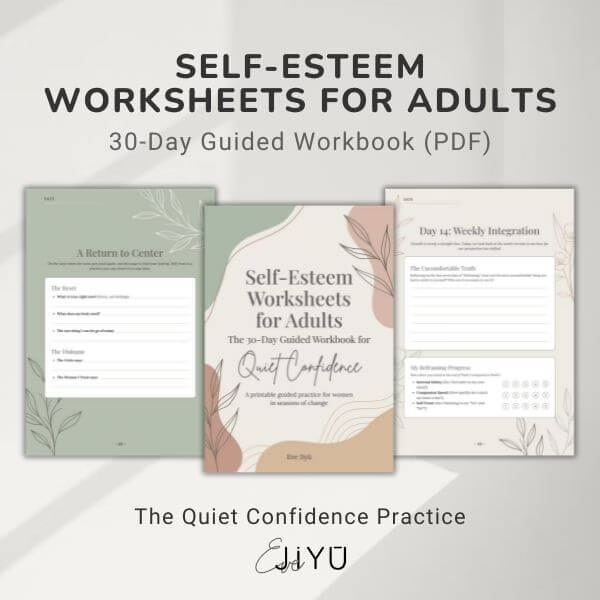
Want to go deeper into this work? Check out The Self-Reflection Journal – created for women in their 30s and beyond, this guided journal helps you reconnect with who you are, what you want, and where you’re going. Or explore how to find your creative voice as another path back to yourself.
What part of yourself have you been pretending away? Leave a comment below—I read every single one.
⬇⬇⬇Pin or save to read later ⬇⬇⬇












0 Comments