
In This Article
Feeling stuck in life is brutal at 2 AM. That’s when I found myself Googling “how to change your life in your 30s,” “new career opportunities after 30,” “working abroad.” I was searching for answers, yet somehow I couldn’t understand why, if my current life didn’t satisfy me, I still couldn’t take that first step. I understood everything intellectually. I was just stuck. The next day I’d do the same thing again – wear that perfect fake smile, trying to silence the voice inside that whispered “this isn’t it” daily.
After more than five years of personal transformation work and connecting with many women navigating life transitions, I noticed something unsettling about feeling stuck in life. We weren’t getting stuck randomly – we were getting stuck in predictable ways.
Then I saw it in conversations with friends. Coffee dates that turned into confession sessions. Women who looked successful from the outside but felt hollow inside. Each story felt different, but the patterns underneath were oddly similar.
Even when new acquaintances seemed to live completely different lives than mine, their stories triggered déjà vu – as if I had experienced the same thing myself or heard it from other women I knew. The conversations would inevitably turn toward life changes, or deep talks with friends over wine would reveal the same underlying themes.
I became obsessed with understanding why smart, capable women (which I always considered myself and my friends to be) kept choosing familiar misery over unknown possibility. What I found changed how I see the ways we limit ourselves.

Why We Get Stuck and Why It’s Not What You Think
Here’s what I learned about feeling stuck in life: We don’t get stuck because something is wrong with us. We get stuck because we’re human.
Somewhere along the way, we developed strategies to protect ourselves. These strategies worked once. They kept us safe, loved, accepted. But what protected us then is now trapping us.
Dr. Daniel Siegel’s work on neuroplasticity reveals that our neural pathways become deeply grooved through repetition – based on the principle that “neurons which fire together, wire together.” These patterns become our default operating system, running automatically in the background of our lives.
What makes these patterns so persistent is that they operate below conscious awareness. They’re stored in what neuroscientist Dr. Stephen Porges calls our “neuroception” – the unconscious detection of safety or threat. Our nervous system continues to respond to current situations based on old programming, even when the original threat no longer exists.
I started mapping these patterns. At first, I thought there were dozens. Then I realized they all fell into five main categories. Plus one more that most women don’t even recognize as limiting.

The Five Patterns That Keep You Feeling Stuck in Life
The Perfectionist Prisoner has seventeen different business plans but hasn’t started one. She’s not lazy – she’s terrified. Every detail must be perfect before she begins, which means she never begins. She researches endlessly, makes elaborate plans, then finds new reasons to wait. Her motto: “I’ll start when I have it all figured out.”
Why this traps you: This pattern often develops in environments where mistakes meant criticism or withdrawal of love. Perfectionism becomes a protective strategy – if I can just do everything right, I’ll be safe. But perfectionism is actually procrastination wearing a fancy outfit.
The People-Pleasing Phoenix remembers everyone’s birthday but forgets her own needs. She covers shifts, plans events, smooths over conflicts while her own dreams collect dust. She’s exhausted from keeping everyone happy but can’t say no because “what would they think?” Her motto: “Everyone else comes first.”
Why this traps you: This typically emerges when love felt conditional on being “good” – agreeable, helpful, never causing problems. Your nervous system learned to scan constantly for others’ needs while suppressing its own signals. Over time, you literally lose touch with what you want.
The Comfort Zone Captive stays in jobs that drain her, relationships that feel wrong, routines that numb her. She knows change would help but the unknown feels scarier than familiar misery. She’s got reasons why she can’t leave – good, logical reasons that keep her exactly where she is. Her motto: “At least I know what to expect here.”
Why this traps you: This often stems from experiences where unpredictability meant danger. Your brain develops a strong bias toward the familiar, even when familiar equals soul-crushing. The nervous system prioritizes safety over growth, keeping you trapped in situations that feel secure but leave you empty.
The Disconnected Dreamer goes through the motions but feels nothing. She used to have dreams but can’t remember them anymore. Everything feels gray and automatic. When people ask what she wants, she honestly doesn’t know. Her motto: “I don’t even know what would make me happy.”
Why this traps you: This can develop when emotions were invalidated during crucial years. You learned to numb or disconnect from your internal experience as survival. Over time, this creates what psychologists call “learned helplessness” – you lose touch with your own agency and authentic desires.
The Burned-Out Achiever has a packed calendar but an empty soul. She achieves everything on paper but nothing feels meaningful. She’s running toward goals that don’t light her up, mistaking busy for worthy. Her worth depends on her output, so she can’t stop. Her motto: “If I’m not productive, what am I worth?”
Why this traps you: This pattern emerges when worth was tied to achievement. You internalized the belief that your value depends on what you accomplish rather than who you are. This creates what researchers call “contingent self-worth” – a fragile sense of value that requires constant external validation.
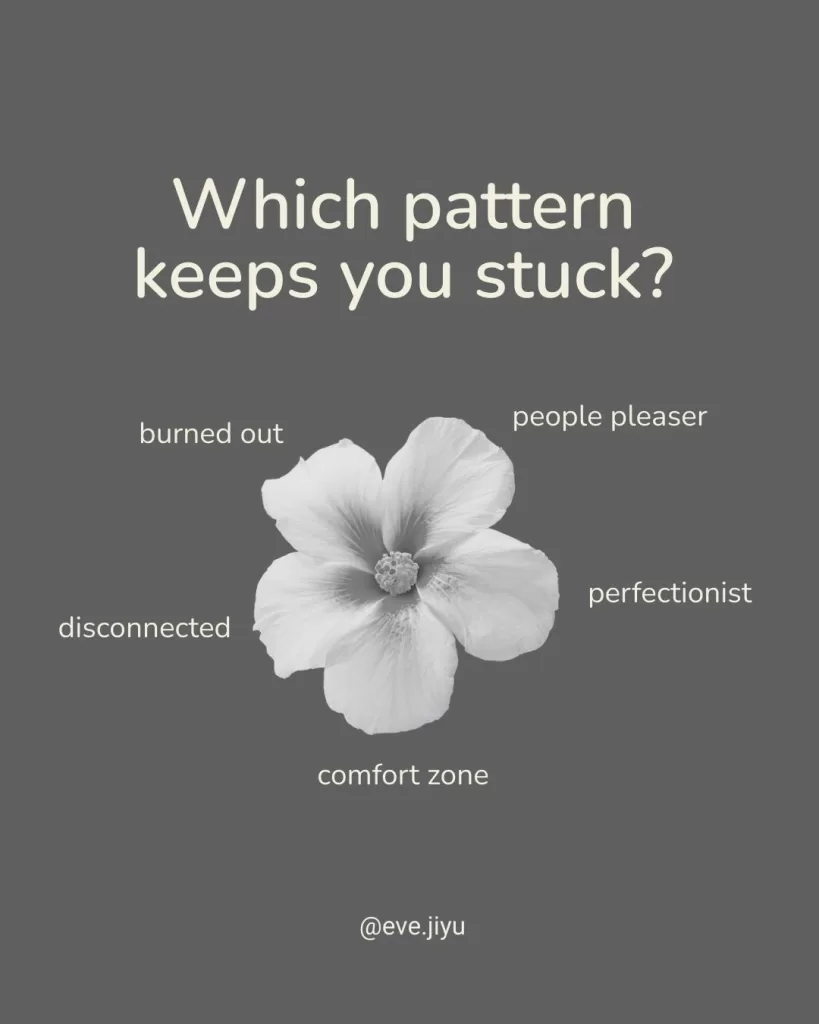
Want to know which pattern runs your life? Pay attention to those moments when you feel that familiar emptiness – whether it’s Sunday night, a random Tuesday morning, or any time you pause long enough to feel the disconnect between where you are and where you want to be.
- Do you spend these moments perfecting plans you won’t execute? (Perfectionist Prisoner)
- Reviewing all the things you said yes to that you didn’t want to do? (People-Pleasing Phoenix)
- Dreading more of the same routine? (Comfort Zone Captive)
- Feeling empty and directionless? (Disconnected Dreamer)
- Planning how to be even more productive? (Burned-Out Achiever)
These quiet moments reveal which pattern controls us most and why we’re feeling stuck in life.
If you’re wondering what specific pattern is keeping you stuck, take this free stuck in life quiz to identify whether you’re trapped in perfectionism, people-pleasing, comfort zone paralysis, disconnection, or burnout.
The Pattern Most Women Don’t Recognize
There’s a sixth pattern I found. The Growth-Focused Explorer doesn’t feel stuck the same way. She’s successful and generally content. But she senses there’s another level waiting. She wants to evolve but isn’t sure how. Her motto: “I’m doing well, but I know there’s more.”
This pattern is different. It’s not about being stuck – it’s about recognizing when you’re ready for expansion.
I now feel like I’m primarily a Growth-Focused Explorer, but other patterns still visit me. Don’t think everything is so simple – that I discovered this, understood it, and now live completely differently. Not at all. There are days when I feel stuck in my perfectionism, but knowing about patterns helps me identify it faster and start moving out of it. When I feel like I can’t cope, I can more easily start looking for an article about it or an inspiring YouTube video with stories of other people’s changes and transformations.
How to Stop Feeling Stuck in Life and Break the Patterns
Each pattern developed for a reason. The perfectionist learned that mistakes meant criticism. The people-pleaser discovered that love came through service. The comfort zone captive found that risks led to pain. The disconnected dreamer learned to numb rather than feel. The burned-out achiever was taught that worth comes from output.
These weren’t random choices. They were smart adaptations to whatever environment we grew up in.
But here’s the trap: We keep using these strategies long after they stop serving us. We’re trying to solve today’s problems with yesterday’s solutions.
The biggest shift came when I stopped seeing these patterns as flaws to fix. They’re not character defects. They’re outdated protection systems.
You don’t need to hate your pattern. You need to understand it, then choose something different and work with it. What often prevents us from moving forward are old beliefs and lack of self-trust that have become so ingrained we don’t even recognize them as optional thoughts rather than absolute truths.
The work isn’t about forcing change through willpower. It’s about creating enough safety in our nervous system to allow new choices. This requires what Dr. Kristin Neff calls “self-compassion” – treating ourselves with the same kindness we’d offer a good friend who was struggling.
When we understand that our patterns developed as intelligent responses to our environment, we can begin to appreciate them for what they were – survival strategies that kept us safe. Only then can we gently begin to outgrow them and stop feeling stuck in life.
I spent two years recognizing my own patterns and testing what actually worked to interrupt them. The tools that helped me became the foundation for something bigger.

What I Created From This Work
When I put these insights together, I created a guide and quiz to help women identify their own pattern. You can download it free – it’s the same process that helped me stop repeating old cycles.
The quiz takes five minutes. It shows you which pattern keeps you stuck and gives you specific tools to start choosing differently. Not perfect tools. Not magic solutions. Just practical ways to interrupt old habits and try something new.
Because here’s what I know now: The life you want isn’t on the other side of perfection. It’s on the other side of starting.
And the first step is recognizing which pattern keeps you from beginning.
Discover which pattern is keeping you feeling stuck in life. Take the free quiz and download the “This Isn’t It” guide at evejiyu.com. The same patterns that kept me small for years don’t have to keep you small anymore.












0 Comments