
Journey Map
“Some nights I go to bed feeling I’m not enough – too slow, too behind, too ordinary. And I wake up wondering: is that feeling telling me the truth, or is it a story my mind has learned to tell me?”
This is the kind of thought I had recently, after meeting a dear friend over dinner. Our conversation, like many between us, drifted from daily life and travel to relationships – and I realized we had touched on something so universal: the guilt of doing nothing and the quiet voice that whispers I’m not enough. If you’ve ever found yourself scrolling through social media, comparing your evening to someone else’s highlight reel, or feeling that your value depends on what you achieve – this article is for you.
This feeling has become the background soundtrack for so many of us in our thirties. We work hard, achieve goals, check boxes – yet still carry this persistent sense of inadequacy.
But here’s what I’ve learned after years of wrestling with this: feeling “not enough” isn’t really about productivity or achievement. It runs much deeper than that.
The Real Problem Behind Feeling Not Enough
That restless, guilty feeling when you’re just existing? It’s not laziness. It’s not a character flaw.
You’ve been conditioned to believe your worth comes from external validation and constant doing. Every scroll through social media reinforces the message that you should always be achieving, creating, improving, or at minimum, documenting something interesting.
The problem isn’t that you’re not doing enough. The problem is that you’ve forgotten you’re already enough, just as you are.
Research backs this up. A 2022 study published in the PMC database found that higher daily social media usage weakens the protective effect that healthy self-esteem has against depression. The constant comparison cycle literally rewires our brains to seek external validation.
But let’s be honest – social media is just the spark. The deeper fire is this: somewhere along the way, you learned your value has to be earned.
As Maya Angelou once said, “You alone are enough. You have nothing to prove to anybody.”
The path forward isn’t about doing more. It’s about remembering who you were before the world told you who you should be.

So, What Actually Helps?
I’m not going to tell you to “just love yourself” or “delete Instagram forever.” (If only it were that easy.) What I will share are five things that actually help me and the women I know when that not enough voice gets loud. They’re simple. They’re human. And they work.
1. Spend Real Time Outside (Not Just “Fresh Air”)
This isn’t about going for a “healthy walk.” It’s about stepping into a space where your human-ness matters more than your productivity.
When you’re in nature, your nervous system shifts. Your cortisol drops. Your perspective expands beyond the narrow confines of what you didn’t accomplish today.
Sit by water for fifteen minutes. Watch clouds move. Or just let your bare feet touch the ground. Let your mind wander without directing it toward goals or improvements.
Science agrees: even 15–20 minutes in nature lowers stress and helps regulate your nervous system. But beyond that, nature reminds you that your worth is not in what you achieve. Trees don’t hustle. The sky isn’t comparing itself to your neighbor.
In nature, you don’t feel inadequate. You feel connected to something larger than your to-do list. That feeling? It’s available every day, just outside your door.
2. Limit Social Media to One Hour Daily
I know, I know. You’ve heard this before. But most people don’t realize how dramatically social media shapes their sense of self-worth until they actually reduce it.
A 2023 study published in the Indian Journal of Psychiatry found that social media use creates comparison cycles that directly impact self-esteem, with body image playing a key mediating role. When you limit exposure, you limit opportunities for unfavorable comparisons.
Set a timer. Use app limits. Whatever works. But actually track it for a week and notice what changes.
You’ll stop measuring your day against strangers’ highlight reels. You’ll start measuring it against your own needs and values.
3. Practice Mindfulness (But Make It Practical)
Traditional meditation advice often feels inaccessible when you’re struggling with self-worth. Start smaller.
Scientific reviews consistently show that mindfulness practices reduce self-referential processing in the brain – essentially, they quiet the voice that constantly evaluates whether you’re “enough.”
When that “not enough” thought pops up, instead of wrestling it, try noticing: Ah, there’s that story again. And then, gently return to your breath.
Or try this: Set aside 10 minutes daily to sit quietly and focus on your breathing. When thoughts about what you should be doing arise, notice them without judgment and return to your breath.
The practice isn’t about emptying your mind. It’s about learning to observe your thoughts without being controlled by them.
4. Write Without Purpose
Grab a notebook. Write three pages of whatever comes to mind. Don’t edit. Don’t publish. Don’t Instagram it.
I started journaling not to become a writer, but because my head was too crowded. Some nights my journal looks like a shopping list mixed with half-sentences and swear words. And yet – after three pages, I feel lighter.
This isn’t about becoming a writer or solving your problems. It’s about getting your internal chatter onto paper so it stops running the show in your head.
Studies show that expressive writing improves emotional regulation and reduces rumination – both key factors in feeling “enough.” When you write regularly, you process experiences instead of just accumulating them.

5. Have Real Conversations About This Stuff
Here’s the most underrated tool: say it out loud.
That night at dinner with my friend, when I admitted, “Sometimes I feel guilty for doing nothing,” she sighed in relief and said, “Oh my god, me too.” We laughed. The weight in the room changed. Suddenly, the shame had less power.
Find someone you trust and talk about feeling inadequate, feeling not enough. Not seeking advice or solutions, just sharing the experience.
You’ll discover you’re not alone in this. Your friend who seems to have it all together? She feels this way too. Your colleague who’s always busy with interesting projects? Same thing.
These conversations don’t fix the feeling, but they normalize it. They remind you that feeling “not enough” is a shared human experience, not a personal failing.
The Science Behind Why This Works
Recent research from the National Center for Complementary and Integrative Health shows that mindfulness practices, nature exposure, and reduced social media consumption all activate the prefrontal cortex while calming the amygdala – the brain region associated with threat detection and comparison.
Simply put: when you practice these habits consistently, your brain literally rewires itself to feel more secure in your inherent worth.
Why This Matters More Than You Think
Learning to feel enough doesn’t just improve your mood. It changes everything.
You stop seeking validation through overwork. You make decisions based on your values rather than others’ expectations. You become more generous with other people because you’re not constantly worried about how you measure up.
You realize that the person who can sit quietly with a cup of tea, who can be present without producing anything, who can exist without performing – that person is already successful at the most important thing: being human.
The world will keep telling you that you need to earn your place here. Social media will keep showing you people who seem to be doing more, having more, being more.
But every time you choose to be present instead of productive, every time you value your inner world as much as your external achievements, you’re practicing a radical act of self-acceptance.
Where to Start Today
Pick one thing from this list. Not all of them – that defeats the purpose. One thing.
Do it for a week. Notice what changes, not just in how you feel, but in how you relate to yourself during quiet moments.
Feeling “enough” isn’t a destination you arrive at after accomplishing certain things. It’s a practice you return to, again and again, especially when the world gets loud about what you should be doing with your life.
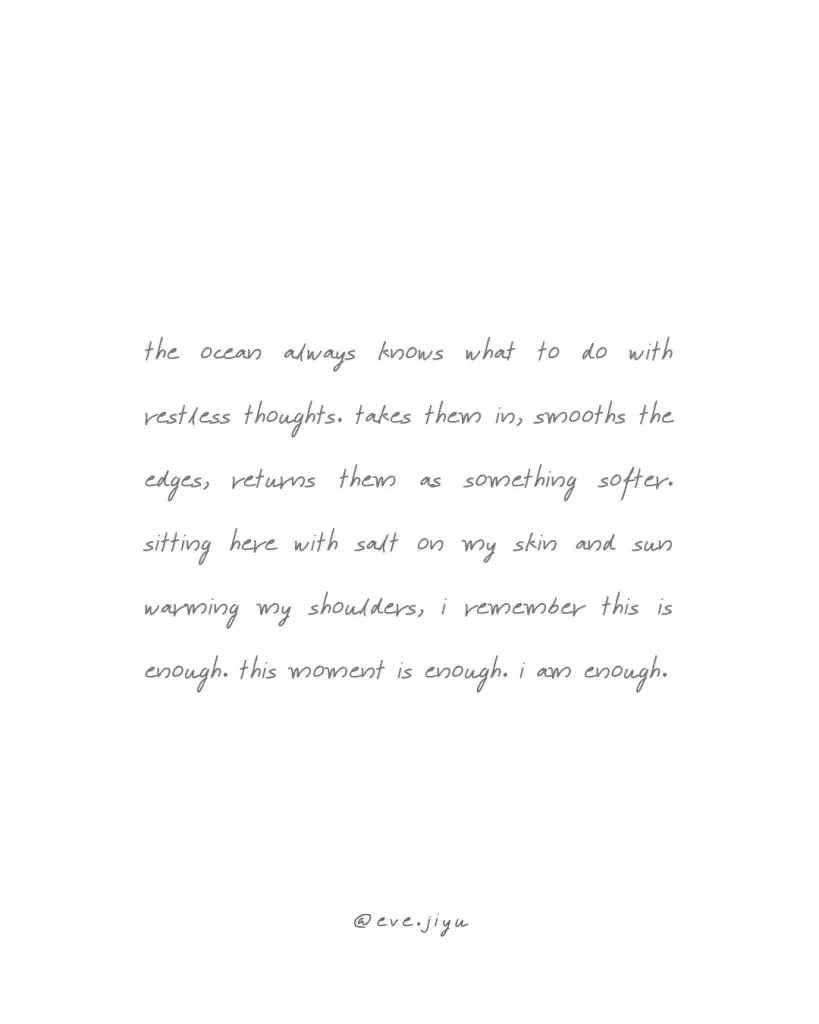
You were born enough. You’re enough right now, reading this. You’ll be enough tomorrow when you do nothing particularly notable.
The only thing you need to do about it is remember.
Want more content like this? Subscribe to my newsletter for honest letters about living life in your thirties without losing yourself in the process.












0 Comments