
In This Article

When you feel lost in life, you’re not broken. You’re at a crossroads. This guide offers seven grounded steps to reconnect with yourself and find clarity in the confusion.
When the Compass Stops Working
You wake up at 3 AM and stare at the ceiling. Your life looks fine on paper – good job, stable relationships, all the boxes checked. But something feels wrong, and you can’t name it. You just know that the person living your life doesn’t feel like you anymore.
If you feel lost in life, you’re not alone in this experience. You’re in a season of transition, and that feeling is more common than you think.
Four years ago, I woke up in my apartment feeling exactly this way. I had everything I thought I wanted, but I felt hollow inside. The scariest part wasn’t the emptiness but realizing I had no idea what would fill it.
That feeling of being lost isn’t a sign you’ve failed at life. Rather, it’s a signal that something inside you is ready to change and grow.
This article walks you through seven practical steps to find your way back to yourself. Not the version you think you should be, but the version that feels true and aligned.
The Difference Between a Rut and a Crisis
Being unhappy with life shows up in subtle ways before it becomes obvious.
You start procrastinating on things that used to excite you. You scroll through social media for hours because nothing else feels worth doing anymore. You say yes to plans and then cancel last minute because you can’t muster the energy to follow through.
Feeling stuck in life often manifests as brain fog and paralysis. You know you need to make a change, but you can’t see the path forward clearly. Every option feels wrong or impossible, and the weight of indecision becomes crushing.
The difference between a temporary rut and a deeper crisis comes down to alignment. A rut happens when your circumstances don’t match your energy levels. A crisis happens when your values don’t match the life you’re actually living.
When I moved to Bali in 2022, I thought I was running from something painful. I later realized I was running toward something I couldn’t name yet. That discomfort was my internal compass pointing me toward a life that actually fit who I had become.
Research in the Journal of Positive Psychology links lower purpose and meaning to reduced life satisfaction. When daily actions don’t reflect core values, it creates disconnection and threat-like stress.
If you’re wondering what specific pattern is keeping you stuck, take this free stuck in life quiz to identify whether you’re trapped in perfectionism, people-pleasing, comfort zone paralysis, disconnection, or burnout.
The good news is that recognizing this feeling is the first step toward changing it completely.
Mental Health Check: How to Know if I’m Depressed
Sometimes feeling lost in life is situational and temporary. You moved to a new city, ended a relationship, or started a job that drains your energy. The feeling has a clear source that you can identify and address.
Other times, the feeling has no obvious cause at all. You feel empty even when things are objectively good in your life. You wake up tired no matter how much you sleep. Small tasks feel impossible to complete. Nothing brings you joy anymore, not even the things that used to light you up.
This is when you need to ask yourself an important question: how to know if I’m depressed?
Situational sadness responds to changes in circumstances and usually lifts with time. Clinical depression doesn’t follow that pattern. It lingers even when your life improves externally. It shows up physically as persistent fatigue, changes in appetite, and disrupted sleep patterns that won’t resolve.
Depression often whispers that you’re lazy or weak or somehow failing. But depression is a medical condition, not a character flaw or personal failure.
If you’ve felt consistently low for more than two weeks, if you’ve lost interest in things you used to love, or if you’ve had thoughts of self-harm, please reach out to a mental health professional. Self-help has real limits, and sometimes the most courageous thing you can do is ask for professional help.
The National Institute of Mental Health provides clear guidelines for recognizing depression symptoms. Therapy gave me language for feelings I couldn’t name on my own. It taught me that feeling lost wasn’t a personal failure but a sign I needed to rebuild my life from a foundation that actually supported me.
If you’re not sure whether what you’re experiencing is situational or clinical, start by talking to your doctor or a licensed therapist. They can help you identify whether you need professional support alongside the self-reflection work you’re doing.

7 Steps to Find Your Way Back to Yourself
1. Stop Moving and Just Breathe
When you feel lost in life, your instinct is to do more and fix everything. Sign up for courses, start new projects, fill every hour with productivity and achievement. But movement without direction just makes you more exhausted and confused.
The first step is counterintuitive: stop doing and start being.
Sit down somewhere comfortable. Take ten slow breaths. Let yourself feel the discomfort of not knowing what comes next.
I spent months after leaving my corporate job trying to figure out my next move. I made endless lists, researched dozens of options, applied for things I didn’t actually want. Nothing clicked or felt right. The turning point came when I stopped forcing answers and just sat with the question.
Sometimes clarity doesn’t come from action or planning. It comes from stillness and allowing space for insight.
Try this practice today: Set a timer for five minutes. Sit somewhere quiet where you won’t be interrupted. Notice your breath moving in and out. When your mind starts planning or worrying about the future, gently bring your attention back to breathing. That’s the entire practice. No goals, no outcomes, just presence with yourself.
2. The Values Audit
Most of us are unhappy with life because we’re chasing values we don’t actually hold deep down.
You want the promotion because you think success means upward mobility and climbing ladders. You stay in the relationship because you think commitment means never leaving, no matter what. You keep yourself busy because you think productivity equals worth and value.
But what if those aren’t your values at all? What if they’re just stories you inherited from family, culture, or society?
A values audit helps you separate what you genuinely care about from what you think you should care about.
Grab a notebook and write down five things that truly matter to you. Not what your parents value or what looks impressive on social media. What you value when nobody’s watching.
For me, the list looked like this: freedom, creativity, connection, learning, beauty.
When I compared that list to how I was spending my time, the disconnect was painfully obvious. I was prioritizing stability and external validation instead. No wonder I felt lost and disconnected.
Reflective questions to guide your audit:
What activities make you lose track of time completely? When have you felt most like your authentic self? What would you do if you didn’t need anyone’s approval or permission? If you could design your ideal Tuesday (not vacation, but regular life), what would it include?
Your answers reveal your real values underneath all the noise. Once you know what matters, you can start building a life around those priorities.

3. Micro-Journaling for Clarity
You don’t need to write pages every day to gain insight and understanding. Sometimes three sentences are enough to crack something open.
Micro-journaling means spending five minutes each morning answering one simple question: How do I actually feel right now?
Not fine or okay or the answer you’d give someone at work. The real answer underneath the performance.
When I started this practice in 2023, my entries were messy and raw. “Tired. Restless. Like I’m waiting for something I can’t name.” But over weeks, patterns emerged clearly. I noticed I felt most alive when I was creating, most drained after certain conversations, most myself in solitude.
Journaling doesn’t solve problems directly, but it surfaces what you’ve been avoiding or ignoring.
If you want more structured prompts to explore this practice deeply, check out these 30 journaling prompts for self-discovery. These prompts help you dig beneath surface thoughts and access deeper truths.
Try this prompt today: “What’s one thing I’ve been pretending is okay when it’s really not?”
Write for five minutes without editing or censoring yourself. Let whatever comes up land on the page without judgment.
4. Embrace the Beginner Mindset
When you feel stuck in life, you’re often stuck in the identity you’ve carefully built. You’re the responsible one, the high achiever, the person who has it together. Trying something new threatens that image you’ve worked so hard to maintain.
But growth requires being bad at things for a while, and that’s uncomfortable.
I started painting again in my thirties after a decade away from art. My first attempts looked like a child’s work, and I hated that feeling. But I kept going anyway. Not because I wanted to be good at painting or become a professional artist. Because I wanted to remember what it felt like to create without judgment or pressure.
The beginner mindset gives you permission to be imperfect and messy. It reminds you that not knowing is part of the process, not evidence of failure.
Pick something you’ve always wanted to try but talked yourself out of repeatedly. Not because it will become a career or impress anyone. Because it might help you remember who you are outside your current roles.
Dance badly in your living room. Write terrible poetry without sharing it. Cook something complicated and watch it fail spectacularly. The point isn’t the outcome or mastery. The point is reconnecting with curiosity and play.
5. Audit Your Digital Consumption
Social media doesn’t cause the “I feel lost” narrative, but it amplifies it relentlessly.
You scroll through feeds of people who seem to have their lives figured out perfectly. They’re traveling to beautiful places, building impressive businesses, glowing in their purpose and passion. Meanwhile, you’re sitting on your couch eating cereal for dinner wondering what’s wrong with you.
Nothing is wrong with you at all. You’re just comparing your internal reality to everyone else’s curated highlight reel.
A 2024 study found low self-esteem drives social media addiction and feelings of inadequacy through anxiety and excessive competition. The more you consume curated content, the more disconnected you feel from your own life and progress.
Try this experiment for one week: Limit social media to 30 minutes per day total. Notice what happens to your mental state. Notice how much mental space opens up when you’re not constantly measuring yourself against strangers online.
If you need to stay connected for work or business, set specific times to check platforms. Don’t scroll first thing in the morning or right before bed at night. Protect those bookend moments for yourself and your own thoughts.
You might discover that your life feels more aligned and peaceful when you stop letting algorithms tell you what matters.
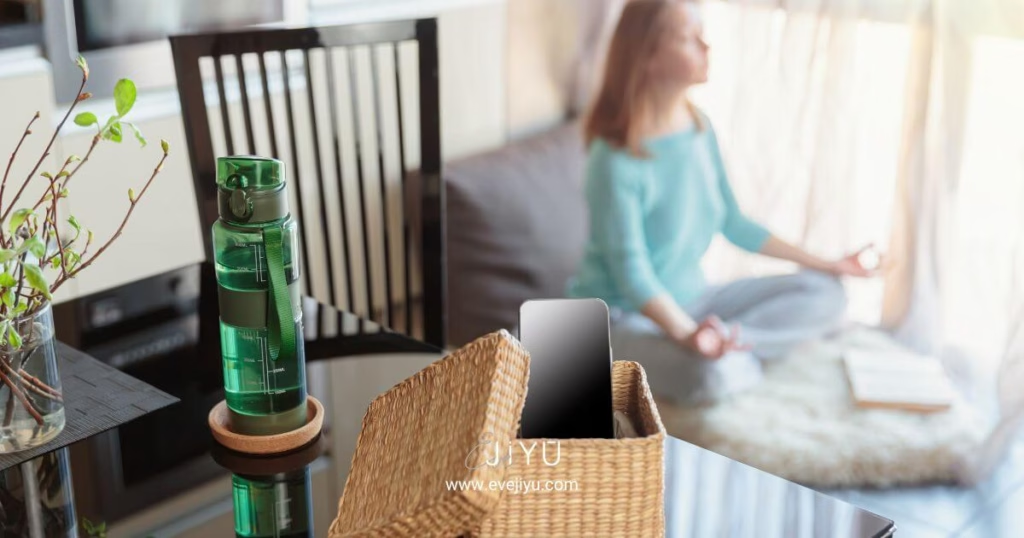
6. Physical Grounding
Your body holds answers your mind can’t access through thinking alone.
When you feel lost, you’re often stuck in your head completely. Thoughts loop endlessly. Anxiety builds without release. You can’t think your way out because overthinking is part of the problem.
Movement breaks the cycle and brings you back to the present.
I don’t mean intense workouts or fitness goals that add more pressure. I mean simple, intentional movement that reconnects you with your body and breath.
Walk without your phone or headphones. Stretch on the floor without following a video. Dance in your living room to music you love. Swim, if you have access to water nearby. Let your body move without a purpose beyond feeling alive in it.
Research shows brief mindfulness meditation, such as 25 minutes daily over a few days, reduces serum cortisol levels and enhances emotional processing by calming stress responses. Your nervous system calms naturally, thoughts slow and clarify, helping you transcend looping mental stories.
I started walking along the beach in Bali every morning without any agenda. No podcast, no music, no destination. Just me, my breath, and the sound of waves. Those walks didn’t solve my problems directly, but they gave me space to process them.
Try this today: Spend 15 minutes moving in a way that feels good. Walk around your neighborhood without distractions. Do gentle yoga in your bedroom. Stretch in front of a window. Pay attention to how your body feels. Notice where you hold tension. Breathe into those tight places.
7. Setting a North Star Goal
Feeling lost often means you lack a sense of agency over your own life. You’re reacting to everything instead of directing anything.
A North Star goal isn’t about achieving something big or impressive. Rather, it’s about choosing one small, non-negotiable daily habit that reminds you that you’re in control of something.
Mine was writing three pages every morning before I did anything else. Some days it was stream-of-consciousness nonsense that no one would ever read. Other days it turned into essays and reflections. But showing up to write every morning gave me proof that I could commit to myself.
Your North Star goal should be simple enough to do every single day, but meaningful enough to matter.
Examples that work:
Meditate for five minutes every morning before checking your phone. Write one page in your journal before bed every night. Move your body for 15 minutes in whatever way feels good. Read one chapter of a real book instead of scrolling social media. Make your bed every morning as a declaration that today matters.
The goal isn’t to transform your life overnight or achieve something massive. The goal is to remind yourself that you can choose how you spend your time. That agency, repeated daily, becomes momentum and eventually becomes identity.
Reflective questions to guide you:
What’s one habit I wish I had in my daily routine? What’s the smallest version of that habit I could commit to right now? How would I feel if I did this for 30 days straight without missing?
Choose one thing that matters to you. Start tomorrow morning.

How to Cheer Up a Friend with Depression
Watching someone you love feel lost in life is painful and helpless. You want to fix it for them. You want to say the right thing that will make everything better. But depression doesn’t respond to positivity or well-meaning advice.
If you’re wondering how to cheer up a friend with depression, start by recognizing the signs they might be struggling. Depression often hides behind “I’m fine” and repeatedly canceled plans. Your friend might seem distant, tired, or emotionally disengaged. They might stop reaching out like they used to. They might say they’re busy when they’re actually struggling to get out of bed.
The best support you can offer isn’t solutions or fixes, but presence and consistency.
Don’t say, “Let me know if you need anything.” Say, “I’m bringing dinner on Tuesday at 6. I’ll leave it on your porch if you’re not up for company.”
Don’t say, “Everything will be okay.” Say, “I’m here. You don’t have to be okay right now.”
Depression makes people feel like burdens to everyone around them. Specific, concrete offers of help remove the mental load of asking for support.
Sit with your friend in silence if words feel too heavy for either of you. Send a text that says, “Thinking of you. No need to respond.” Show up without expecting them to perform gratitude or improvement.
Mental Health America highlights reminding others they’re not alone as key to healing depression.
If your friend mentions thoughts of self-harm or shows signs of severe depression, gently encourage them to seek professional help. Offer to help them find a therapist or accompany them to an appointment if they want support.
You can’t save someone from depression, but you can walk beside them while they find their way through it.
You Are Your Own Way Home
To feel lost in life is an invitation to search for something deeper and more authentic. It’s not a sign you’re failing at being human. Rather, it’s a sign you’re ready to stop living on autopilot and start living intentionally.
The seven steps in this article aren’t a cure or quick fix. They’re a compass to help you navigate uncertainty. They help you slow down, reconnect with your values, and remember that you have agency even when everything feels uncertain and overwhelming.
Stop moving long enough to breathe deeply. Audit your values and compare them to your life. Journal your truth without censoring. Embrace being a beginner at something new. Limit digital noise and comparison. Ground yourself in your body through movement. Commit to one small daily habit that gives you agency.
These steps won’t erase the feeling of being lost overnight or in a week. But they will remind you that you’re capable of finding your way back to yourself.
The second act of life is often the most beautiful because it’s built on self-awareness instead of obligation or expectation. You’re not starting over from nothing. You’re starting from a place of truth and clarity.
And that makes all the difference in the world.
What’s One Small Thing That Made You Feel Like You Again?
Feeling lost in life is isolating and lonely. Sharing your experience breaks that isolation and creates connection.
Leave a comment below and tell us: What’s one small thing that made you feel like yourself again today?
Maybe it was a walk without your phone in your pocket. Maybe it was saying no to plans you didn’t want to attend. Maybe it was five minutes of silence before your day started.
Your story might be exactly what someone else needs to hear right now.
If you’re ready to go deeper into self-discovery work, explore my guide on how to find your creative voice or learn more about navigating feelings of not being enough. These resources offer additional support for your journey.
You’re not lost forever or broken beyond repair. You’re just between chapters of your story. Keep going.
⬇⬇⬇Pin or save to read later ⬇⬇⬇












0 Comments