
In This Article
Understanding the difference between self esteem and self confidence can finally explain why you feel capable at work but uncertain in relationships, accomplished on paper but fragile inside.
I spent years building confidence in every visible way. I learned new skills, delivered presentations, managed teams, traveled solo across continents. From the outside, I looked self-assured. But alone at night, I still questioned my worth.
The confusion wasn’t about what I could do. It was about who I believed I was when no one was watching.
Many women mistake confidence for self-esteem. They work harder, achieve more, and wonder why the internal emptiness persists. The truth is simpler than we think: confidence changes what you accomplish, but self-esteem changes how you exist.
This article clarifies the difference between self esteem and self confidence, explains why one without the other leaves you exhausted, and offers a grounded path toward building both.
What Is Self-Esteem? (Your Inner Sense of Worth)
Self-esteem is your baseline sense of worth. It exists independent of your resume, your productivity, or anyone’s approval. It’s the quiet conviction that you deserve kindness, rest, and belonging simply because you’re human.
Where self-esteem comes from is rarely about adulthood. It develops in childhood through early relationships, emotional safety, and whether you learned that your needs mattered. If your worth was conditional—tied to good behavior, high grades, or keeping the peace—you likely internalized the belief that you had to earn your place in the world.
Signs of Low Self-Esteem in Adult Women
Low self-esteem doesn’t always look like insecurity. Sometimes it wears the mask of high achievement. You might recognize these patterns:
- Over-apologizing for taking up space or having needs
- Feeling like you’re “too much” or perpetually “not enough”
- Self-criticism even when life looks successful from the outside
- Exhaustion from constant self-monitoring
- Difficulty accepting compliments without deflecting
Research shows women with low self-esteem often engage in self-silencing in relationships, prioritizing others’ needs to maintain connection. This pattern doesn’t stem from weakness. It stems from believing your worth depends on being useful, pleasant, or perfect.
Reflection question: When you think about the word “self-esteem,” what’s the first memory or feeling that surfaces? Does your worth feel like solid ground, or does it shift based on external feedback?
What Is Self-Confidence? (Your Belief in Your Abilities)
Self-confidence is your belief in your ability to perform, act, or handle specific situations. Unlike self-esteem, confidence is situational and skill-based. You build it through repetition, practice, and feedback.
Confidence is easier to develop because it’s measurable. You can become confident at public speaking by giving more talks. You can gain confidence in your creative work by sharing it repeatedly. You can feel confident in your career by accumulating experience.

Why Confidence Without Self-Esteem Feels Hollow
Here’s where it gets complicated. You can be confident in your professional abilities but deeply insecure about your worth in relationships. You can feel socially confident but privately struggle with self-doubt. You can appear self-assured while internally questioning whether you deserve the success you’ve achieved.
I’ve met women who run companies but apologize for asking their partners to do the dishes. I’ve watched accomplished friends second-guess themselves in conversations with family members who still see them as the “sensitive” or “difficult” child.
Confidence in one area doesn’t transfer to your sense of inherent worth. That requires something deeper.
Example: A woman might confidently lead a team at work (high confidence) but still believe she’s unworthy of rest unless she’s productive (low self-esteem). The skills exist. The internal safety doesn’t.
Self Esteem vs Self Confidence: The Core Difference
The simplest way to understand self esteem vs self confidence is this:
Confidence = what you can do
Self-esteem = who you believe you are
Confidence is performance-based. It grows when you succeed and can waver when you fail. Self-esteem is identity-based. It remains steady regardless of external outcomes.
Comparison Points
| Aspect | Self-Confidence | Self-Esteem |
|---|---|---|
| Source | External validation, skill-building | Internal sense of worth |
| Stability | Situational, fluctuates | Long-term, foundational |
| Response to Failure | “I need to improve” | “I’m still worthy” |
| Relationships | “I can handle conflict” | “I deserve healthy boundaries” |
| Motivation | Achievement-driven | Growth-driven |
When you have confidence without self-esteem, you become a high-functioning performer who still feels empty. When you have self-esteem without confidence, you feel grounded but may avoid challenges. Ideally, both coexist.
Reframe for clarity:
Confidence asks: “Can I handle this?”
Self-esteem asks: “Am I worthy even if I fail?”
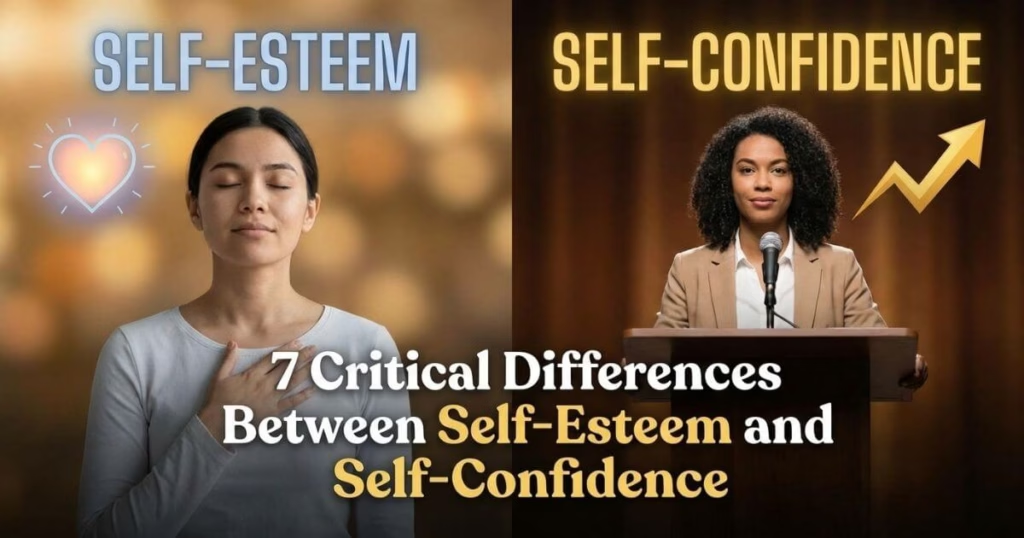
7 Critical Differences Between Self-Esteem and Self-Confidence
1. Source: Inner Worth vs External Validation
Self-esteem originates internally. It’s the belief that you matter regardless of accomplishments. Confidence, on the other hand, often depends on external feedback—praise from a boss, likes on a post, or measurable results.
A woman with strong self-esteem might feel nervous before a presentation (low confidence in that moment) but won’t spiral into self-loathing if it doesn’t go perfectly. A woman with high confidence but low self-esteem might deliver a flawless presentation but still feel like an impostor afterward.
2. Stability: Long-Term vs Situation-Dependent
Self-esteem is relatively stable. It’s the foundation you return to when life gets chaotic. Confidence fluctuates based on context. You might feel confident cooking dinner but anxious speaking in front of strangers.
This is why “fake it till you make it” works for confidence but fails for self-esteem. You can practice a skill until you feel competent. You cannot pretend your way into believing you’re inherently worthy.
3. Failure Response: Self-Compassion vs Self-Punishment
When someone with strong self-esteem fails, they process the disappointment without internalizing shame. They might think, “That didn’t go well, but I’m still okay.”
When someone with low self-esteem but high confidence fails, the internal dialogue turns punishing: “I’m a failure. I should have known better. I’m not good enough.”
Research from the University of Texas found that self-compassion—a key component of healthy self-esteem—predicts resilience better than self-confidence alone. Self-compassion allows you to hold your humanity gently, even when things fall apart.
4. Relationships: Boundaries vs People-Pleasing
Self-esteem allows you to set boundaries without guilt. You understand that protecting your energy doesn’t make you selfish. Confidence, without self-esteem, often shows up as people-pleasing. You know how to advocate for others but struggle to advocate for yourself.
I once worked with a woman who confidently negotiated million-dollar contracts but couldn’t tell her mother she needed space during the holidays. Her professional confidence was rock-solid. Her self-esteem—her belief that her needs mattered—was fragile.
5. Motivation: Growth vs Approval
Confidence-driven motivation often centers on proving yourself. You work hard to earn recognition, avoid criticism, or maintain an image. Self-esteem-driven motivation centers on growth. You pursue challenges because they align with your values, not because you’re trying to silence an inner critic.
When I stopped chasing approval and started asking, “What do I actually want?” my relationship with ambition shifted. I still work hard, but the work no longer feels like evidence I’m enough. It feels like expression.
6. Emotional Safety: Calm vs Constant Self-Monitoring
Women with strong self-esteem experience a baseline sense of emotional safety. They trust themselves to handle discomfort. Women with high confidence but low self-esteem often live in a state of hypervigilance, constantly scanning for signs of rejection or judgment.
This exhaustion isn’t laziness. It’s the nervous system staying on alert because internally, you don’t believe you’re safe just as you are.
7. Inner Dialogue: Supportive vs Conditional
The way you speak to yourself reveals the difference between self esteem and self confidence more clearly than anything else.
Confidence says: “I can figure this out.”
Low self-esteem says: “If I fail, I’m worthless.”
High self-esteem says: “I’m allowed to struggle and still deserve kindness.”
High confidence says: “I’ll prove I’m capable so people respect me.”
Reflection questions:
What’s the harshest thing your inner voice says when you make a mistake?
Would you ever speak to a friend that way?
What would change if you treated yourself with the same patience you offer others?
Why Confidence Without Self-Esteem Feels Exhausting
Performative confidence is the art of appearing self-assured while internally questioning your worth. It’s the smile you hold in a meeting while your stomach knots. It’s the polished Instagram post that took fifteen tries because you were terrified of judgment.
This pattern is especially common in high-achieving women. You’ve built impressive skills, climbed professional ladders, and received external validation. But the validation never feels like enough because the real issue isn’t competence. It’s the belief that your worth depends on staying impressive.
Common Patterns of Performative Confidence
Overachieving: You take on more projects than you can handle because rest feels like proof you’re falling behind.
Fear of Slowing Down: Pausing feels dangerous. You worry that if you stop performing, people will see you’re not as capable as you appeared.
Anxiety When Validation Disappears: A quiet week at work or a lack of social media engagement triggers panic. Without external proof of your value, you feel untethered.
I spent my twenties overworking to prove I was capable. I thought exhaustion was the price of success. It wasn’t until I burned out completely that I realized I wasn’t building confidence. I was compensating for a deep belief that I wasn’t inherently valuable.
The cost of this pattern is chronic stress, strained relationships, and a persistent sense of emptiness no amount of achievement can fill.
The Link Between Self-Love and Confidence
The phrase “self-love” has been diluted by Instagram captions and marketing campaigns. Real self-love isn’t bubble baths or affirmations written in cursive. It’s the unglamorous practice of emotional honesty and self-respect.
Self love and confidence are connected, but not in the way most people think. Confidence grows naturally when self-esteem is stable because you’re no longer trying to prove your worth through performance. You’re simply living from a place of internal safety.
What Self-Love Actually Looks Like
Emotional Honesty: Naming how you feel without judgment. “I’m overwhelmed” instead of “I should be handling this better.”
Self-Respect: Honoring your limits even when it disappoints others.
Inner Safety: Trusting yourself to handle discomfort without self-abandonment.
When self-love becomes the foundation, confidence stops feeling like a performance. You speak up not because you’re trying to be impressive, but because your voice matters. You set boundaries not because you read it in a self-help book, but because you genuinely believe your needs are valid.
Key insight: Confidence built on self-esteem feels grounded. Confidence built on insecurity feels frantic.
How to Build Self-Esteem (Not Just More Confidence)
Most advice about building confidence focuses on external action: take risks, face your fears, practice self-affirmations. These strategies work for developing competence, but they don’t address the deeper question of whether you believe you’re worthy when you’re not achieving anything.
Building self-esteem requires internal work. It’s less about doing and more about being with yourself differently.
Why Most Advice Doesn’t Work
Traditional confidence advice assumes the problem is lack of skills or experience. But many women already have those. The real issue is the internal narrative that says, “I’m only valuable when I’m productive, likable, or impressive.”
You can’t affirmation your way out of that belief. You have to interrogate where it came from, notice when it shows up, and practice relating to yourself with more compassion.

Journaling and Self-Reflection as Tools for Self-Esteem
Journaling isn’t about documenting your life. It’s about slowing down enough to hear your own voice. When you write without an audience, you create space to notice patterns you’ve been too busy to see.
Questions like “What am I pretending is okay?” or “When did I start believing my worth was conditional?” don’t have quick answers. They require sitting with discomfort, and that discomfort is where transformation begins.
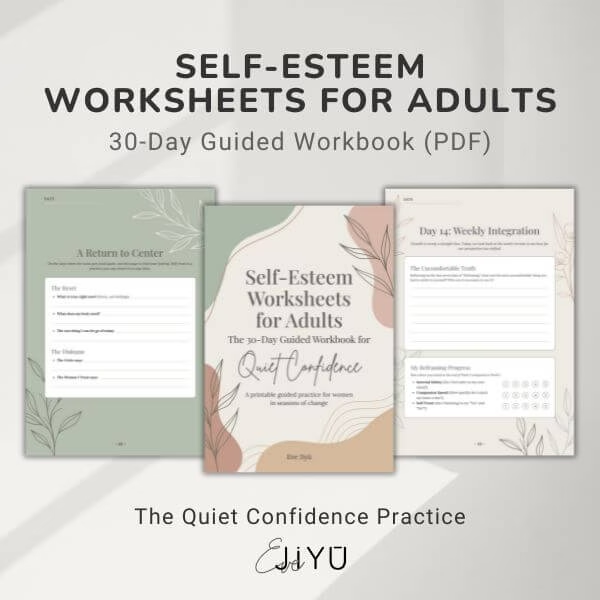
For women navigating this process, I created the Self-Esteem Worksheets for Adults, a 30-day guided journal designed to gently build quiet, sustainable confidence. It’s not about fixing yourself. It’s about developing the kind of self-trust that doesn’t collapse when life gets hard.
The worksheets guide you through four phases: awareness, reframing, boundaries, and integration. Each day includes reflective prompts, practical exercises, and space to notice patterns without judgment. It’s especially helpful for women who appear confident externally but feel uncertain inside.
This isn’t about pressure or perfection. It’s about giving yourself permission to slow down and rebuild your relationship with yourself.
Practical exercise: Set aside ten minutes today to write about one moment this week when you felt “not enough.” What triggered that feeling? Whose voice does the criticism sound like—yours, or someone from your past?
Who Should Focus on Self-Esteem First?
If you’ve spent years building confidence but still feel emotionally fragile, you might need to focus on self-esteem instead of adding more skills to your toolkit.
This section is for women who:
- Feel successful on paper but unfulfilled internally
- Are tired of self-improvement books that promise breakthroughs but deliver burnout
- Crave emotional steadiness, not motivational hype
- Recognize that their worth shouldn’t depend on productivity or approval
You don’t need to fix yourself. You need to remember that you were whole before the world told you otherwise.
Permission slip: You’re allowed to stop chasing confidence and start building a foundation of self-worth. You’re allowed to rest without earning it. You’re allowed to exist without proving anything.
Confidence Is What You Do—Self-Esteem Is Who You Are
The difference between self esteem and self confidence comes down to this: confidence improves your performance, but self-esteem changes how you experience life.
You can be confident in your abilities and still feel like an impostor. You can achieve impressive things and still believe you’re not enough. Or you can cultivate self-esteem—the steady, quiet knowing that your worth isn’t conditional—and watch how confidence grows naturally from that foundation.
Sustainable confidence doesn’t come from proving yourself. It comes from trusting yourself. And trust doesn’t develop through affirmations or achievements. It develops through consistent, compassionate self-reflection.
Closing reflection: What would change if you believed your worth wasn’t something you had to earn? What would you stop doing? What would you finally allow yourself to want?
If you’re ready to explore these questions more deeply, the Self-Esteem Worksheets for Adults offer a gentle, structured way to begin. Thirty days of guided reflection to help you rebuild your relationship with yourself—not through pressure, but through presence.
You don’t need more confidence. You need to remember who you are when you’re not performing.
⬇⬇⬇Pin or save to read later ⬇⬇⬇












0 Comments