
In This Article

Deep self-discovery questions cut through surface-level reflection to expose the real mechanisms driving your choices. The disconnect isn’t sudden, it’s cumulative. You are competent, responsible, doing all the ‘right’ things, and yet there is this low hum of wrongness that persists—a feeling you can’t quite name. You might spend hours scouring the internet for answers, scrolling through endless listicles that tell you to ‘follow your passion’ or ‘find your why,’ only to close your device feeling more confused and defeated than when you started.
The problem isn’t that you don’t know yourself. The problem is you’re asking surface-level questions that can only produce surface-level answers.
Most self discovery journal prompts operate like this: “What makes you happy?” “What are your dreams?” These questions assume you have unfettered access to your own desires, as if your authentic self is just sitting there, fully formed, waiting for you to check in. But if you’ve spent years performing the version of yourself that keeps everyone comfortable, or if you’ve built your identity around achievement and external validation, your first answer to “What do I want?” is probably just another iteration of what you think you should want.
Real self-discovery isn’t a lightning bolt of clarity. As positive psychology suggests, it’s the consistent process of increasing awareness of what we’re thinking and feeling, developing a clearer understanding of our strengths, and learning to accept ourselves and others more readily. This isn’t passive journaling; it’s an emotional intelligence audit.
The deep self-discovery questions in this article are structured to go deeper than conventional self discovery journal prompts. They’re organized into three categories that build on each other: questions to reveal core values (the foundation), questions that expose recurring patterns in life and psychological blocks (the excavation), and questions that reveal your true self through daily alignment (the integration).
The method matters here. Set aside 10-15 minutes per question. Write by hand if you can—there’s something about the slower pace that bypasses your internal editor. Self-reflection questions should explore values, experiences, and patterns to foster self-discovery and growth. Your first answer will likely be the conditioned one, the response you’ve practiced giving. The second or third answer, the one that makes you slightly uncomfortable, is usually closer to the truth.
Self-Discovery Questions to Reveal Core Values: The Foundation
Your values aren’t the ones you list on your LinkedIn profile or mention at dinner parties. Values are principles that give our lives meaning and allow us to persevere through adversity. These questions to reveal core values are designed to catch you in the act of showing what you truly care about, not what you’ve been told to care about.

The Envy Detector
What is one thing you see others doing that makes you feel a pang of envy, and what specific value does that act represent?
Envy is data. When you feel that hot, uncomfortable flash of “Why do they get to do that?”—that’s your value system waving a flag. The woman who quit her corporate job to write full-time might trigger envy not because you want to be a writer, but because she chose creative expression over security. The friend who sets firm boundaries with her family might spark that feeling because she’s prioritizing her own needs, and you haven’t given yourself permission to do the same.
Notice I’m not asking about admiration or inspiration—those feelings are too polite, too processed. Envy cuts through your intellectual understanding of who you should be and points directly at what you’re starving for. The specific thing that makes you jealous is almost always connected to a value you’re not honoring in your own life. This is one of the most powerful self discovery journal prompts for uncovering hidden priorities.
The Time Audit
When was the last time you were completely absorbed in an activity, lost track of time, and felt like yourself in the most essential way? What value does that activity fulfill?
This isn’t about identifying a hobby you should monetize or a career path you missed. This is about noticing the psychological need that got met in that moment. Were you solving a complex problem? Were you creating something with your hands? Were you helping someone figure something out? Were you completely alone and quiet?
The activity itself matters less than the underlying value it satisfied. If you lost time while organizing your entire closet, maybe you’re not secretly passionate about home organization—maybe you’re craving a sense of control in a life that feels chaotic. If you were absorbed in a three-hour conversation with a friend, perhaps what you’re actually missing is deep intellectual connection, not more social time in general.
The Argument Insight
What topic or issue makes you the most emotionally reactive—not thoughtfully engaged, but viscerally angry or defensive? What value is being violated when that happens?
We don’t get activated by things that don’t matter to us. Your emotional reactivity is a direct line to your value system. If you find yourself furious when people are chronically late, you might value respect and integrity more than flexibility. If you get defensive when someone suggests you’re being “too sensitive,” you probably value emotional depth and authenticity over surface-level pleasantness.
The goal isn’t to justify your anger or work on being less reactive. The goal is to understand what that reactivity is protecting. When you get emotionally charged, there’s usually a core value underneath that feels threatened. Name it. These questions to reveal core values work precisely because they bypass your rational mind and access your emotional truth.
The Legacy Test
If you were to pass away tomorrow, what is the one thing you would regret not having done or said—not because it would look good, but because it would be true?
Strip away the performative answer here. This isn’t about regretting that you didn’t launch a successful business or travel to 50 countries. This is about the gap between who you are and who you’ve let people see.
Would you regret never telling your mother that her criticism shaped your entire relationship with yourself? Would you regret not creating the body of work you’ve been planning for a decade? Would you regret staying small to keep other people comfortable? The legacy question reveals what matters so much that its absence would constitute a fundamental betrayal of yourself.
The Older Self
What advice would your 80-year-old self give your current self about how to spend your energy right now?
This question works because it removes you from the immediacy of your current pressures. Your 80-year-old self isn’t worried about whether your manager will be annoyed if you set a boundary. She’s not concerned with whether saying no to that obligation will disappoint someone. She has the clarity that comes from looking backward at a full life.
When you imagine her perspective, what does she tell you? Does she tell you to stop waiting to feel ready? Does she tell you that the people who left when you started being honest were always going to leave? Does she tell you that the year you spent recovering from burnout was the best investment you ever made? Listen to her. She knows which risks were worth taking and which fears were just noise.
Self-Discovery Questions About Recurring Patterns in Life: The Excavation
Self-awareness without pattern recognition is just interesting self-observation. These deep self-discovery questions force you to look at the places where you keep ending up, the behaviors you keep repeating, the same lesson you keep refusing to learn. Understanding recurring patterns in life is where the real archeological work begins.

The Recurring Theme
What is the one challenging situation—in work, relationships, or family—that seems to repeat itself no matter how many times you change the external circumstances? What lesson are you walking away from?
Maybe you keep ending up in work environments where you’re undervalued and overlooked, despite switching jobs multiple times. Maybe every romantic relationship follows the same arc: intense connection, gradual withdrawal, painful ending. Maybe you consistently attract friends who take more than they give.
The pattern is information—individuals may unconsciously recreate patterns of failure or disappointment that feel familiar and, paradoxically, safe. It’s not bad luck or poor judgment—it’s a loop you’re stuck in because there’s something you haven’t fully learned yet. Often, these recurring patterns in life are the universe’s way of saying, “You’re going to keep meeting this lesson until you stop outsourcing the solution.” If you keep attracting partners who won’t commit, the lesson might not be about choosing better—it might be about why you’re drawn to unavailability in the first place.
The Unconscious Pattern
What is your primary coping mechanism when you feel shame, disappointment, or failure? Be specific—what do you actually do?
Do you overwork until you’re too exhausted to feel anything? Do you isolate and convince yourself you’re better off alone? Do you immediately start people-pleasing to reestablish your sense of worth? Do you numb out with food, alcohol, scrolling, shopping? Do you pick fights to confirm your belief that people will leave you anyway?
Your coping mechanism isn’t the problem—it’s a symptom of the original wound. If your automatic response to shame is to work harder, you probably learned early that your value is conditional on your productivity. If you isolate when you’re hurting, you might have internalized the message that your needs are a burden. The coping mechanism is trying to protect you from something that felt unbearable at some point. Understanding what it’s protecting you from is how you start to dismantle it. This is among the most revealing self discovery journal prompts for understanding your behavioral patterns.
The Hidden Fear
If failure was completely impossible—if success was guaranteed in whatever you attempted—what would you immediately start doing tomorrow? What fear is that action currently buried under?
This question bypasses all your practical objections. You can’t say “I don’t have time” or “I need more experience” because those are just sophisticated versions of fear. When you remove the possibility of failure, what emerges?
Maybe you’d write the book. Maybe you’d leave the relationship. Maybe you’d start the business, go back to school, move across the country, set a firm boundary with your family, stop performing the version of yourself that keeps everyone comfortable. Now work backward: what are you actually afraid will happen if you do that thing? Rejection? Judgment? Discovering you’re not as capable as you thought? Being seen as selfish or irresponsible? The fear underneath is usually more specific than “failure.” Name it precisely.
The Inner Critic’s Script
What is the exact phrase your inner critic uses most often? Not the general sentiment—the actual words you hear in your head. Then ask: where did that script come from?
“You’re not ready yet.”
“Who do you think you are?“
“It’s too late for you.“
“You’re too much/not enough.”
“No one cares what you have to say.“
These aren’t your thoughts—they’re recordings. Someone else said them first, or communicated them through their actions, and you internalized the message so completely that you now believe it originated with you. Early experiences with family—whether nurturing or neglectful—shape core beliefs about oneself and others, often leading to self-sabotaging behaviors in adulthood. Your inner critic’s script is often a direct echo of the way you were evaluated, dismissed, or conditioned as a child or in a formative relationship.
Once you identify the exact phrase, trace it back. Whose voice does it sound like? What were the circumstances when you first learned to believe it? This isn’t about blaming the original source—it’s about recognizing that the criticism is old data, not current truth. Identifying these recurring patterns in life is essential for breaking free from them.
The Unpopular Choice
What decision are you currently making in your life solely to meet someone else’s expectation? Not because you want to, not because it aligns with your values, but because disappointing them feels impossible.
Are you staying in a career path because your parents sacrificed for your education? Are you having children because your partner assumes you will, even though you’re ambivalent? Are you maintaining a friendship that depletes you because ending it would make you look like the bad person? Are you staying geographically close to family even though you dream of leaving?
The unpopular choice question is uncomfortable because it requires you to admit that you’re betraying yourself to avoid conflict, guilt, or disapproval. Living according to someone else’s script always builds resentment. The decision you’re making to keep them happy is costing you your integrity, and eventually that cost becomes unbearable.
Questions That Reveal Your True Self Through Daily Alignment
You’ve collected the data. You’ve identified your core values and the patterns that keep you from living them. Now comes integration—the work of building a life that actually reflects what you’ve discovered about yourself. These questions that reveal your true self are designed to move you from insight to action.

The Essential “No”
Based on the values you identified earlier, what is one activity, obligation, or commitment you must say no to this week?
Notice I didn’t ask what you could say no to. I asked what you must say no to in order to honor your actual priorities. If you discovered that deep connection is a core value and you’re spending every evening in surface-level social obligations, what needs to go? If you realized that creative expression is essential to your sense of self and your calendar is booked solid with other people’s agendas, what do you clear?
This question is a test of whether you’re serious about alignment or just collecting interesting insights about yourself. Saying no to something that doesn’t serve you is the most basic form of self-respect. If you can’t do it now, in this small way, you won’t do it later when the stakes are higher.
The Energy Exchange
What are three actions you can take this week that cost you 15 minutes of time but give you back an hour of mental energy?
This is where people get stuck—they think alignment requires a complete life overhaul. It doesn’t. It requires strategic micro-adjustments. What if the answer is as simple as: going for a 15-minute walk before you start work, which makes you 300% more focused for the rest of the day? Spending 15 minutes on Sunday planning your meals, which eliminates the daily decision fatigue? Sending a quick text to decline an invitation immediately instead of letting it create low-level dread for a week?
The energy exchange question forces you to think about return on investment. You’re not looking for more time—you’re looking for the small actions that create disproportionate relief. Identify them, then protect them like they’re non-negotiable appointments. This practical approach makes these deep self-discovery questions actionable rather than merely reflective.
The Daily Choice
What small decision—taking less than five minutes—can you make every single day that is 100% aligned with your true self, not your role or your conditioning?
This has to be small enough that you can’t talk yourself out of it. It might be: writing three sentences in your journal every morning. Saying “I need a minute” before responding to a request instead of automatically saying yes. Putting your phone in another room for the first hour after you wake up. Wearing the clothes that make you feel like yourself instead of the ones that are “appropriate.”
The daily choice is your anchor. When everything else in your life feels like a compromise, this one small thing is evidence that you haven’t completely abandoned yourself. It sounds trivial, but consistency in tiny acts of self-honoring builds the foundation for larger ones.
The Body Scan
Where in your body do you physically hold stress, and what does that sensation tell you about the decision you’re avoiding?
Your body knows before your mind does. The tension in your jaw is trying to tell you something. The knot in your stomach when you think about that upcoming conversation is information. The exhaustion that no amount of sleep fixes is a message.
Sit quietly and scan your body from head to toe. Where do you notice tightness, heaviness, discomfort? Once you’ve located it, ask the sensation what it’s holding. What decision are you not making? What truth are you not speaking? What boundary are you not setting? Sometimes the answer is immediate. Sometimes it takes sitting with the discomfort for a while before it reveals what it’s protecting you from.
The Confident Person
Who are you when you’re not defined by your job title, your relationship status, your parenting role, or your history of failures and achievements? Describe her in one sentence.
This is the hardest question because we’re so used to deriving our identity from external markers. But those markers are all conditional. You can lose the job, the relationship, the success. The person underneath those things—the one who exists independent of any role or outcome—is your true self.
When you strip away everything you do and everything that’s happened to you, who remains? Are you someone who asks hard questions? Someone who creates order from chaos? Someone who sees people clearly? Someone who needs beauty and silence? Someone who tells the truth even when it’s uncomfortable?
Write one sentence. Not a list of qualities, not a resume—one sentence that captures the essence of who you are when no one is watching and nothing is at stake. This final prompt in our collection of deep self-discover questions that reveal your true self often becomes the most meaningful.
From Discovery to Action: Making Self-Discovery Journal Prompts Work

The 15 deep self-discovery questions have shown you something. Maybe it’s uncomfortable. Maybe it confirms what you’ve known but haven’t wanted to face. Maybe it’s clarifying in a way that feels both liberating and terrifying.
Here’s what happens next: nothing, unless you decide otherwise.
Insight without action is just sophisticated procrastination. You can know yourself deeply and still choose to live in misalignment. The difference between self-awareness and self-betrayal is whether you’re willing to let what you’ve discovered change how you live.
You don’t have to overhaul your entire existence by Friday. In fact, trying to do that guarantees you’ll burn out and revert to old patterns within a month. Instead, look back at your answers to these deep self-discovery questions and choose one discovery—just one—that demands attention right now. Maybe it’s the value you’re violating every single day. Maybe it’s the fear that’s keeping you stuck in place. Maybe it’s the coping mechanism that’s stopped serving you.
Take that one thing and commit to a single micro-action in the next seven days. Not “I’m going to change everything about my life.” Just “I’m going to say no to this one obligation” or “I’m going to have the conversation I’ve been avoiding” or “I’m going to spend 20 minutes doing the thing my 80-year-old self told me matters.”
The work of becoming yourself isn’t a destination. It’s a series of small choices to honor what you know to be true, even when it’s inconvenient, even when it disappoints people, even when you’re not sure you’re ready. You start where you are, with the information you now have, and you make one aligned choice. Then another. Then another.
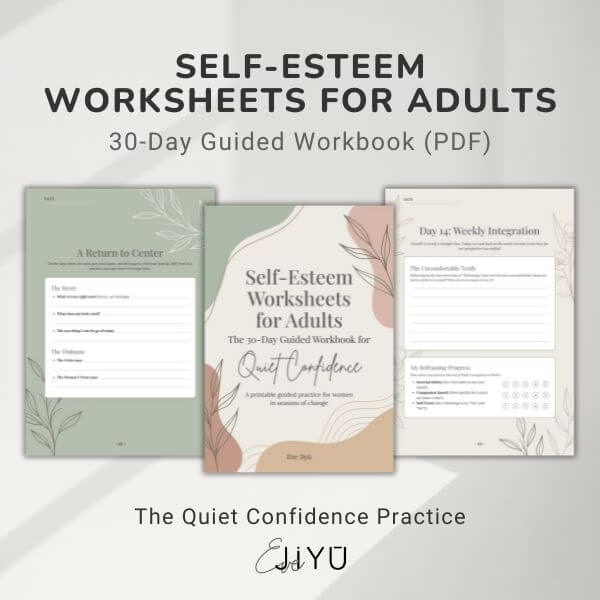
If you’re realizing that these deep self-discovery questions that reveal your true self have exposed a major misalignment—that the gap between who you are and how you’re living is wider than you thought—you might benefit from more structured guidance. For more self-discovery journal prompts and exercises, explore additional resources designed specifically for women navigating life transitions.
Working through deep self-discovery questions regularly can help you track how your values shift over time and notice when new recurring patterns in life begin to emerge. The questions to reveal core values in this article are meant to be revisited every few months as you grow and change.
Ready for deeper support? Take the Stuck in Life Quiz to get a personalized roadmap for your next steps based on where you are right now in your journey of self-discovery.













0 Comments