
You’ve been there. The journal is open, the pen is in your hand, and you’ve even downloaded a beautiful set of prompts from someone whose feed made it all look so effortless. And yet, nothing.
You glance at the first prompt, feel vaguely resistant, consider just writing freely instead, then worry that free writing will turn into a spiral, and before long the journal is closed and you’re back on your phone, quietly disappointed in yourself.
If that scene feels familiar, you’re not alone. This particular kind of paralysis is remarkably common, especially for women navigating burnout, life transitions, or the tender early stages of turning inward. The irony is that the very act meant to bring clarity becomes another thing to do wrong.
Here’s what nobody tells you: that moment of hesitation isn’t a failure of discipline. It’s actually a signal worth listening to. It’s your inner world asking a genuinely useful question: What do I actually need right now?
This article is a gentle exploration of two different approaches to self-reflection, structured prompts and flexible, open-ended writing, and what makes each one valuable in different seasons of your life. It’s not a prescription.
There’s no verdict at the end declaring one method superior. What you’ll find instead is a framework for understanding yourself a little better, so that the next time you sit down with a blank page, you can make a choice that actually serves you rather than one made by default or guilt.
Both approaches lead to the same place: a deeper, more honest relationship with yourself. They simply take different roads to get there. And knowing which road suits the terrain of your current life is, in itself, a profound act of self-awareness.
Two Doors Into the Same Room
Before we explore which approach might suit you better, it helps to understand what each one actually is, not just in theory, but in practice.
What are Structured prompts
Structured prompts are guided questions or sentence starters designed to direct your attention toward a specific theme, feeling, or insight. They might look like: “What am I avoiding right now?” or “Describe a moment this week when you felt most like yourself.” Or they might be more specific to a particular area of growth, like shadow work prompts that gently invite you to examine a reaction that surprised you, or self-compassion prompts that ask you to speak to yourself as you would to someone you love.
The key characteristic of structured prompts is that someone else, a coach, a journaling guide, a thoughtfully designed resource, has already done the work of choosing the direction. Your job is simply to respond. The question is already there. All you have to do is answer it.
What is flexible self-reflection
on the other hand, flexible self reflection is the open-ended counterpart. It might look like stream-of-consciousness writing, where you let words spill onto the page without any particular destination in mind.
It might look like sitting quietly with a feeling and letting your thoughts move around it without forcing structure. It might look like writing a letter to no one, or filling pages with fragments and questions and half-formed observations.
There’s no prompt guiding you, no framework holding the shape. You follow the thread wherever it leads, which can feel liberating, disorienting, or both at once.
What’s important to understand is that both of these approaches are aiming for the same destination: deeper self-awareness, greater emotional clarity, and a more honest relationship with your inner world. The difference lies in the path, not the purpose.
Structured prompts offer a container. Flexible reflection offers open space. Neither is inherently more profound or more valid. But understanding which one you’re reaching for, and why, transforms journaling for self-discovery from something you either do or don’t do into something you can actually choose, consciously and kindly, based on what your inner world needs today.
When Structure Becomes a Lifeline
There’s a particular kind of exhaustion that comes with burnout that feels like a mental fog, that makes even small decisions feel enormous. What to eat. What to wear. Whether to reply to that message now or later. When you’re living in that fog, the idea of sitting down with a blank journal page and simply “reflecting” can feel like being asked to navigate a forest without a map.
This is where structured prompts become less of a journaling tool and more of a genuine lifeline.
When the brain is depleted, it struggles with what psychologists call decision fatigue, the diminishing capacity to make choices after a long period of decision-making.
For women in burnout, this isn’t just about big decisions. It extends to the smallest acts of self-care, including reflection. A blank page asks you to decide: what do I focus on? Where do I begin? What even matters right now? For an already-exhausted mind, those questions can feel impossible before you’ve written a single word.
A well-crafted prompt removes that barrier entirely. It says: start here. The decision has already been made for you. Your only job is to respond.
This matters especially for overthinkers and perfectionists, women who want their journaling to be meaningful, who worry that what they write won’t be deep enough or honest enough or useful enough. The prompt gives the inner critic something to work with, rather than leaving it to spiral in the open air of an unstructured page.
Structured prompts are also particularly valuable for women who are beginning to explore shadow work for beginners or sitting with difficult emotions for the first time. Shadow work, at its core, involves turning toward the parts of yourself that have been pushed into the background, the reactions that embarrass you, the patterns you keep repeating, the beliefs you’ve absorbed without examining. That territory can feel genuinely frightening to enter without some kind of guide.
A thoughtfully designed prompt creates psychological containment. It says: we’re going to look at this specific thing, in this specific way, together. That container doesn’t trap you, it protects you just enough to take the first step. And often, the first step is everything.
If you’ve ever felt like journaling is something you should be able to do but somehow can’t quite manage, it’s worth asking whether the problem is the blank page rather than you.
Structure isn’t a crutch. For many women, in many seasons of life, it’s the very thing that makes honest reflection possible at all especially during burnout recovery in your 30s.
The Freedom That Free Writing Offers
Here’s something that structured prompts, for all their gifts, cannot always do: surprise you.
When you follow a prompt, you’re responding to a question someone else asked. That question is thoughtful, perhaps even beautifully chosen. But it’s still a direction imposed from outside. And there are things living in your inner world that no external question would ever think to point you toward, because they’re too specific, too strange, too quietly yours.
This is the particular magic of unstructured, flexible self-reflection. When you write without a prompt, without a framework, without a destination, you create the conditions for something unexpected to surface. A memory you’d forgotten. A grief you didn’t know was still there. A desire so quiet you’ve been talking over it for years.
Free writing, in the tradition of expressive writing explored extensively by psychologist Dr. James Pennebaker at the University of Texas, is associated with accessing material that sits just below the surface of conscious thought. When the mind isn’t busy following directions, it sometimes reveals what it’s actually been carrying.
That said, flexible self-reflection tends to work best when you already have some degree of emotional literacy and inner trust. It asks you to navigate without a map, which means you need to have some confidence in your own ability to find your way.
If you’re in a period of deep disconnection from yourself, which burnout often creates, that confidence may not be readily available. The open page can feel less like freedom and more like standing in a very large, very quiet room with no idea what you’re supposed to be doing there.
Free writing can also be messy. Nonlinear. Repetitive. You might write the same sentence four different ways and not know why. You might fill a page with something that feels meaningless, only to find the honest thing buried in the last paragraph. That messiness isn’t a sign that you’re doing it wrong.
It’s often exactly where the most real self-discoveries live, in the wandering, not the arriving.
The discomfort of unstructured reflection is worth naming, because many women abandon it precisely when it starts to feel uncomfortable, assuming that discomfort means it isn’t working. Often, the opposite is true. The moment free writing gets uncomfortable is frequently the moment something real is trying to come through.
If you have a reflective practice already, or if you’re in a season of relative emotional steadiness, free writing can take you places that no prompt ever could. It’s not better than structure. It’s just a different kind of honest.
Reading Your Own Signals
So how do you actually choose? Not in the abstract, but today, in this moment, when you sit down with your journal and need to decide which door to walk through?
The most useful framework isn’t about personality type or journaling philosophy. It’s about your current emotional state.
Think of it this way: when you’re experiencing high overwhelm, emotional numbness, or mental exhaustion, your inner world is asking for gentleness and containment. A blank page in that state isn’t an invitation, it’s another demand. Leaning toward structured prompts during these periods isn’t giving up on depth. It’s meeting yourself where you actually are, rather than where you think you should be.
When you’re experiencing more emotional clarity, a sense of restlessness, or a feeling that something is brewing just below the surface that you can’t quite name, that’s often a signal that you have the capacity for open-ended exploration. Free writing in these moments can feel like finally exhaling. The words come more naturally, and the direction reveals itself as you go.
It’s also worth introducing a concept that might reframe how you think about this entirely: reflection readiness. Your capacity for open-ended introspection isn’t fixed. It shifts depending on how much sleep you’ve had, how much stress you’re carrying, where you are in a particular life season, and how far along you are in your personal growth journey.
Someone in the early stages of burnout recovery may find that even a single structured prompt feels like too much some days. Someone who has been in a steady reflective practice for a year might find that prompts feel constraining in moments when they want to go deeper. Neither experience means something is wrong. It means your needs are changing, which is exactly what healing and growth look like.
The most important shift you can make is to stop treating your preferred method as a fixed identity. Saying “I’m a structured journaler” or “I only do free writing” closes off options that might serve you beautifully in a different season.
The woman you are in burnout recovery is not the same woman you’ll be six months from now. Your reflection practice deserves to evolve with you, much like the process of working on yourself does.
Check in with yourself before you open the journal, not after. A simple question, do I need a container or open space today?, takes about ten seconds and can completely change the quality of what follows.
A Hybrid Approach Worth Trying
What if you don’t have to choose?
Many journaling practitioners and coaches who work with reflective writing advocate for a blended approach, one that uses the accessibility of structure and the depth of freedom together, in the same session. It’s less of a compromise and more of a conversation between the two.
The most natural version of this looks like using a structured prompt as a warm-up, or what you might think of as a “door opener.” You begin with the prompt, respond to it honestly, and then, when something real surfaces, when you feel a shift in your chest or a thought that surprises you, you set the prompt aside and follow that thread wherever it leads. The structure got you in the room. The freedom takes you deeper.
There are a few practical ways to experiment with this:
- The prompt as a launch pad: Choose one prompt and write until your answer surprises you. The moment you write something you didn’t expect to write, stop following the prompt and start following that. Let the unexpected thing lead
- The reverse approach: Begin with five minutes of completely free writing, no direction, no goal, just words on a page. Then read back what you wrote and choose a journal prompt for self-growth that speaks to something that emerged. Use the structure to go deeper into what the freedom already revealed
- The single honest question: Write one question at the top of a blank page, something you’ve been quietly wondering about yourself, not something from a list. Then write freely in response to your own question. This sits somewhere between the two approaches: it has the container of a prompt, but the prompt came from inside you.
It’s also worth saying this gently but clearly: some days, neither approach will feel right. Some days, the most honest thing is to close the journal without writing anything. Not because you failed, but because you checked in and the answer was: not today. That is also self-awareness. Recognizing when you need rest rather than reflection is not a gap in your practice. It is the practice.
What Your Inner World Needs Today
The question was never really “which method is better?” That framing turns self-reflection into a productivity problem, something to optimize, a technique to get right. And when reflection becomes another thing to do correctly, it loses the very quality that makes it valuable.
The better question, the one worth returning to every time you sit down with a journal or a quiet moment is simply:
what does my inner world need today?
That shift in framing is small but significant. It moves reflection out of the realm of self-improvement and into the realm of self-compassion. It treats your inner life not as a project to be managed, but as something worth listening to.
Here’s the gentlest possible guidance for moving forward: experiment without judgment. Try a structured prompt on a day when you feel scattered and notice whether it helps you begin.
Try free writing on a day when something is quietly pressing on you and notice whether it gives it room to breathe. Pay attention to what opens you up versus what shuts you down. That information is more valuable than any journaling rule you’ll ever read.
And trust that consistency matters far less than honesty. Showing up every day with a closed heart is not more valuable than showing up once a week with genuine willingness.
The quality of your presence with yourself is what creates change, not the frequency, not the method, not the perfectly filled pages.
Curiosity is a gentler starting point than commitment. You don’t have to decide today that you’re a certain kind of journaler. You just have to be willing to try one small thing and see what it opens.
The Blank Page Was Never the Enemy
Come back, for a moment, to the woman at the beginning. Journal open, pen in hand, prompts downloaded, freedom available, and somehow, none of it feeling accessible.
That moment of paralysis, as frustrating as it feels, contains something important: it means she cares. She showed up. She wanted to connect with herself and didn’t quite know how.
The right choice in that moment isn’t the perfectly chosen method. It’s the willingness to try something, anything, even imperfectly. One prompt answered in three sentences. Five minutes of writing that goes nowhere obvious. A single honest question written at the top of a page and then sat with, quietly, without needing an answer.
That’s enough. That is, genuinely, enough.
Self-reflection isn’t a performance. It’s a practice and one that shifts and evolves with you, that looks different in grief than it does in growth, that sometimes needs a container and sometimes needs open air. The most important thing is not getting the method right. It’s staying curious about yourself, season after season, with as much gentleness as you can manage.
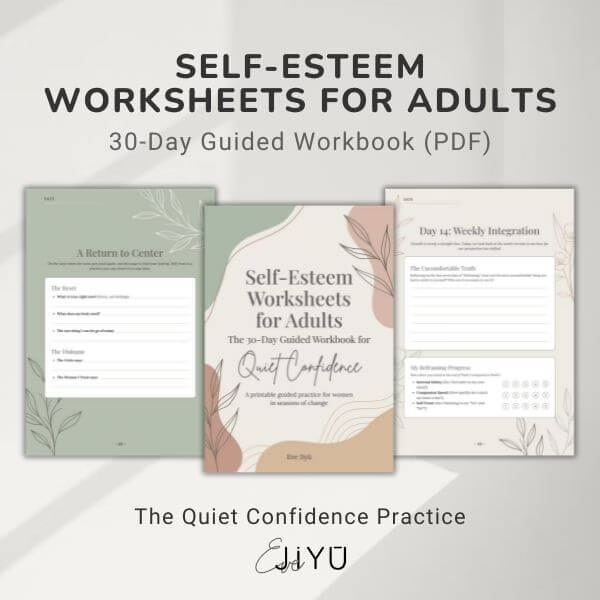
If you’re looking for a place to begin, whether that means exploring structured journaling prompts, shadow work questions, or simply finding a community of women who are also learning to listen to themselves, you might find these deep resources and templates rather helpful in your journey.
Happy exploring 🙂
How to Completely Reinvent Yourself at 30, 40, or 50 (The Step-by-Step Framework)


0 Comments
Trackbacks/Pingbacks