
In This Article
Have you ever felt completely stuck, unable to figure out what you actually want from life? Three years ago, that was me – awake at 2 AM, Googling “how to find yourself” while feeling lost and directionless. What I discovered changed everything: journaling prompts became my roadmap to self-discovery.
The transformation wasn’t instant or magical. It was messy, honest, and sometimes uncomfortable. But it worked. Journaling helped me uncover who I really am and what I truly want from life.
In this article, I’ll share how journaling prompts can help you understand yourself on a deeper level, backed by research and personal experience. And if you’re ready to start your own journey, you can download my free guide – 30 Best Journaling Prompts for Self-Discovery – to help you begin with clarity and purpose.
Why Journaling Prompts Actually Transform Lives
Research consistently shows that journaling isn’t just trendy self-help advice – it’s a scientifically validated mental health tool. A comprehensive meta-analysis published in BMJ Open’s Family Medicine and Community Health journal found that journaling interventions resulted in a 5% reduction in mental health symptom scores compared to control groups, with even more significant benefits for anxiety (9% reduction) and PTSD (6% reduction).
But here’s what makes prompts specifically powerful: they eliminate the paralysis of the blank page while directing your attention to meaningful self-discovery.
The Science Behind Writing for Self-Discovery
When you write about your deepest thoughts and feelings, something remarkable happens in your brain. Pioneering psychologist James Pennebaker from the University of Texas at Austin conducted the first expressive writing study in 1986, demonstrating that writing helps organize chaotic thoughts and release pent-up emotions, leading to improved mental clarity and emotional resilience
Clinical studies demonstrate that regular journaling practice can:
- Improve working memory and cognitive performance by freeing up mental resources previously occupied by intrusive thoughts
- Reduce symptoms of anxiety and depression, with meta-analysis showing a 9% reduction in anxiety symptoms and varying benefits for depression
- Improve immune function and physical health, with significant improvements in various biochemical markers
- Reduce physiological stress responses and lower cortisol levels in some studies
- Increase emotional regulation and self-awareness by helping us accept rather than judge our mental experiences
The Power of Prompts: Why They Work Better Than Blank Pages
Staring at an empty journal page wondering what to write is one of the fastest ways to abandon your journaling practice. Prompts solve this problem by providing a specific starting point that guides your reflection without constraining it.
Here’s why prompts are uniquely effective:
1. They bypass writer’s block. Instead of wondering “what should I write about,” you have a clear question or direction to explore.
2. They reveal patterns you’d otherwise miss. When you examine your reactions, choices, and relationships through structured questions, patterns emerge that random free-writing often doesn’t uncover.
3. They make decisions clearer. Understanding yourself better through targeted reflection helps you know what matters and what doesn’t, simplifying complex choices.
4. They’re accessible and affordable. No therapy appointment needed – just you, a notebook, and five minutes of honest reflection.
5. They create psychological space. Writing down the thoughts spinning in your head stops the mental loop and brings clarity to chaos.
How to Use Journaling Prompts Effectively
Before diving into the prompts themselves, let’s establish some best practices that will maximize your self-discovery journey:
Start Small and Stay Consistent
You don’t need to write pages every day. Research shows that even 5-10 minutes of focused journaling several times per week can produce significant benefits. Start with a realistic commitment – perhaps three prompts per week – and build from there.
Choose Your Medium Wisely
While traditional pen-and-paper journaling remains valuable, digital journaling offers convenience and accessibility. Choose whatever medium you’ll actually use consistently. Some people find that handwriting creates a deeper connection, while others prefer the speed and searchability of digital journals.
Create a Comfortable Environment
Set aside a specific time and place for journaling. Whether it’s morning coffee with your journal or evening reflection before bed, consistency matters more than perfection. Find a quiet space without distractions where you can be honest with yourself.
Be Radically Honest
Your journal is for you alone. The therapeutic benefits come from authentic self-expression, not from writing what you think you “should” feel or believe. Give yourself permission to be messy, confused, angry, or uncertain on the page.
Don’t Judge Your Writing
This isn’t about crafting beautiful prose or impressive insights. Sometimes the most valuable entries are the ones that simply dump thoughts onto the page without structure or eloquence. Trust the process.

The 5 Categories of Self-Discovery
Effective self-discovery journaling explores five interconnected dimensions of your life. The most comprehensive approach touches on all these areas regularly:
1. Understanding Your Present – Where you are right now, what’s taking up your mental energy, and what your current reality looks like without judgment.
2. Exploring Your Past – The experiences, decisions, and influences that shaped who you are today, including both triumphs and challenges.
3. Defining Your Values – What matters most to you, your non-negotiables, and the principles that guide your choices.
4. Imagining Your Future – Who you want to become, what you’re building toward, and the life you want to create.
5. Understanding Your Relationships – How you show up for others, what you need from connections, and the boundaries that protect your wellbeing.
Sample Prompts to Get You Started
Let me share a few powerful prompts from each category to give you a taste of what effective self-discovery looks like:
Understanding Your Present
“What’s taking up most of my mental space right now?”
Write down everything spinning in your head – work stress, that conversation you keep replaying, plans you’re making. Getting it on paper helps you see what’s actually demanding your energy and whether it deserves that attention.
“What would I do today if I wasn’t trying to impress anyone?”
Remove the imaginary audience. What would you wear? How would you spend your time? This reveals where you’re performing instead of living authentically.
Exploring Your Past
“What’s the best decision I ever made and why did I make it?”
Look at what drove that choice. Was it intuition? Logic? Desperation? Understanding your best decisions helps you recognize and replicate the conditions that lead to good choices.
“What did I love doing as a kid that I’ve stopped doing?”
Kids do what they actually enjoy without overthinking it. What did you drop and why? Sometimes we abandon parts of ourselves that need to be reclaimed.
Defining Your Values
“What matters more to me than being comfortable?”
Comfort isn’t bad, but what would you endure discomfort for? This shows what you truly value beyond surface preferences.
“What makes me feel alive?”
Not happy – alive. That thing that makes time disappear and makes you feel like yourself. Write about when you last felt that way and what conditions created it.
Imagining Your Future
“Where do I want to be in one year?”
Be specific. Not just “happier” or “more successful.” Where do you live? What’s your daily life like? Who’s in it? Vague goals rarely materialize.
“What am I building toward?”
Your actions add up to something. What are you creating with your daily choices? Is it what you actually want?
Understanding Your Relationships
“Who do I feel most myself around?”
The people where you don’t edit yourself. Where you can be messy or quiet or excited. Who are they and why do they create that space?
“What boundary do I need to set?”
What keeps getting crossed? What leaves you feeling resentful? Boundaries aren’t mean – they’re necessary for sustainable relationships.

Ready to Transform Your Self-Discovery Journey?
These sample prompts are just the beginning. To fully unlock the power of journaling for self-discovery, you need a comprehensive collection of prompts that guide you through all aspects of understanding yourself.
That’s exactly what I’ve created for you.
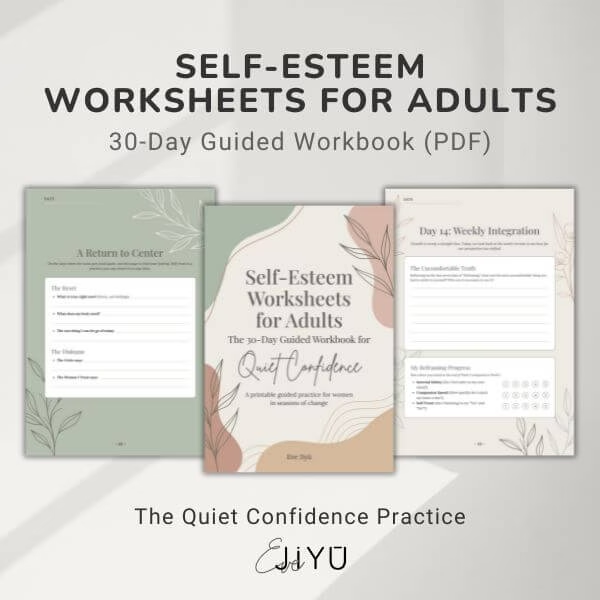
Download Your Free Guide: 30 Journaling Prompts for Self-Discovery
After three years of personal transformation through journaling, I’ve compiled the 30 most powerful prompts that changed my life – and they’re yours free.
This beautifully designed guide includes:
- 30 carefully crafted prompts across all 5 categories of self-discovery
- Detailed explanations for each prompt to help you go deeper
- Practical tips for maintaining a consistent journaling practice
- A framework for honest self-reflection without judgment
Get instant access to your free 30 Journaling Prompts for Self-Discovery guide below:
Making Journaling a Sustainable Habit
Getting the prompts is step one. Actually using them consistently is where transformation happens. Here’s how to build a sustainable journaling practice:
Start Where You Are
You don’t have to use all 30 prompts immediately. Pick one that speaks to you and write for five minutes. That’s it. Some days you’ll write pages. Other days you’ll manage two sentences. Both count. Both matter.
Revisit Prompts Over Time
Come back to these prompts whenever you need clarity. They hit differently depending on where you are in life. A prompt that feels simple now might crack you open six months later. Your answers will evolve as you do, providing valuable insight into your growth.
Track Your Progress
Every few weeks, go back and read some of your journal entries. Notice patterns, shifts in mindset, or themes that keep appearing. These insights become increasingly valuable as you continue your self-discovery journey.
Combine with Other Practices
Journaling works best as part of a holistic approach to mental health and personal growth. Consider pairing it with:
- Daily meditation or mindfulness practice
- Regular physical exercise
- Adequate sleep and healthy nutrition
- Professional therapy when needed
- Meaningful social connections

Common Journaling Challenges (And How to Overcome Them)
Even with great prompts, you might encounter obstacles. Here’s how to handle the most common challenges:
“I don’t have time to journal”
Start with just 5 minutes. Research shows that even brief journaling sessions provide benefits. You can journal while drinking your morning coffee, during your lunch break, or before bed. It’s about consistency, not duration.
“My thoughts are too messy to write down”
That’s exactly why you should write them down. The messiness in your head becomes clearer on paper. Don’t try to organize your thoughts before writing – let the writing be the organizing process.
“I feel like I’m just complaining”
Writing about difficulties and frustrations is valid and therapeutic. Studies show that expressing negative emotions through writing actually helps process and reduce them. You’re not complaining – you’re processing.
“I’m not sure if I’m doing it right”
There’s no “right” way to journal. If you’re writing honestly about your thoughts and feelings, you’re doing it correctly. The goal isn’t perfect answers – it’s honest ones.
Transformation is waiting
Three years ago, I was stuck, confused, and desperately searching for direction. Today, I’m living a life that feels authentically mine – not perfect, not Instagram-worthy every day, but genuinely mine.
That same transformation is waiting for you. Not my life – yours. The one that makes you feel alive instead of just busy. The one where “this isn’t it” becomes “this is exactly it.”
Self-discovery doesn’t have to be complicated or expensive. You already have everything you need: these prompts, a pen, and the courage to be honest with yourself.
Your self-discovery journey starts the moment you pick up that pen.
Don’t wait for the “perfect time” to begin. Download your free guide to 30 Journaling Prompts for Self-Discovery now and take the first step toward understanding who you really are and what you truly want.
Frequently Asked Questions About Journaling for Self-Discovery
How often should I journal for self-discovery?
There’s no magic frequency, but research suggests that consistency matters more than duration. Start with 5-10 minutes, 3-4 times per week. Many people find that daily journaling deepens the practice, but even weekly sessions can produce meaningful insights.
What if I feel worse after journaling about difficult topics?
It’s normal for journaling about painful experiences to feel uncomfortable initially. This is part of the processing. However, if you’re dealing with significant trauma, consider working with a therapist who can guide you through expressive writing safely. For most people, the initial discomfort leads to greater clarity and emotional relief.
Should I journal digitally or by hand?
Both methods work – choose what you’ll actually use consistently. Some research suggests handwriting engages different neural pathways and may enhance memory and processing, but digital journaling offers convenience, searchability, and accessibility. Experiment with both and see what feels right.
Can I use the same prompt multiple times?
Absolutely. Your answers will evolve as you change and grow. Revisiting prompts months or years later provides valuable insight into your progress and transformation.
What’s the difference between a diary and journaling for self-discovery?
A traditional diary typically records daily events and activities. Self-discovery journaling goes deeper, focusing on exploring thoughts, feelings, patterns, values, and growth. Both have value, but prompts specifically designed for self-discovery tend to produce more transformative insights.
Your Next Steps
Understanding yourself better changes everything. It simplifies decisions, clarifies priorities, and helps you build a life that actually aligns with who you are.
You’ve learned why journaling prompts work, seen examples of powerful questions, and discovered how to build a sustainable practice. Now it’s time to take action.
Here’s what to do next:
- Download your free guide to all 30 journaling prompts (if you haven’t already)
- Set aside 10 minutes today to try your first prompt
- Choose a consistent time for regular journaling – morning, lunch break, or evening
- Be patient with yourself as you build this new habit
Remember: This isn’t about achieving perfection or having profound revelations every time you write. It’s about showing up for yourself, being honest on the page, and gradually building deeper self-understanding.
The answers you’re looking for aren’t out there in self-help books or productivity apps. They’re already inside you, waiting for the right questions to bring them to light.
Your transformation starts now. Pick up that pen, download your guide, and begin the most important conversation you’ll ever have – the one with yourself.
Get your free 30 Journaling Prompts for Self-Discovery guide now and start your transformation today.
Have questions about journaling or want to share your self-discovery journey? I read every email personally and would love to hear from you at eve@evejiyu.com.








Good article. I will be facing many of these issues as well..
Thank you so much! I really appreciate you taking the time to read it.
It’s actually comforting to know we’re not alone in facing these things, right? I’ve found that just having the prompts ready makes such a difference on those days when you know you need to reflect but have no idea where to start.
If you do decide to try any of the prompts, I’d love to hear which ones resonate with you. Sometimes the questions that feel hardest to answer end up being the most revealing.
Wishing you clarity on your journey! 💛